Beyond the Halving: The Strategic Metamorphosis of Bitcoin Miners into AI Powerhouses
The landscape of the cryptocurrency mining industry is undergoing a structural paradigm shift, marking the beginning of a new, more integrated era. Following the highly anticipated Bitcoin halving event in April 2024—which saw block rewards slashed by 50%—the sector has been forced to confront a brutal economic reality. With daily revenues plummeting by over 70% in the immediate aftermath, the traditional "mine-and-sell" business model has been pushed to its breaking point. This catalyst has triggered an industry-wide pivot, as mining firms scramble to diversify their revenue streams and secure their financial viability in an increasingly unforgiving market.
The solution, it seems, lies in the high-voltage synergy between decentralized computing and the booming artificial intelligence (AI) sector.
The Chronology of a Sector in Transition
The timeline of this transformation began long before the April 2024 halving. For years, Bitcoin miners operated as single-product entities, their profitability tethered exclusively to the hash rate and the spot price of Bitcoin. However, the maturation of AI, spearheaded by the widespread adoption of large language models like OpenAI’s ChatGPT, created an unprecedented demand for high-performance computing (HPC) power.
As the halving approached, forward-thinking mining operators realized that the infrastructure required for crypto mining—specifically massive data centers, high-capacity electrical power agreements, and advanced cooling systems—could be repurposed to serve the AI revolution.

In the weeks following the halving, this transition accelerated from a speculative strategy to a survival necessity. With reduced BTC yields, companies that lacked secondary income streams saw their margins evaporate, forcing them to look toward AI hosting and cloud compute services. Today, firms like Bit Digital, Hive Digital, and Hut 8 are no longer just miners; they are evolving into diversified digital infrastructure providers.
Supporting Data: The Cost of Capitulation
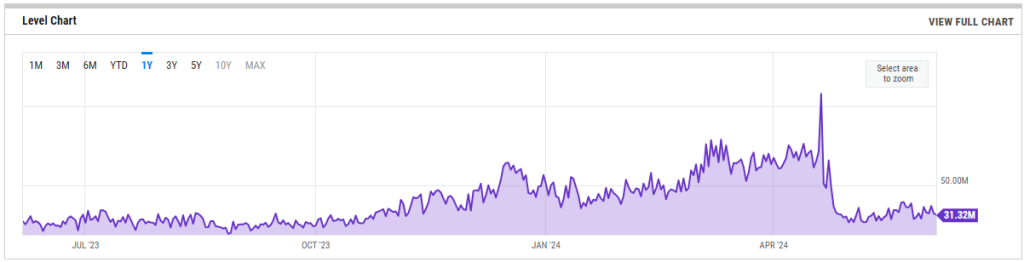
The current state of the mining sector is best reflected in the network’s hash rate, which serves as a primary metric for mining health. Recent data from YCharts and other industry trackers indicates a notable decline in the total network hash rate. This reduction is not merely a technical fluctuation; it is a clear signal of "miner capitulation."
Smaller operators, particularly those relying on legacy mining rigs with higher energy consumption and lower efficiency, have found themselves unable to remain profitable under the new subsidy regime. As these firms shut down their operations, the "Hash Ribbons" indicator—a popular analytical tool that measures the delta between short-term and long-term mining activity—has shown significant volatility.
Historically, such spikes in the Hash Ribbon signify a capitulation event, where the cost of mining one Bitcoin exceeds the potential reward. For institutional observers, this often serves as a "buy signal," as it suggests that the most inefficient actors are being cleared out, potentially stabilizing the market for more resilient, capital-efficient players.

AI: A Strategic Beacon in a Volatile Sea
The pivot toward artificial intelligence is not merely a stop-gap measure; it is a fundamental shift in business modeling. Unlike the cyclical and often erratic nature of Bitcoin price movements, the demand for AI computation is characterized by steady, contractual revenue streams.
Bit Digital, for instance, has reported that more than 30% of its current revenue is now derived from AI-related services. By integrating AI into their operations, these companies are moving toward a more diversified model that promises predictable cash flows.
Adam Sullivan, CEO of Core Scientific, articulated this strategic necessity during a recent investor update: "The shift to AI allows us to create a diversified business model with more predictable cash flows." This sentiment is shared across the boardroom tables of the industry’s heavyweights. By leveraging existing data center infrastructure, miners can tap into the AI market with significantly lower capital expenditure than a new entrant would require, providing them with a competitive "moat."
Official Responses and Industry Outlook
The industry’s response to these challenges has been multifaceted. While some firms are liquidating their Bitcoin reserves to fund the purchase of expensive GPUs (Graphics Processing Units) required for AI workloads, others are exploring joint ventures with existing tech giants.
The rationale is clear: the energy-intensive nature of Bitcoin mining makes these firms ideal partners for AI companies seeking massive, reliable power sources. In many regions, miners have already secured long-term Power Purchase Agreements (PPAs) at favorable rates, an asset that is now proving to be as valuable as the mining hardware itself.
Furthermore, analysts at firms like Capriole Investments have pointed out that the reduction in mining pressure is a positive indicator for the broader crypto market. When miners are forced to capitulate, they stop selling their daily-mined Bitcoin to cover overheads. This reduction in "mining sell-pressure" is historically bullish, as it removes a constant supply of liquidity from the market, allowing demand from institutional investors—currently hungry for "risk-on" assets—to drive prices higher.
Implications: A Metamorphosis or a Mass Exodus?
The question remains whether the industry is witnessing a "mass exodus" or a "miner metamorphosis." The evidence points toward the latter. The current period is akin to the industrial revolution of the digital age. The firms that survive will be those that view their energy and data centers as flexible assets rather than rigid, single-use facilities.
1. The Death of the "Pure Play" Miner
The era of the "pure-play" Bitcoin miner—a company that does nothing but hash for BTC—may be drawing to a close. Investors are increasingly demanding companies that offer exposure to the high-growth AI sector while maintaining a base layer of Bitcoin production.
2. The Rise of the Energy Aggregator
Miners are becoming sophisticated energy aggregators. By operating on the edge of the power grid and providing load-balancing services, they are becoming integral to national energy infrastructure. This, in turn, provides them with better regulatory standing and more stable long-term revenue.
3. Institutional Integration
As miners become AI infrastructure providers, they are attracting a different class of investor. Pension funds, sovereign wealth funds, and traditional tech-focused institutional investors are beginning to see the value in companies that power both the future of finance (Bitcoin) and the future of intelligence (AI).
4. Market Stabilization
For the Bitcoin network, this transition acts as a filter. It ensures that the network is supported by the most efficient, well-capitalized, and technologically advanced operators. This shift toward "professionalization" is likely to reduce the volatility associated with miner sell-offs in the long term.
Conclusion: The Path Forward
The April 2024 halving acted as a crucible for the mining industry. It burned away the inefficiencies and forced a rapid evolution. While the short-term statistics show a decline in hash rate and a period of turbulence, the underlying trend is one of resilience and reinvention.
By embracing artificial intelligence, Bitcoin miners are securing their place in the modern tech economy. They are moving from being passive beneficiaries of a protocol to active participants in the global AI supply chain. As these companies continue to diversify their operations, the "mining" label may soon become an understatement. The future belongs to those who can master the dual requirements of securing the most decentralized financial network in history while powering the most significant computational advancement of the 21st century.
For the long-term bull, the current market climate is not a cause for alarm, but a signal that the infrastructure underlying the digital asset ecosystem is becoming more robust, more professional, and ultimately, more profitable. The era of the "miner-as-an-AI-provider" has officially arrived, and it promises to reshape the landscape of digital finance for years to come.