
The Great Squeeze: Bitcoin Mining Complexity Peaks Amidst Market Volatility
The Bitcoin ecosystem is currently navigating a precarious intersection of technical intensity and market pressure. As the network’s mining difficulty reaches a historic zenith of 127.6 trillion, the world’s leading cryptocurrency is simultaneously grappling with a cooling price trend. This convergence has created a "perfect storm" for mining operations globally, forcing an industry-wide reassessment of operational efficiency, energy consumption, and long-term viability.
Main Facts: A Network at Maximum Strain
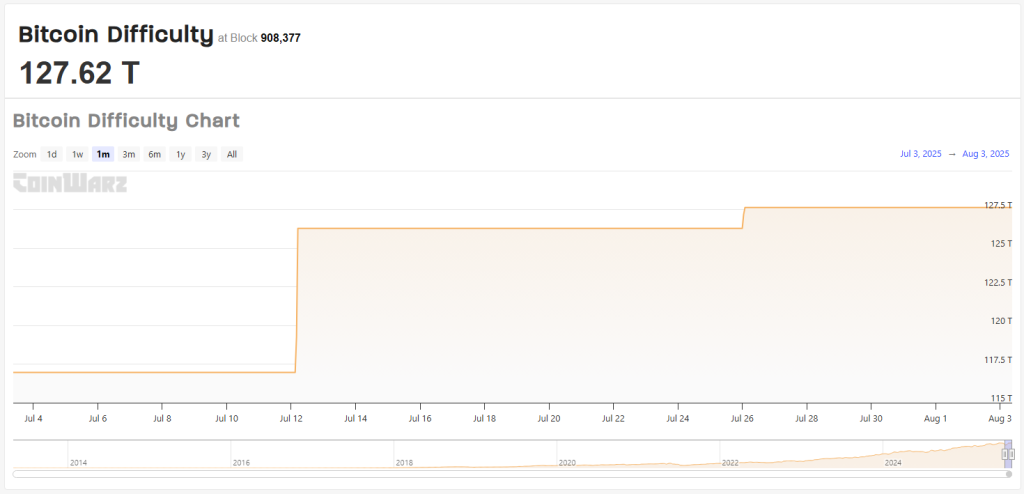
In a week marked by intense technical performance, the Bitcoin network recorded an all-time high in mining difficulty, reaching 127.6 trillion. This metric, which serves as the primary gauge for how hard it is to discover a new block of transactions, reflects a surge in the network’s total hashrate—the collective computational power dedicated to securing the blockchain.
Simultaneously, the financial markets signaled a correction. Bitcoin experienced a 3% intraday decline, testing the $113,005 support level before showing signs of stabilization near $113,250 by late evening. For the average observer, these two data points might appear disconnected; however, for the mining industry, they represent the tightening of a vice that could dictate the survival of smaller, less efficient operations.
Chronology: The Road to the 127.6 Trillion Peak
To understand the current state of the network, one must look at the recent trajectory of mining activity. Following a significant dip in June, where difficulty bottomed out at approximately 117 trillion, the network entered a period of aggressive expansion. By late July, the influx of new, high-powered mining rigs—likely deployed by institutional-grade mining facilities—began to push the difficulty upward in a relentless climb.
- June 2025: Network difficulty hits a local low of 117 trillion, providing a temporary respite for miners with higher operational overhead.
- Late July 2025: A sustained increase in hashrate triggers a series of upward adjustments in difficulty as the network attempts to maintain its 10-minute block cadence.
- Early August 2025: The network reaches its current record of 127.6 trillion.
- August 9, 2025 (Projected): Analysts expect a relief valve to open, with a projected 3% reduction in difficulty to roughly 124 trillion.
This two-week adjustment cycle is the heartbeat of Bitcoin’s monetary policy. Every 2,016 blocks, the protocol automatically recalibrates, ensuring that even as the total hashrate fluctuates, the supply of new blocks remains consistent. Currently, block times are averaging 10 minutes and 20 seconds, slightly behind the intended 10-minute target, signaling that the network is currently "working harder" than its ideal equilibrium point.
Supporting Data: The Mechanics of Hashrate and Difficulty
The relationship between price and mining difficulty is cyclical and self-correcting. When the price of Bitcoin rises, the profitability of mining increases, incentivizing more actors to join the network. This surge in participation increases the hashrate, which consequently forces the difficulty to rise.

According to data from CoinWarz, the current difficulty of 127.6 trillion is a testament to the robust hardware upgrades being implemented across the globe. As mining facilities transition from older ASIC (Application-Specific Integrated Circuit) models to next-generation hardware capable of greater terahash-per-second (TH/s) output, the "floor" for entry continues to rise.
However, the data also suggests a looming correction. Because block times are currently drifting above the 10-minute goal, the protocol is primed for the upcoming August 9 adjustment. This 3% drop will act as a marginal benefit for miners, effectively lowering the cost-per-block and potentially delaying the necessity for some firms to power down their older machines.
Implications: The Squeeze on Mining Operations
The most significant implication of these metrics is the impact on the "break-even" point for mining enterprises. Mining is essentially a race against electricity costs and hardware depreciation. When difficulty spikes while the market price of Bitcoin stagnates or declines, the profit margins for miners shrink rapidly.
The Survival of the Fittest
For industrial-scale miners, this environment rewards only those with access to the cheapest electricity and the most efficient hardware. Firms that rely on legacy equipment, which consumes more electricity per unit of hashrate than modern alternatives, are currently facing a "shut-down" scenario.
Industry analysts suggest that if the current pairing of high difficulty and suppressed prices continues, we may see a period of consolidation. Smaller, less capitalized mining operations may be forced to sell their equipment to larger, more efficient firms, or simply go bankrupt. This process, while harsh, is a fundamental aspect of the Bitcoin network’s design, serving to purge inefficiencies and centralize power in the hands of the most cost-effective operators.
Market Feedback Loops
The relationship between price and mining is also reflexive. When the price of Bitcoin drops, miners who are "underwater" (where their electricity cost exceeds the value of the mined Bitcoin) are forced to switch off their rigs. This reduces the total hashrate, which in turn makes the next difficulty adjustment lower. As the network becomes easier to mine, the remaining, more efficient miners capture a larger share of the block rewards, stabilizing the network until the next price or difficulty cycle begins.
Official Responses and Industry Outlook
While no central authority dictates Bitcoin mining, industry leaders have been vocal about the current climate. In recent discussions, representatives from major mining pools have noted that the "cost of production" has become the primary metric for investors.
"We are seeing a clear migration of hashrate toward jurisdictions with sustainable and low-cost energy," noted one industry analyst. "The 127.6 trillion difficulty mark isn’t just a number; it’s a stress test for the entire ecosystem. Companies that haven’t hedged their electricity costs or upgraded their hardware are currently in a race against time."
The consensus among market watchers is that while volatility remains the defining characteristic of the sector, the fundamental resilience of the Bitcoin network remains unshaken. The protocol is designed to withstand these periods of extreme difficulty. The anticipated adjustment on August 9 is expected to provide a "breathing room" that will allow the industry to recalibrate, even if price volatility persists in the short term.
Conclusion: A Maturing Infrastructure
The record-breaking difficulty of 127.6 trillion serves as a powerful reminder of the massive, distributed computational power backing the Bitcoin network. While the 3% price dip to $113,005 highlights the sensitivity of the market to macroeconomic and network-level shifts, it is important to view these events through the lens of long-term protocol health.
As the industry moves toward its next epoch and the August 9 adjustment, the focus will remain on operational efficiency. The miners who survive this "squeeze" will be the ones that define the next generation of blockchain infrastructure. For the Bitcoin network itself, these fluctuations are merely the growing pains of a decentralized system that continues to secure, verify, and finalize transactions with unprecedented reliability, regardless of the price of the asset it protects.