Institutional Capital Returns: Crypto Investment Products Kick Off 2025 with $582 Million Influx
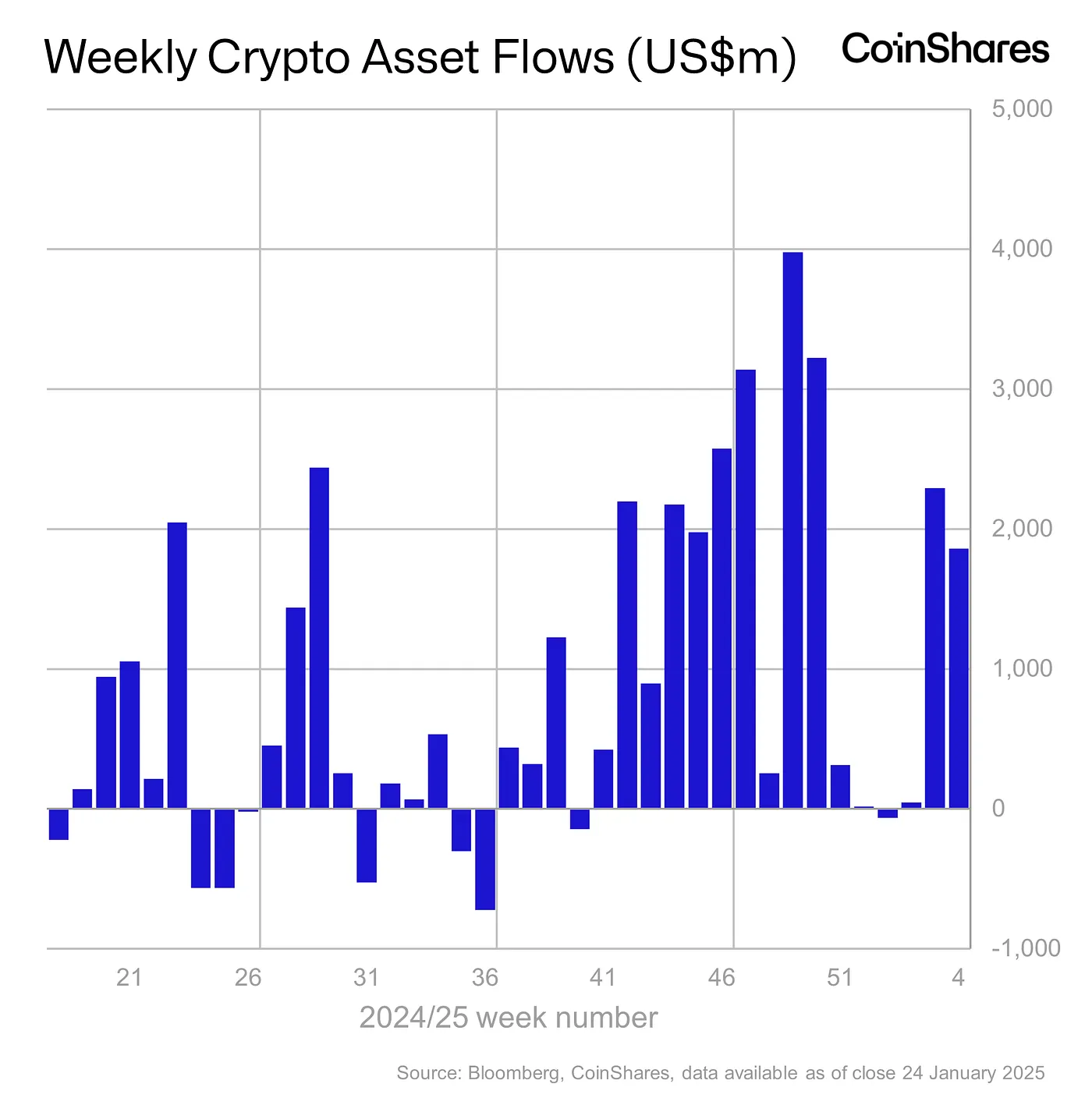
As the global financial markets settle into the rhythm of a new calendar year, the institutional appetite for digital assets has once again demonstrated its resilience. According to the latest "Digital Asset Fund Flows" report from CoinShares, institutional investors have signaled renewed confidence in the cryptocurrency sector, logging a significant $582 million in net inflows during the first week of 2025. This surge suggests that despite periods of market volatility and macroeconomic uncertainty, the "smart money" remains committed to the long-term potential of blockchain-based assets.
Main Facts: A Strong Start to 2025
The data reveals a dynamic beginning to the year. While the week started with initial outflows—suggesting a cautious approach among some market participants—the sentiment shifted dramatically by Friday. The report highlights that institutional investors funneled a staggering $671 million into digital asset products on the final trading day of the week, effectively reversing earlier losses and pushing the total net inflow for the week to $582 million.
This momentum is primarily anchored by the "Big Three" of the crypto investment space: Bitcoin (BTC), Ethereum (ETH), and XRP. Bitcoin remained the primary beneficiary, absorbing $512 million in new institutional capital. Ethereum followed with a robust $119 million, while XRP saw a respectable $10.7 million. Interestingly, the trend was not universal; Solana (SOL), which has historically been a darling of institutional portfolios, faced a minor setback with $30 million in outflows, indicating a potential profit-taking cycle or a rotation of assets by institutional managers.
Chronology: From a Record-Breaking 2024 to a Promising 2025
To understand the current trajectory, one must examine the landscape of the previous year. The year 2025 concluded with total global digital asset inflows reaching $47.2 billion, a figure that nearly matched the all-time record of $48.7 billion set in 2024.
The 2025 Performance Breakdown:
- Bitcoin Dominance: Bitcoin products maintained their lead, attracting $26.9 billion in total inflows throughout 2025. Short-bitcoin products, designed to profit from price declines, saw a modest interest of $105 million, proving that they remain a niche segment compared to the long-only investment vehicles.
- The Ethereum Surge: Ethereum saw a massive 138% year-over-year growth, netting $12.7 billion in inflows. This performance highlights a growing institutional realization of Ethereum’s utility beyond mere store-of-value, particularly as decentralized finance (DeFi) and layer-2 solutions continue to mature.
- The Altcoin Explosion: XRP and Solana were the standout performers in terms of percentage growth. XRP saw inflows of $3.7 billion—a 500% increase over the previous year—while Solana attracted $3.6 billion, representing a staggering 1,000% surge in interest compared to its 2024 performance.
This sustained growth reflects a market that has transitioned from speculative retail fervor to a more structured, regulated, and professionalized institutional environment.
Supporting Data: Regional Shifts and Global Sentiment
The geographic distribution of these inflows provides a clear picture of where the momentum is concentrated. The United States continues to be the engine of the digital asset market, accounting for $44.5 billion of the total 2025 inflows. However, this figure represents a 12% decline from the previous year, suggesting that while the U.S. remains the primary hub, the global market is becoming more diversified.
Notable Regional Turnarounds:
- Germany: Often seen as a barometer for European institutional sentiment, Germany staged an impressive recovery. After experiencing net outflows in 2024, the nation recorded $2.5 billion in inflows in 2025, signaling a renewed confidence among European institutional players.
- Canada: Canada maintained its steady growth, contributing $1.1 billion in inflows, reinforcing its position as a friendly and stable jurisdiction for crypto-financial products.
- Switzerland: Switzerland solidified its status as a premier crypto hub, recording $775 million in new inflows, largely due to its robust regulatory framework and long-standing history of private banking innovation.
While the "Big Three" assets enjoyed massive support, the broader altcoin market saw a 30% decline in sentiment-driven inflows. This divergence indicates that institutional investors are becoming more selective, choosing to allocate capital toward assets with proven liquidity and established market track records rather than speculative, lower-cap tokens.
Official Responses and Expert Analysis
Industry analysts at CoinShares noted that the rapid shift from mid-week outflows to Friday’s massive $671 million inflow is a testament to the "buy the dip" mentality that now permeates institutional desks. When asked about the potential for further growth, market strategists point to the narrowing gap between the 2025 total of $47.2 billion and the 2024 record of $48.7 billion as proof that the crypto market has reached a level of maturity that allows it to absorb massive institutional volume without collapsing.
"The market is no longer just reacting to headlines," one analyst noted. "It is reacting to the underlying development of institutional-grade infrastructure—ETFs, regulated custodial services, and clearer accounting standards. The inflows we are seeing now are driven by systematic asset allocation rather than retail FOMO (Fear of Missing Out)."
Implications for the Future of Digital Assets
The implications of these figures are profound for both the retail investor and the broader financial ecosystem.
1. The Professionalization of Crypto
The fact that institutional inflows are consistently targeting major assets like Bitcoin and Ethereum suggests that these cryptocurrencies are increasingly being viewed as "digital gold" and "digital oil," respectively. As institutional portfolios become more diversified, the inclusion of crypto as an "alternative asset class" is likely to become a standard practice for pension funds and insurance companies.
2. Market Resilience
The ability of the market to sustain $47.2 billion in annual inflows in 2025 demonstrates that digital assets have successfully decoupled from the most extreme volatility cycles of the past. The presence of sophisticated players who utilize short-bitcoin products as hedges suggests that the market is developing the necessary financial tools to manage risk, which in turn encourages more conservative institutional players to enter the space.
3. The Altcoin Divide
The 30% decline in other altcoin inflows serves as a warning for smaller projects. Investors are increasingly favoring assets that provide tangible utility or have massive, well-established network effects. The "rising tide" that lifted all boats in previous bull runs is being replaced by a more discerning, fundamental-based investment philosophy.
4. Regulatory Clarity
The regional shifts, particularly Germany’s turnaround, highlight the importance of regulatory clarity. As jurisdictions clarify their tax and legal frameworks, institutional capital tends to flow toward those regions. The decline in U.S. inflows, while still massive in absolute terms, may serve as a signal to policymakers that global competition for digital asset capital is intensifying.
Conclusion: A New Era of Financial Maturity
As we move deeper into 2025, the data suggests that the institutional embrace of digital assets is not a fleeting trend, but a structural shift in the global financial landscape. With nearly $600 million in inflows during the first week of the year alone, the industry is showing clear signs of sustained momentum.
For the average investor, this trend underscores the importance of due diligence. While the influx of institutional capital provides a layer of stability and legitimacy, the market remains inherently high-risk. Investors should look beyond the headlines and consider the long-term utility of the assets they hold. As the lines between traditional finance and decentralized technology continue to blur, the role of institutional players will likely remain the defining force in shaping the price discovery and adoption of the next generation of financial infrastructure.
Disclaimer: Opinions expressed in this report are for informational purposes only and do not constitute investment advice. Investors should conduct their own thorough due diligence before making any high-risk investments in Bitcoin, cryptocurrency, or other digital assets. All trading involves risk, and any losses incurred are the sole responsibility of the investor. This article may contain affiliate links.