Institutional Capital Floods Crypto Markets Following Federal Reserve’s Pivot
The landscape of digital asset investment has experienced a seismic shift as institutional investors recalibrate their strategies in the wake of the U.S. Federal Reserve’s recent monetary policy pivot. According to the latest Digital Asset Fund Flows Weekly Report from CoinShares, the cryptocurrency market has witnessed a robust influx of capital, signaling a renewed appetite for risk assets despite initial market trepidation.
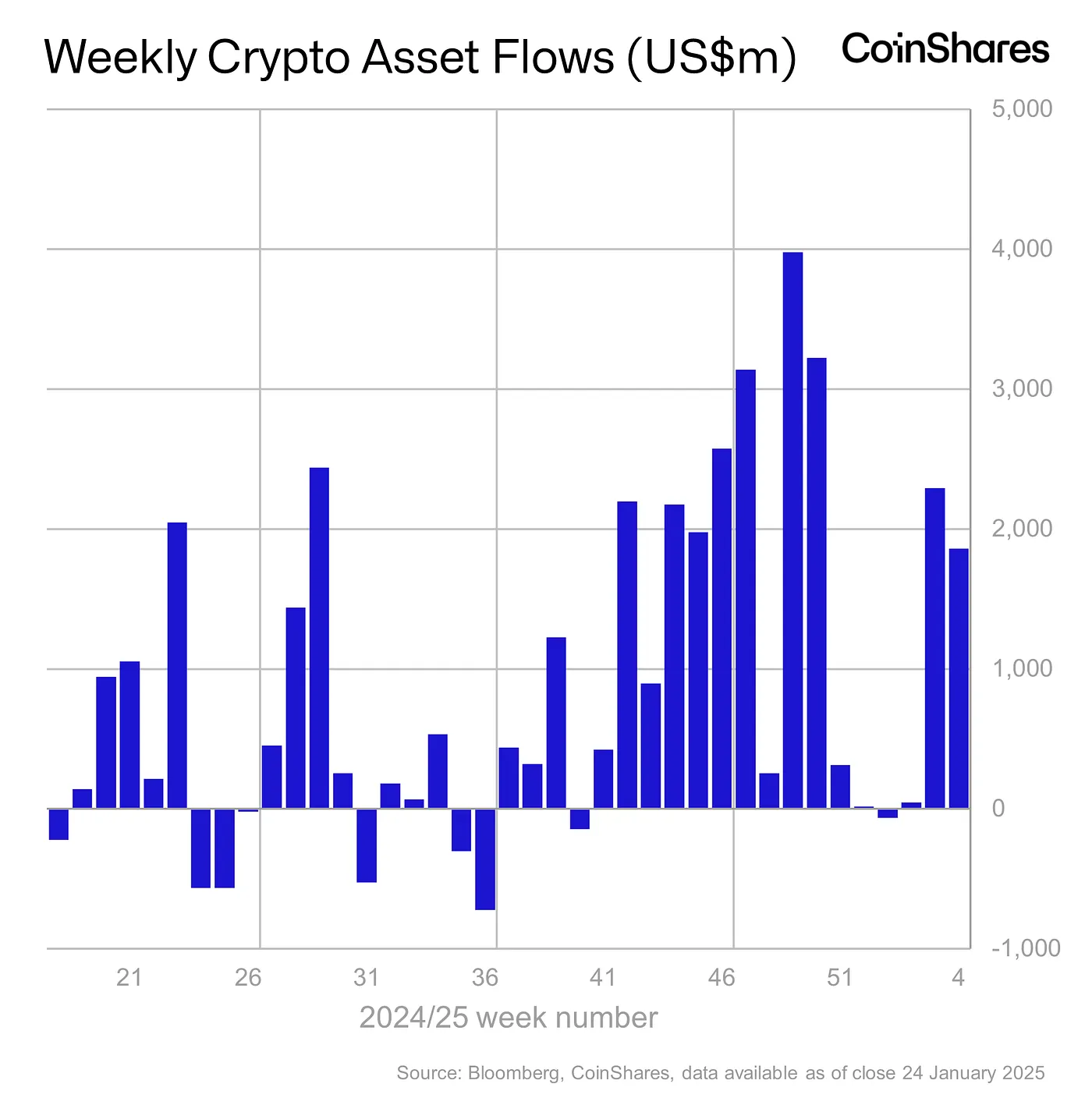
With a total of $1.9 billion flowing into digital asset investment products over the past week, the data suggests that institutional players are increasingly viewing crypto exchange-traded products (ETPs) as a primary vehicle for navigating a changing interest rate environment.
The Chronology of Market Sentiment: From Caution to Confidence
The week began under a cloud of uncertainty. As the Federal Reserve finally moved to cut interest rates—a long-anticipated move by global markets—investors initially responded with characteristic skepticism. Analysts termed the move a "hawkish cut," as the Fed’s communication suggested a measured approach rather than a full-scale abandonment of restrictive policies.
For the first few days, capital flows into crypto products were sluggish as traders parsed the implications of the Fed’s messaging. However, as the week progressed, the sentiment shifted decisively. By Thursday and Friday, the market displayed a clear "risk-on" appetite, with $746 million pouring into digital asset products in those two days alone. This late-week surge suggests that as the dust settled, institutional investors concluded that a lower-rate environment remains fundamentally bullish for non-sovereign digital assets.
A Regional Breakdown: The Dominance of U.S. Markets
While the interest in digital assets is global, the United States remains the undisputed engine of this recent capital surge. CoinShares data highlights a massive disparity between the U.S. and the rest of the world, with the United States accounting for $1.8 billion of the total $1.9 billion in weekly inflows.
This dominance is largely attributed to the maturation of the U.S. spot Bitcoin and Ethereum ETF ecosystem, which provides institutional-grade access to these assets with high liquidity and regulatory oversight. Following the U.S., Germany and Switzerland reported inflows of $51.6 million and $47.3 million, respectively, while Brazil saw a notable $9.3 million. Conversely, Hong Kong experienced a minor outflow of $3.1 million, illustrating that while sentiment is broadly positive, regional macroeconomic factors continue to influence capital distribution.
The Asset Hierarchy: Bitcoin, Ethereum, and Beyond
Bitcoin (BTC) continues to hold its position as the institutional favorite, commanding the lion’s share of the weekly inflows at $977 million. This sustained demand for the world’s largest cryptocurrency suggests that institutional investors view BTC as a "digital gold" hedge against potential currency debasement in a falling interest rate environment.
Perhaps most notably, the performance of short-bitcoin investment products has reached a critical juncture. These products, which bet against the price of BTC, saw $3.5 million in outflows, dragging their total Assets under Management (AuM) down to a multi-year low of $83 million. This trend indicates that the market conviction for a long-term bull run is significantly outweighing bearish sentiment.
Ethereum (ETH) also enjoyed a massive resurgence, capturing $772 million in inflows. This is a significant development, as Ethereum has recently faced criticism regarding its price performance compared to its competitors. Solana (SOL) and XRP continued to maintain their relevance as institutional-grade assets, securing $127.3 million and $69.4 million in inflows, respectively, confirming that institutional diversification is expanding beyond the "big two."

Supporting Data: Analyzing the Macro Environment
To understand why $1.9 billion flowed into these assets, one must look at the macro-financial backdrop. Interest rate cuts generally lower the yield on traditional "safe-haven" assets like government bonds and high-yield savings accounts. When the opportunity cost of holding non-yielding assets like Bitcoin drops, investors naturally seek higher potential returns in the digital asset space.
Furthermore, the "hawkish" nature of the Fed’s cut—often referred to as a "dovish pivot masked in hawkish rhetoric"—suggests that the central bank is attempting to engineer a "soft landing." If successful, this creates a goldilocks scenario for risk assets: economic growth is sustained, but liquidity is cheapened. For institutional portfolios, which often require exposure to uncorrelated assets, digital currencies have become an essential component of modern asset allocation.
Implications: What This Means for the Future of Crypto
The implications of this institutional inflow are profound. Firstly, it signals that the "crypto winter" is firmly in the rearview mirror. When institutional capital enters the market at this scale, it provides a floor for price volatility and increases the legitimacy of the asset class.
Secondly, the shift in capital flows highlights a change in the investor base. We are no longer seeing the speculative retail-heavy trading of 2021; instead, we are witnessing the strategic, long-term accumulation of assets by hedge funds, pension funds, and asset managers. These entities operate on longer time horizons, meaning that these inflows are likely to be "sticky"—less prone to sudden, panic-induced sell-offs.
However, risks remain. As noted by industry analysts, the "hawkish" tone from the Fed serves as a reminder that the path to lower rates may be bumpy. Any inflationary spike that forces the Federal Reserve to pause or reverse its rate-cutting cycle would likely cause an immediate, sharp withdrawal of liquidity from crypto markets.
Conclusion: A New Era of Institutional Integration
The recent $1.9 billion in inflows into digital asset products serves as a definitive validation of the maturing crypto market. By moving past the initial uncertainty of the Federal Reserve’s policy shift, investors have signaled their belief in the long-term utility and value proposition of digital assets.
As we look toward the final quarter of the year, the focus will likely remain on whether these inflows are sustained. If the current momentum continues, the integration of digital assets into traditional portfolios will likely accelerate, further blurring the lines between "Wall Street" and "Crypto Street." Investors, however, should remain vigilant. While the macro winds currently favor digital assets, the inherent volatility of the space necessitates a disciplined, research-driven approach to portfolio management.
Disclaimer: The information provided in this article is for educational and informational purposes only and does not constitute financial, investment, or legal advice. Digital assets are high-risk investments, and you may lose some or all of your capital. Always conduct your own thorough research and consult with a qualified financial advisor before making any investment decisions.