Institutional Appetite Rebounds: Digital Asset Funds See Record-Breaking Inflows as Market Sentiment Shifts
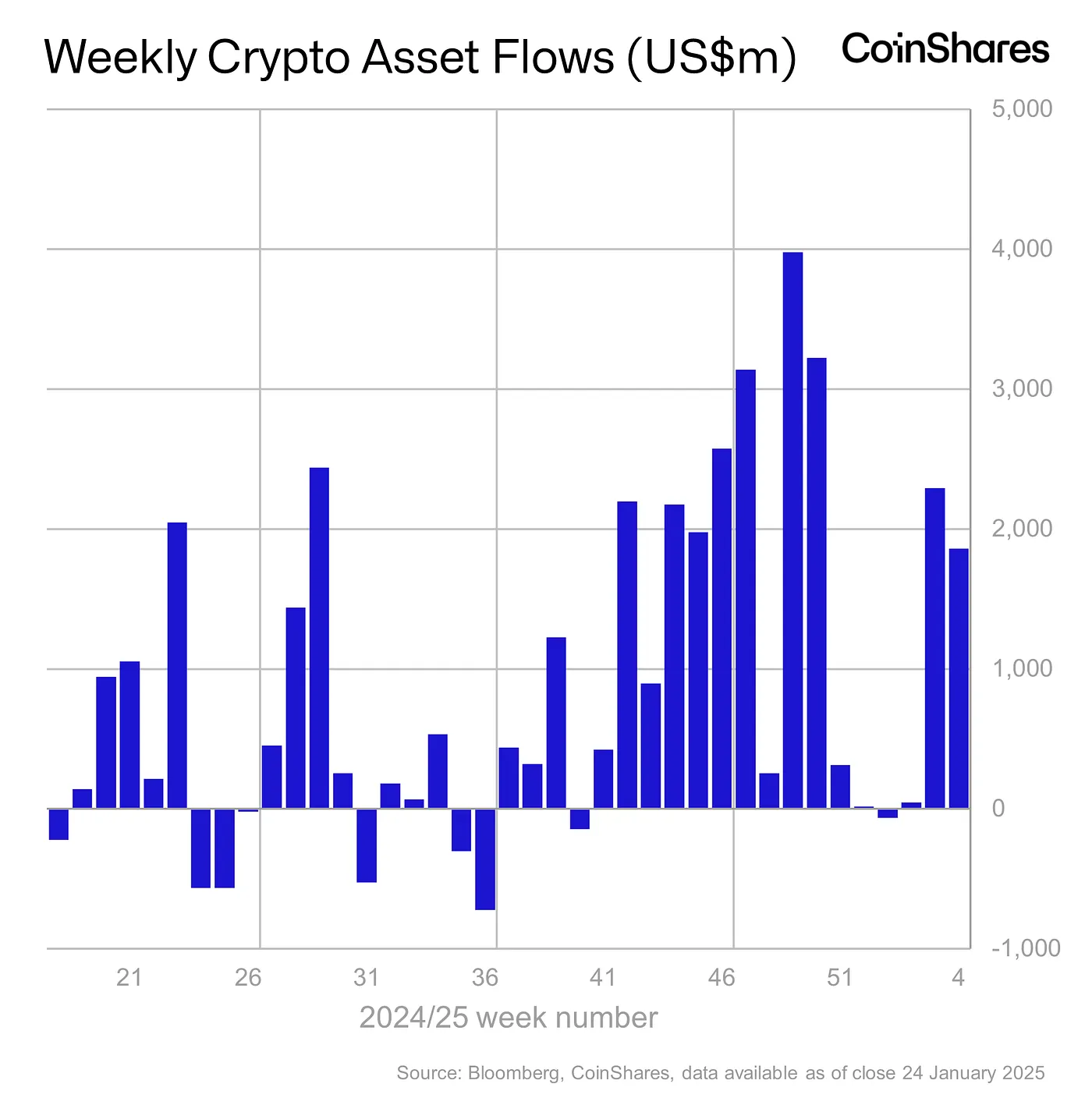
The global landscape for digital asset investment is experiencing a seismic shift, with institutional interest reaching a fever pitch. According to the latest "Digital Asset Fund Flows Weekly" report by CoinShares, one of the world’s most prominent digital asset managers, the sector has recorded its fourth consecutive week of robust growth. This surge in capital is not merely a localized trend but a global phenomenon, underscoring a deepening institutional conviction in the long-term viability of crypto-based exchange-traded products (ETPs).
The Main Facts: A Global Surge in Institutional Capital
The data released by CoinShares highlights an impressive accumulation of wealth into digital asset investment vehicles. In the most recent reporting period alone, crypto ETPs attracted nearly $1 billion in fresh capital, totaling $882 million in global inflows. This influx brings the year-to-date (YTD) figure to a staggering $6.7 billion, placing the industry on a direct collision course with the record-setting peaks observed in early 2024.
At the heart of this movement is the United States, which continues to act as the primary engine for global crypto demand. With $840 million in inflows originating from American investors, the U.S. market has effectively eclipsed international performance. While markets in Canada and Hong Kong saw minor outflows—$8 million and $4.3 million, respectively—these were easily absorbed by the massive capital deployment in the U.S., Germany ($44.5 million), and Australia ($10.2 million).
Chronology of the Recent Bull Run
To understand the current momentum, one must look at the recent timeline of institutional crypto adoption:
- Early February 2024: The market reached a significant milestone, with cumulative net inflows into U.S.-listed Bitcoin ETFs hitting a previous high of $61.6 billion.
- Mid-2024 Consolidation: Following the initial excitement of ETF launches, the market entered a period of relative stabilization, characterized by fluctuating flows as investors gauged the impact of macroeconomic shifts.
- October 2024: The current four-week streak of inflows began, signaling a return to aggressive accumulation.
- Present Day: Total cumulative net inflows for U.S.-listed Bitcoin ETFs have officially breached the $62.9 billion mark, setting a new all-time record and signaling that the institutional "winter" has firmly thawed.
Supporting Data: The Dominance of Bitcoin and Emerging Altcoins
While the broader market is rising, the distribution of capital remains highly concentrated. Bitcoin (BTC) continues to be the undisputed heavyweight, commanding the vast majority of investor interest. Last week alone, Bitcoin-focused vehicles attracted $867 million in global inflows. This level of dominance reflects the asset’s status as a "digital gold" equivalent, serving as the primary vehicle for institutions seeking exposure to the crypto space without the volatility of smaller, less established tokens.
However, the report also highlights interesting secondary movements. SUI, a high-performance Layer-1 blockchain, recorded $11.7 million in inflows, demonstrating that investors are beginning to rotate into specific, utility-driven projects beyond the two market leaders. Interestingly, Ethereum (ETH) saw a more muted performance, attracting only $1.5 million in new capital. This discrepancy suggests that while the "Big Two" (BTC and ETH) remain the bedrock of portfolios, the market is becoming increasingly nuanced, with capital flowing toward assets that offer specific technological differentiation or competitive yields.
Expert Analysis: The Macroeconomic Drivers
CoinShares’ researchers attribute this sudden, sharp increase in both pricing and inflows to a confluence of macroeconomic factors that have historically favored decentralized assets.
M2 Money Supply Expansion
The global rise in M2 money supply—a measure of the total volume of cash and easily convertible assets—is a critical driver. As central banks potentially shift toward easier monetary policy to support slowing economies, investors are increasingly looking for hedges against fiat currency debasement. Bitcoin, with its strictly capped supply of 21 million units, serves as a natural defensive asset in an environment of increasing liquidity.
Stagflationary Risks in the United States
The U.S. economy faces a unique set of pressures characterized by persistent inflation alongside sluggish growth. This "stagflationary" environment creates a difficult landscape for traditional equities and fixed-income portfolios. Institutional investors are increasingly viewing Bitcoin not just as a speculative tech play, but as a strategic store of value that operates independently of traditional central banking cycles.
The Emergence of Sovereign Interest
Perhaps the most transformative development cited by CoinShares is the increasing approval of Bitcoin as a strategic reserve asset by several U.S. states. This move signals a transition from "retail-only" interest to a paradigm where governments and municipalities are actively considering crypto as part of their balance sheets. When local governments begin to codify Bitcoin into their financial planning, it provides a layer of institutional legitimacy that was previously unimaginable.
Implications for the Future of Finance
The implications of these record-breaking inflows are profound. As capital continues to flow into regulated ETP structures, the barrier between traditional finance (TradFi) and decentralized finance (DeFi) continues to erode.
1. Increased Market Liquidity and Stability
As more capital is funneled into transparent, regulated products, the liquidity of the underlying assets increases. This, in turn, can help dampen the extreme volatility historically associated with cryptocurrency, potentially paving the way for wider institutional adoption by pension funds, insurance companies, and sovereign wealth funds that require a degree of market maturity.
2. The Normalization of Digital Assets
The achievement of record-high cumulative inflows into U.S. ETFs serves as a proof-of-concept for the entire industry. It demonstrates that the demand for crypto is not a passing fad but a structural demand driven by investors who are looking for portfolio diversification. This normalization is likely to trigger further regulatory clarity, as legislators and regulators see that the demand is coming from highly regulated institutional entities.
3. Shift in Portfolio Allocation
The data suggests that the "crypto allocation" is becoming a standard feature of modern wealth management. Rather than treating Bitcoin as a "side bet," advisors are now incorporating it into core portfolios. This shifts the long-term price floor of the asset, as institutions are generally "long-term holders" (HODLers) compared to the more reactionary retail trading base.
Conclusion: A New Era of Institutional Integration
The findings from the latest CoinShares report serve as a definitive marker of the current cycle. With global inflows reaching nearly $900 million in a single week and total U.S. ETF assets under management shattering previous records, the narrative has shifted from "if" institutional crypto adoption will happen to "how quickly" it will scale.
As macroeconomic uncertainty continues to permeate the global economy, the role of Bitcoin and other digital assets as a hedge and a strategic reserve is being put to the test. For now, the evidence suggests that institutional investors are confident in the outcome, choosing to deploy capital at an unprecedented rate. The industry now stands at a threshold where it is no longer just a fringe movement of early adopters, but a foundational component of the next generation of global financial infrastructure.
Disclaimer: The information provided in this article is for educational and informational purposes only and does not constitute financial, investment, or legal advice. Cryptocurrency investments involve significant risk, and readers should conduct their own thorough due diligence and consult with a certified financial advisor before making any investment decisions. The Daily Hodl does not endorse the purchase or sale of any specific assets, and any losses incurred are the responsibility of the investor.