Ethereum Under Pressure: Derivatives Data Reveals Uneven Leverage Reset Amidst Price Plunge
The second-largest cryptocurrency, Ethereum (ETH), is currently navigating a critical juncture, trading precariously below the $1,700 mark. This downward trajectory, which has seen ETH shed approximately 28% from its recent peaks, is drawing scrutiny not just for its immediate price action, but for the underlying structural shifts being revealed in its derivatives market. A deep dive into the data suggests a complex deleveraging process, with significant implications for the asset’s future trajectory.
Recent analysis by CryptoQuant, a prominent blockchain analytics firm, highlights a dramatic unwinding of Open Interest (OI) across major cryptocurrency exchanges. This development is not merely a consequence of the price decline but appears to be a foundational recalibration of leveraged positions that had been accumulating throughout 2025 and into 2026. The scale of this unwinding has, in a compressed timeframe, reverted multiple trading venues to levels not seen since April 2025, effectively nullifying over a year’s worth of leveraged exposure.
This "structural clearing," as it’s being termed, is particularly pronounced on exchanges like Gate.io and Bybit. On Gate.io, ETH Open Interest plummeted from $4.84 billion on May 7th to $2.68 billion on June 9th – a substantial reduction of approximately $2.16 billion, or roughly 45%, in just over a month. This current figure closely mirrors the $2.67 billion recorded on April 11th, 2025. Bybit exhibits a strikingly similar pattern, with its ETH Open Interest dropping to near $805 million, almost precisely matching the $795 million level observed on April 9th, 2025.
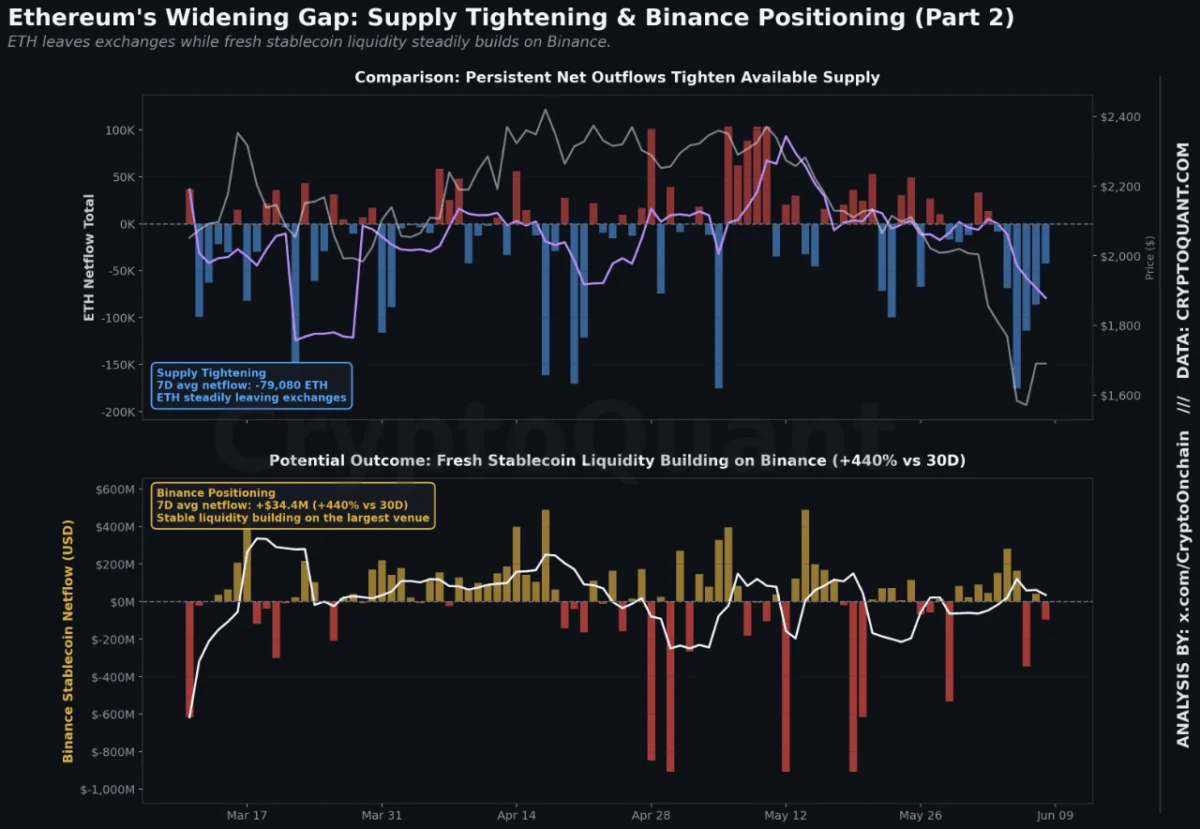
The simultaneous return of two major exchanges to their April 2025 market structure signifies a substantial clearing of leverage that had been built up during the intervening period. This deleveraging is further corroborated by the funding rates on Binance, which have turned negative. This indicates that the remaining futures activity is not driven by bullish conviction but rather by a prevailing sentiment of uncertainty, or at best, a mild bearish bias.
The Uneven Deleveraging: A Deeper Dive into Derivatives Data
While the overall decline in Open Interest is a significant indicator, the CryptoQuant analysis reveals a crucial asymmetry in this deleveraging process. Gate.io and Bybit have indeed returned to their April 2025 market structure, effectively erasing over a year of accumulated leverage in a matter of weeks. However, Binance has not mirrored this trend. ETH Open Interest on Binance remains elevated, hovering around $2.76 billion, maintaining its position near its higher range. This divergence from the sharp contraction seen on other major venues suggests a more complex underlying dynamic at play on the world’s largest cryptocurrency exchange.
The retained positioning on Binance does not automatically signal an unwavering bullish intent. The exchange’s funding rates offer a more nuanced perspective. Currently standing at approximately -0.0038, Binance’s funding rates have turned negative again. This signifies that traders are not willing to pay a premium to hold long exposure. While Open Interest persists, the conviction behind it appears to have shifted from directional bullishness to a more defensive stance.

The combination of these factors paints a specific picture of the current market sentiment. The derivatives reset is undeniable, but its uneven nature is a critical detail. While some exchanges have fully purged their leveraged positions, Binance continues to hold residual exposure. This retention, however, is occurring against a backdrop of negative funding rates, which reflect caution rather than unbridled confidence.
Negative funding rates during a price decline typically signal one of three conditions:
- Defensive Positioning: Existing participants are hedging their long positions, anticipating further downside.
- Short Pressure: Traders are actively betting against a recovery, initiating short positions.
- Absence of Aggressive Long Conviction: Market participants are not willing to pay a premium to hold bullish exposure, indicating a lack of strong buying conviction.
Individually, none of these conditions necessarily portend an immediate rally. Collectively, however, they describe a derivatives structure that has undergone a partial reset, with the most significant venue retaining positions that lack the directional commitment required for constructive market movement. This suggests that the market is not yet poised for a significant upward surge, and further consolidation or even continued decline remains a distinct possibility.
Ethereum’s Technical Breakdown: Breaking Key Support Levels
Beyond the derivatives landscape, Ethereum’s price action on the charts paints a similarly concerning picture. The cryptocurrency is currently trading near $1,670, having experienced one of its most severe weekly breakdowns of the current cycle. This decline has pushed ETH below its February lows, reaching levels not witnessed since early 2023. This is a significant development as it invalidates the broad trading range that had contained ETH for the majority of 2026 and confirms a continuation of the bearish structure that has been developing since the rejection from the $4,800 cycle peak.
From a market structure perspective, the chart is characterized by a clear sequence of lower highs and lower lows. Following a failure to hold above the critical $2,250-$2,350 resistance zone, Ethereum lost the vital $1,800 support area, which had previously served as the floor for its February-March consolidation. This breakdown triggered a rapid descent toward the $1,500 region, where buyers finally intervened to prevent a more precipitous collapse.
A particularly telling detail is that ETH is now trading below all major weekly moving averages. The 50-week, 100-week, and 200-week moving averages are all situated significantly above the current price. This reinforces the strength of the prevailing downtrend and establishes substantial overhead resistance, making any potential recovery efforts more challenging.

The recent low established near $1,500 now represents the most critical support level on the chart. Should buyers successfully defend this area, Ethereum might find a base to build upon and attempt a recovery towards the $1,800 mark. However, a weekly close below these recent lows would expose the market to a more profound retracement, potentially extending the correction towards the $1,300-$1,400 region and further confirming a deterioration in the long-term market structure.
Historical Context and Market Sentiment
The current price action and derivatives data echo periods of significant market stress in the past. The rapid unwinding of leverage seen on exchanges like Gate.io and Bybit is reminiscent of capitulation events, where over-leveraged positions are forcibly liquidated. While this can sometimes precede a bottoming process, the presence of residual, unconvicted positioning on a major exchange like Binance adds a layer of uncertainty.
The years 2025 and 2026, as referenced in the analysis, represent a period of significant accumulation and potentially speculative fervor within the crypto market. The unwinding of this accumulated leverage suggests that the market is undergoing a necessary, albeit painful, deleveraging phase. This process is crucial for establishing a healthier foundation for future growth, but it often involves significant price discovery downwards.
The initial article’s mention of the "Trusted Editorial" process, along with a disclaimer regarding "Ad Disclosure," points to a commitment to journalistic integrity. This is crucial in the volatile cryptocurrency market, where misinformation can have severe consequences for investors. The review by "leading industry experts and seasoned editors" suggests an effort to provide a well-researched and balanced perspective.
Implications for Investors and the Broader Market
The current situation presents a complex outlook for Ethereum investors. The technical breakdown below key support levels, coupled with the uneven deleveraging in the derivatives market, suggests that further downside risk remains. The negative funding rates on Binance, in particular, indicate a lack of strong bullish conviction among active traders, making a swift and decisive recovery less likely in the immediate term.
For those looking to enter the market or add to their positions, the current environment demands caution. Identifying the true support levels and observing how they hold will be paramount. The $1,500 mark is the immediate line in the sand. A sustained break below this could trigger a cascade of further selling.

Conversely, if buyers can defend the $1,500 level and the market begins to show signs of stabilization, the unwound leverage could eventually create a foundation for a more sustainable rally. However, this would likely require a significant shift in market sentiment and a clear increase in bullish conviction, reflected in positive funding rates and a break of key resistance levels on the charts.
The analysis also highlights the importance of understanding the nuances of derivatives markets. While price action is the most visible indicator, metrics like Open Interest and funding rates provide a deeper insight into the sentiment and positioning of market participants. The divergence observed on Binance underscores the need for a multi-faceted approach to market analysis, rather than relying on a single data point.
As Ethereum navigates this challenging period, its ability to hold key support levels and the broader market’s reaction to the deleveraging process will be closely watched. The coming weeks and months will likely determine whether this current downturn is a temporary correction within a larger bull market or the beginning of a more extended bearish phase. The insights gleaned from derivatives data suggest that caution is warranted, and a clear re-establishment of bullish momentum will be necessary to signal a sustainable recovery. The market is undergoing a significant recalibration, and the path forward for Ethereum will be shaped by its ability to overcome these structural headwinds.