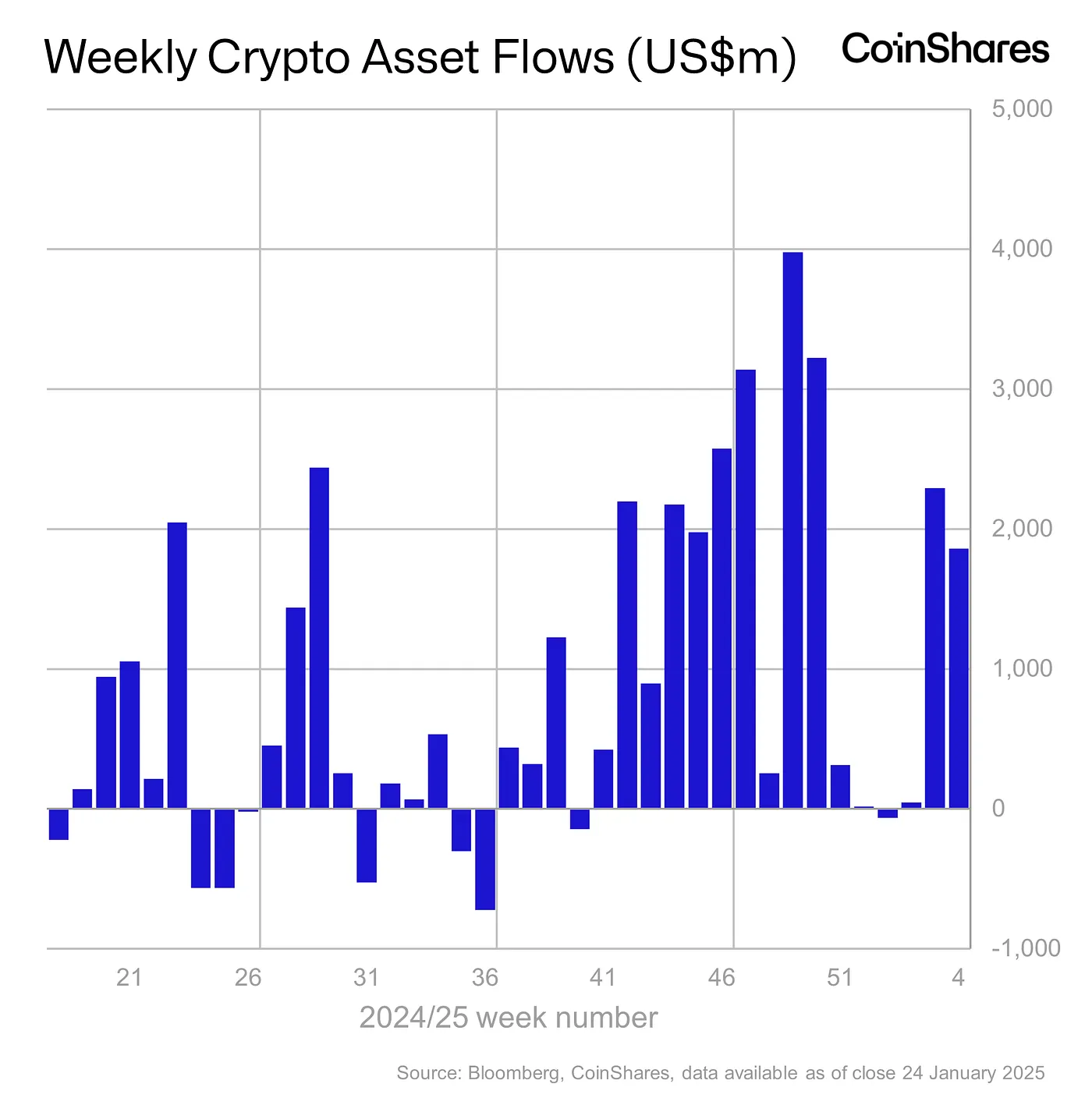
Institutional Capital Surge: Digital Asset Investment Products Approach Record Yearly Highs
The institutional embrace of digital assets has reached a fever pitch, with the latest data from CoinShares revealing that cryptocurrency investment products are on the brink of shattering yearly inflow records. As traditional finance continues to integrate with blockchain-based infrastructure, the narrative surrounding Bitcoin and its peers has shifted from speculative curiosity to a core component of modern portfolio management.
According to the latest Digital Asset Fund Flows Weekly Report from CoinShares, the global market for crypto exchange-traded products (ETPs) saw a massive influx of nearly $1 billion last week alone. This momentum underscores a broader shift in macroeconomic sentiment, where digital assets are increasingly viewed as a hedge against systemic volatility.
The Main Facts: A Billion-Dollar Wave of Institutional Sentiment
The digital asset landscape is currently witnessing its fourth consecutive week of sustained capital inflows. Globally, investment products captured a staggering $882 million in a single seven-day period. This recent activity has pushed year-to-date (YTD) inflows to a formidable $6.7 billion, placing the market within striking distance of the $7.3 billion all-time high recorded earlier this year in February.
The surge is not merely a quantitative increase; it is a qualitative shift in who is entering the market. Institutional investors, ranging from pension funds to wealth management firms, are utilizing ETPs as their primary vehicle for gaining exposure to digital assets without the operational burdens of self-custody. The ease of access provided by these financial products has democratized institutional entry, turning what was once a fringe asset class into a mainstream financial staple.
Chronology of the Current Rally
To understand the current trajectory, one must look at the progression of the 2024 market cycle.
- Early Q1 2024: The industry saw an initial explosion of interest following the approval of spot Bitcoin ETFs in the United States. This period set the benchmark high, with inflows reaching a peak of $7.3 billion by early February.
- Mid-Year Consolidation: As is typical with nascent asset classes, the market experienced a period of moderate outflows and consolidation throughout the summer months. During this time, investors recalibrated their portfolios in response to changing interest rate expectations.
- October/November Resurgence: The current four-week streak represents a distinct "second wind" for the sector. Driven by a combination of geopolitical uncertainty and fiscal policy shifts, capital began to rotate back into digital assets at an accelerating rate.
- The Current Milestone: Last week’s $882 million inflow marked the climax of this recent trend, effectively erasing the summer’s stagnant performance and putting the industry on a direct path to eclipse the previous yearly record within the next fiscal quarter.
Supporting Data: Regional Disparities and Asset Performance
While the sentiment is bullish globally, the flow of capital is geographically uneven. The United States remains the undisputed engine of this growth, accounting for $840 million of the total $882 million in global inflows. This dominance is largely attributed to the maturity of the US ETF market and the aggressive marketing strategies of major asset managers.
Regional Breakdown
- United States: $840 million (The primary beneficiary of institutional demand).
- Germany: $44.5 million (Maintaining its position as a key European hub for crypto-asset exposure).
- Australia: $10.2 million (Showing emerging strength in the Asia-Pacific region).
- Outflows: Conversely, Canada and Hong Kong saw outflows of $8 million and $4.3 million, respectively. Analysts suggest these figures reflect profit-taking rather than a loss of confidence, as investors in these regions rebalance their positions amidst local market fluctuations.
Asset-Specific Performance
Bitcoin (BTC) continues to command the lion’s share of the market, attracting $867 million in inflows last week. This brings a significant milestone: US-listed Bitcoin ETFs have now recorded cumulative net inflows of $62.9 billion since their inception in January 2024, officially surpassing the previous high of $61.6 billion set in early February.
While Bitcoin dominated the narrative, altcoins did not go unnoticed. SUI-based investment vehicles captured $11.7 million, signaling an appetite for high-performance Layer-1 alternatives. Interestingly, Ethereum (ETH) saw a more muted performance, with only $1.5 million in inflows, suggesting that institutional interest remains heavily concentrated on "digital gold" narratives rather than smart-contract-heavy ecosystems at this current stage.
Macroeconomic Implications and Official Analysis
CoinShares’ research team attributes this sharp uptick in institutional interest to a confluence of macroeconomic catalysts. The report highlights three specific pillars driving the current demand:
- Global M2 Money Supply Expansion: As central banks globally begin to signal or enact shifts toward liquidity injections, investors are turning to assets with fixed or programmatic supplies—like Bitcoin—to hedge against potential currency debasement.
- Stagflationary Risks in the US: The ongoing concern regarding a "stagnant growth + high inflation" environment has led institutional allocators to re-evaluate traditional 60/40 portfolios. Bitcoin is increasingly being positioned as a "non-sovereign store of value" that operates independently of traditional monetary policy.
- Bitcoin as a Strategic Reserve Asset: Perhaps the most significant development is the political movement within the United States. With several states exploring the possibility of incorporating Bitcoin into their strategic reserves, the asset has gained a layer of institutional legitimacy that was unimaginable only five years ago.
The Institutional Shift
From the perspective of financial analysts, the current data suggests that digital assets are undergoing a "maturation phase." The transition from retail-led volatility to institutional-led accumulation is a hallmark of a long-term bull market. When major asset managers like BlackRock or Fidelity facilitate these flows, they provide a level of security and regulatory compliance that mitigates the risk profile for conservative institutional investors.
Future Implications: What This Means for the Market
As we look toward the end of the year, the implications of these consistent inflows are profound.
1. Market Stability and Liquidity
Higher institutional participation typically leads to deeper liquidity and, theoretically, lower volatility in the long run. As these ETPs grow, they create a "buffer" against flash crashes, as institutional money tends to follow a longer time horizon than retail day traders.
2. Regulatory Normalization
The fact that US states are considering Bitcoin as a reserve asset indicates that the "regulatory gray area" is rapidly shrinking. As governments integrate these assets into their own balance sheets, it becomes increasingly difficult for hostile regulators to argue for a complete ban or severe restriction of the sector.
3. The "Ethereum Gap"
The disparity between Bitcoin and Ethereum inflows is a point of contention among analysts. While Bitcoin acts as the hedge, Ethereum’s current performance indicates a "wait and see" approach from the market. Whether this gap closes depends on the successful implementation of upcoming network upgrades and the institutional understanding of Ethereum’s utility as a decentralized compute platform.
4. Continued Growth of ETPs
The success of these investment products will likely encourage more firms to launch niche crypto-ETPs. We may soon see products tracking decentralized finance (DeFi) protocols, privacy-focused chains, or specific infrastructure providers, effectively turning crypto into an investable sector on par with Technology or Energy in the S&P 500.
Conclusion
The data provided by CoinShares is more than just a weekly update; it is a signal of a structural shift in the global financial order. By crossing the $62.9 billion milestone in net inflows, the digital asset industry has proven that it is no longer a fringe movement. It is a maturing, institutional-grade asset class that is responding directly to the pressures of the global macroeconomic environment.
Investors and market observers should monitor the next quarter closely. With the potential for continued M2 expansion and the evolving legislative landscape in the United States, the current momentum is unlikely to dissipate. As the gap between traditional finance and blockchain technology continues to close, the record-breaking flows of today may soon be viewed as merely the beginning of the institutional era for digital assets.
Disclaimer: The information provided in this article is for educational and informational purposes only and does not constitute financial, investment, or legal advice. Cryptocurrency investments involve a high degree of risk and are subject to extreme volatility. Potential investors should conduct thorough due diligence and consult with a qualified financial advisor before making any investment decisions. The Daily Hodl is not an investment advisor and does not recommend the purchase or sale of any specific asset.