
Silicon Valley Giant Andreessen Horowitz Unveils Massive $4.5 Billion Crypto Fund to Usher in the "Golden Era" of Web 3.0
SAN FRANCISCO — In a bold statement of long-term conviction that cuts against the grain of broader market sentiment, Silicon Valley venture capital titan Andreessen Horowitz (a16z) has announced the launch of a staggering $4.5 billion crypto fund. The monumental capital injection arrives precisely as traditional cryptocurrency markets grapple with widespread stagnation, prolonged volatility, and macroeconomic headwinds.
Despite the pervasive pessimism gripping retail investors and short-term traders, a16z is doubling down on the digital asset ecosystem. The firm’s leadership asserts that current market conditions offer a pristine environment for foundational development, free from the blinding noise of speculative price action. By securing one of the largest war chests in venture capital history dedicated to digital assets, Andreessen Horowitz is signaling that the infrastructure of the next-generation internet is ready to scale.
Main Facts: Breaking Down the $4.5 Billion War Chest
The newly unveiled fund—officially designated as Crypto Fund IV—brings a16z’s total capital raised specifically for digital assets to a staggering $7.6 billion across four distinct funds. According to a formal announcement penned by General Partner Chris Dixon, the $4.5 billion will be meticulously deployed across multiple stages of venture development, ranging from early seed investments to fully scaled, late-stage networks.
The capital allocation strategy is broad, encompassing several of the most dynamic and rapidly evolving sectors within the blockchain economy:
- Web 3.0 and Decentralized Social Media: Funding protocols designed to return data ownership and monetization rights to individual creators and users rather than centralized corporate gatekeepers.
- Decentralized Finance (DeFi): Supporting next-generation financial architectures that aim to remove traditional intermediaries, enhance liquidity, and democratize access to global financial services.
- Metaverse Gaming and Virtual Economies: Investing in immersive digital worlds powered by cryptographic tokens and verifiable digital scarcity.
- Non-Fungible Token (NFT) Communities: Scaling projects that leverage blockchain technology for digital identity, membership, intellectual property, and community governance.
- Decentralized Autonomous Organizations (DAOs): Refining governance frameworks and operational tooling for leaderless, community-run organizations.
- Zero-Knowledge (ZK) Proofs and Layer-2 Scaling: Advancing cryptographic solutions that dramatically improve network throughput while preserving user privacy.
The sheer scale of Crypto Fund IV dwarfs most traditional venture capital pools, underscoring the institutionalization of blockchain technology and cementing a16z’s position as the undisputed heavyweight champion of Web 3.0 venture financing.
Chronology of Innovation: Tracing the Computing Cycles
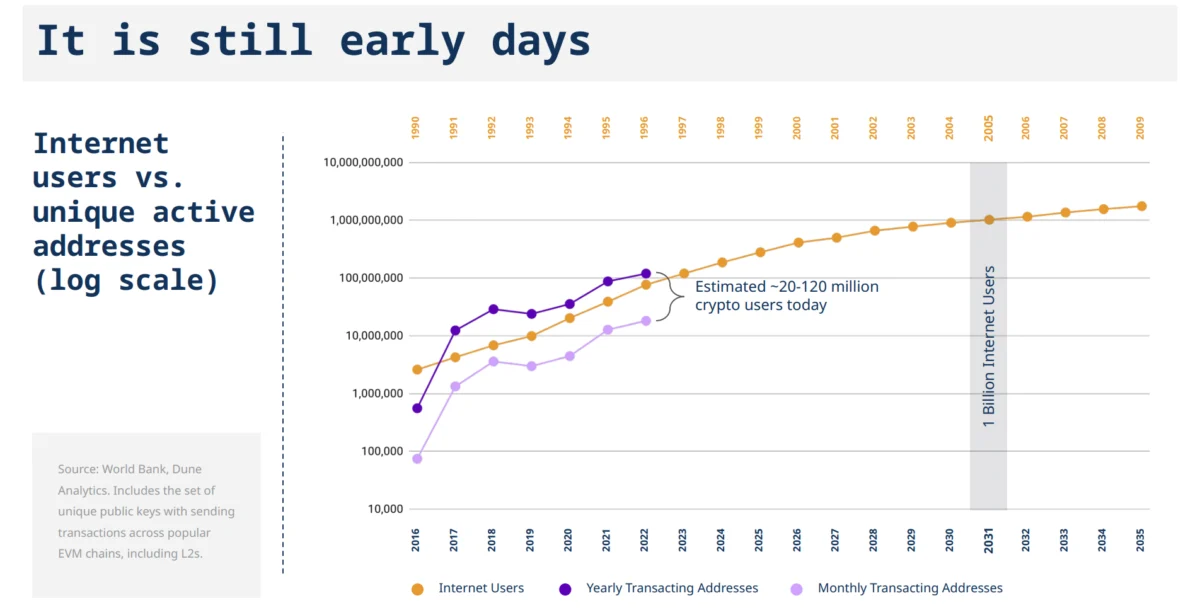
To contextualize the magnitude of this $4.5 billion bet, a16z’s leadership points to the historical cadence of technological revolutions. In his foundational memo announcing the fund, Chris Dixon laid out a deterministic view of technological progress, arguing that humanity is simply following a well-established blueprint of computing adoption.
[1940s - 1970s] Mainframe Era & Early Computing
       │
       ▼
    [1980s] Personal Computer (PC) Revolution
       │
       ▼
    [1990s] The Commercial Internet Boom
       │
       ▼
    [2000s] Mobile Computing & Smartphone Era
       │
       ▼
    [Present] Programmable Blockchains & Web 3.0 (The Golden Era)
The 10-to-15-Year Rule
According to historical data observed by technology historians and economists, a major computing paradigm shift occurs roughly every decade to decade-and-a-half.
- The 1980s democratized computing through the mass adoption of Personal Computers (PCs).
- The 1990s interconnected the globe through the commercialization of the internet (Web 1.0 and Web 2.0).
- The 2000s put supercomputers in every pocket via the mobile revolution and smartphone ecosystems.
Entering the Web 3.0 Paradigm
Andreessen Horowitz argues that blockchains are the logical and inevitable successor to mobile computing. While the past decade was largely characterized by Bitcoin’s emergence as digital gold and early speculative experimentation, the current decade is defined by programmable blockchains.
Dixon noted that smart contract platforms have finally matured to a point where they are sufficiently advanced, stable, and secure. Furthermore, a diverse array of consumer-facing applications has successfully scaled to tens of millions of users, proving that decentralized networks can handle real-world utility.
Supporting Data: Why Bear Markets Breed Billion-Dollar Opportunities
A critical component of a16z’s investment thesis relies on the historical correlation between macroeconomic downturns and technological breakthroughs. While retail investors often panic during crypto winters, historical data reveals that some of the world’s most enduring technology companies were founded during periods of severe economic distress.
Lessons from Past Crypto Winters
During previous market contractions—such as the prolonged bear markets of 2014–2015 and 2018–2019—speculative capital fled the ecosystem. However, this exodus cleared the playing field, allowing genuine builders, cryptographers, and engineers to focus intensely on core infrastructure without the distraction of hyper-inflationary token valuations.
- Ethereum (ETH): Conceived during the 2013–2014 bear market slump, laying the foundation for smart contracts and decentralized applications.
- Coinbase: Founded in 2012 in the aftermath of early Bitcoin market crashes, eventually growing into a publicly traded Wall Street titan.
- Solana, Polygon, and Chainlink: Developed core architecture during challenging market cycles before exploding into multi-billion-dollar ecosystems during subsequent bull runs.
By deploying $4.5 billion during a period of widespread market stagnation, a16z is positioning itself to capture equity and token allocations in protocols at attractive, rational valuations—avoiding the inflated pricing bubbles that plague hyper-bull markets.
Official Responses and Executive Insights
The announcement of Crypto Fund IV has sent ripples through the global tech and financial communities, prompting high-profile commentary from a16z’s executive leadership.
Arianna Simpson on the Psychology of Bear Markets
In an exclusive interview with CNBC, a16z General Partner Arianna Simpson elaborated on the strategic timing of the fund. She emphasized that market downturns act as a natural filter, weeding out short-term speculators and leaving behind committed, mission-driven developers.
"Bear markets are often when the best opportunities come about when people are actually able to focus on building technology rather than getting distracted by short-term price activity," Simpson stated during her CNBC interview.
She further explained that engineering talent flocking to Web 3.0 is no longer deterred by regulatory friction or media skepticism. Instead, the intellectual capital entering the space has reached an all-time high, comprising brilliant minds from traditional tech giants, premier academic institutions, and elite financial organizations.
Chris Dixon on the Talent Influx
Echoing Simpson’s sentiments, Chris Dixon highlighted the unprecedented human capital migrating into the cryptographic ecosystem over the past year.
"More importantly, a massive wave of world-class talent has entered Web 3.0 over the last year," Dixon wrote in the fund’s official manifesto. "They are brilliant and passionate and want to build a better internet."
According to internal a16z metrics, the quality of engineers, product managers, and designers leaving Web 2.0 companies (such as Meta, Google, and Apple) to build decentralized protocols has accelerated exponentially, validating the long-term viability of the sector.
Market Implications: What $4.5 Billion Means for the Future of Tech
The injection of $4.5 billion into the digital asset ecosystem carries profound implications for venture capital, regulatory landscapes, and the trajectory of the internet itself.
1. Institutional Validation Amid Uncertainty
At a time when traditional venture capital firms are pulling back from risk assets due to rising interest rates, inflation, and global geopolitical tensions, a16z’s massive commitment serves as a stabilizing vote of confidence. It signals to institutional limited partners (LPs)—such as pension funds, university endowments, and sovereign wealth funds—that blockchain technology is an enduring asset class rather than a passing fad.
2. Fueling the Shift from Speculation to Utility
With billions of dollars earmarked for infrastructure, ZK-rollups, and scalability solutions, the funding will directly address the traditional bottlenecks of blockchain adoption: high transaction fees, network congestion, and poor user experience. As these technical hurdles are systematically dismantled, the friction preventing mainstream users from interacting with Web 3.0 applications will evaporate.
3. Redefining the Creator and Digital Economy
By prioritizing decentralized social media protocols, DAOs, and metaverse economies, a16z is placing a structural bet against the monopolistic data-harvesting models of Web 2.0. The implication is clear: the next decade will likely see the mainstream transition from centralized platforms (where users are the product) to user-owned networks (where users are stakeholders and economic beneficiaries).
Conclusion
Andreessen Horowitz’s $4.5 billion crypto fund is more than just a massive financial transaction; it is a definitive philosophical stance on the future of human coordination, computing, and digital ownership.
While short-term market stagnation and price volatility will undoubtedly continue to test the patience of retail traders, institutional giants like a16z are operating on a multi-decade timeline. By capitalizing the builders of the decentralized future during their darkest hour, Silicon Valley is betting that the "golden era" of Web 3.0 is not merely approaching—it is already being forged.