
Raoul Pal Predicts Crypto Market Cap Will Explode to $300 Trillion Within a Decade, Outpacing the Internet and Oil
GLOBAL FINANCIAL MARKETS — In a wide-ranging discussion during a recent Google Tech Talks appearance, macro expert and former Goldman Sachs executive Raoul Pal laid out a monumental long-term thesis for the digital asset ecosystem. According to Pal, the cryptocurrency and Web3 sectors are preparing for an era of hyper-growth that will dwarf traditional asset classes. He forecasts that the current $1 trillion crypto market capitalization will surge to an astonishing $300 trillion over the next decade to fifteen years.
This dramatic market expansion, Pal argues, will be driven by unprecedented venture capital inflows, deep-seated institutional adoption operating quietly behind the scenes, and the unique structural mechanics of blockchain protocol layers that allow value to accrue directly at the base level.
Main Facts: The Blueprint for a $300 Trillion Economy
At the heart of Pal’s thesis is a comparison between the digital asset market and legacy global financial markets. Traditional asset classes—including global equities, real estate, and sovereign debt—typically hover in the $200 trillion to $300 trillion range individually. Pal believes that crypto and Web3 will eventually match or surpass these monolithic sectors entirely.
Key Takeaways from Pal’s Google Tech Talks Interview:
- The Valuation Leap: The crypto market cap is projected to leap from its current baseline of roughly $1 trillion to an unprecedented $300 trillion within 10 to 15 years.
- Structural Value Accrual: Unlike traditional internet companies where value is captured primarily by equity shareholders at the application layer, blockchain protocols inherently accrue value directly to the network layer, accelerating capital formation.
- The "Big Tech & Finance" Quiet Accumulation: Major Web2 corporations and traditional financial institutions are heavily invested or positioning themselves in the ecosystem, though regulatory caution keeps much of this activity out of the public eye for now.
- Unmatched Velocity: Pal characterizes this impending financial shift as the fastest and largest wealth and value creation event in human history, easily outpacing the industrial impact of oil and the digital expansion of the early internet.
Chronology of a Paradigm Shift: From Niche Asset to Macro Giant
To understand Pal’s aggressive timeline, it is helpful to contextualize the rapid evolutionary milestones of the cryptocurrency and blockchain sector over the past decade and a half.
Phase 1: Genesis and Cryptographic Experimentation (2009–2016)
Following the 2008 global financial crisis, Bitcoin was introduced as a peer-to-peer electronic cash system. For the first several years, the asset class existed primarily on the fringes of finance, viewed by mainstream economists as a speculative digital novelty with virtually no institutional backing.
Phase 2: The Retail Explosion and ICO Boom (2017–2020)
The introduction of smart contract platforms, most notably Ethereum, catalyzed the Initial Coin Offering (ICO) wave of 2017. This era brought broader retail participation, the birth of decentralized finance (DeFi), and the initial waves of institutional curiosity, culminating in Bitcoin crossing the $20,000 threshold and subsequently attracting corporate treasuries during the COVID-19 pandemic monetary expansion.
Phase 3: The Institutional Inflow and Venture Capital Surge (2021–2022)
During the 2021 bull market and its immediate aftermath, venture capital firms aggressively targeted the space. An estimated $60 billion in VC funding flooded into Web3 startups and infrastructure projects over an intensive 18-month window. This period also saw traditional financial giants—such as BlackRock, Fidelity, and Goldman Sachs—lay the groundwork for digital asset custody, tokenization initiatives, and crypto-linked investment vehicles.
Phase 4: Macro Headwinds and Quiet Building (Present)
In the current macroeconomic climate defined by aggressive central bank tightening, high interest rates, and regulatory friction, market prices have consolidated. However, Pal notes that this environment has only driven builders to continue developing infrastructure. As macro conditions clear, the massive influx of venture-backed products from the past two years is poised to hit the market.
Supporting Data: Capital Inflows, VC Funding, and Market Realities
Pal’s projection is not built on optimism alone; it is grounded in historical trend lines of technology adoption, venture deployment, and structural financial engineering.
Analyzing the $60 Billion VC Cushion
Over the last year and a half, despite volatile market conditions, approximately $60 billion in venture capital was injected into the Web3 ecosystem. Because the cryptocurrency industry operates at a much faster innovation cycle than traditional tech sectors, Pal emphasizes that this capital is rapidly transforming into tangible consumer products, developer tools, and institutional-grade infrastructure.
[Traditional Markets]  -> $200T - $300T each (Equities, Real Estate, Bonds)
[Current Crypto Market]-> ~$1T (Baseline Phase)
[Projected Crypto Cap] -> $300T (10-15 Year Horizon)
The Velocity of Digital Adoption
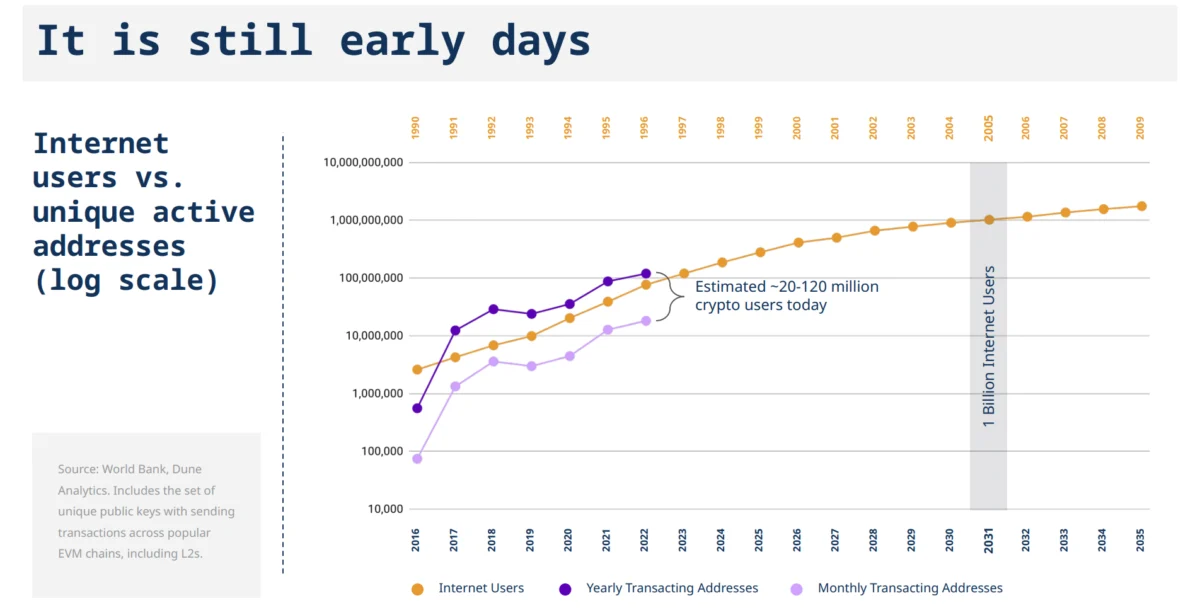
When comparing the adoption curve of the internet in the 1990s to the growth rate of blockchain networks, user adoption curves consistently skew steeper for decentralized technologies. The internet connected information; Web3 connects and tokenizes value natively. This fundamental design shift allows economic incentives to propagate globally in real-time, drastically reducing the friction associated with traditional capital formation.
Official Responses and Institutional Sentiment
While retail investors often focus on day-to-day price action, executive commentary from major financial institutions corroborates Pal’s observation that "everybody is involved."
Wall Street’s Quiet Preparation
Despite ongoing regulatory ambiguity—particularly in the United States from regulatory bodies like the Securities and Exchange Commission (SEC)—Wall Street has steadily built out digital asset divisions. Major asset managers have filed for spot Bitcoin and Ethereum exchange-traded funds (ETFs), signaling a permanent shift toward mainstream integration.
Institutional executives frequently echo the sentiment that blockchain technology offers unprecedented efficiencies in settlement times, asset issuance, and cross-border payments. Although public compliance departments exercise extreme caution, proprietary trading desks and investment banking divisions have systematically integrated digital asset research into their core macroeconomic strategies.
Regulatory Friction as a Temporary Bottleneck
Pal specifically highlights regulatory uncertainty as the primary reason why traditional Web2 giants and legacy financial institutions have not yet fully deployed their capital into the open market. Once regulatory clarity is established—whether through comprehensive congressional legislation or clearer SEC guidelines—Pal predicts an immediate "green light" scenario where institutional capital rushes in simultaneously.
Implications: What a $300 Trillion Web3 Economy Means for the Future
If Raoul Pal’s macroeconomic forecast materializes, the global economic landscape will undergo a structural transformation unlike anything seen since the Industrial Revolution.
1. Reallocation of Global Wealth
A migration of value toward a $300 trillion digital asset market cap implies a massive reallocation of capital away from legacy systems. Sovereign bonds, traditional real estate holdings, and legacy equities could see capital siphon into tokenized, borderless, and programmatic financial networks.
2. The Rise of Protocol-Level Economics
In traditional tech ecosystems, consumer-facing applications capture the lion’s share of valuation (e.g., Apple, Google, Meta). In contrast, public blockchains distribute value directly to the foundational protocol layers and their native asset holders. This means users, developers, and token holders actively participate in the financial upside of the underlying networks they utilize, fundamentally altering wealth distribution models.
3. Acceleration of Technological Innovation
The deployment of the $60 billion in venture capital funding will serve as the catalyst for the next wave of consumer adoption. As user experience (UX) barriers drop—making self-custody seamless, transaction speeds instantaneous, and gas fees negligible—Web3 will transition from an alternative financial ecosystem into the invisible backbone of the global internet.
Conclusion
Raoul Pal’s bold forecast paints a picture of a near future where digital assets are no longer a speculative asset class on the periphery of finance, but rather the dominant settlement layer for the global economy. While macroeconomic headwinds and regulatory hurdles continue to create short-term friction, the underlying fundamentals—driven by relentless venture capital investment, institutional preparation, and superior technological architecture—suggest that the path to a multi-trillion-dollar digital economy is well underway.
Disclaimer: The information provided in this article is for informational and educational purposes only and does not constitute financial or investment advice. Readers should conduct their own thorough research and consult with a licensed financial advisor before making any high-risk investments in cryptocurrencies or digital assets.