
Diverging Paths: Ethereum Spot ETFs Witness Resurgence as Bitcoin Faces Continued Capital Outflows
In the volatile landscape of digital asset investment, the performance of U.S.-listed spot exchange-traded funds (ETFs) serves as a critical barometer for institutional sentiment. Recent data from market intelligence platform SoSoValue reveals a stark divergence in investor behavior: while Bitcoin (BTC) spot ETFs are grappling with sustained liquidity withdrawals, Ethereum (ETH) spot ETFs have staged a notable recovery, signaling a potential shift in market appetite.
This departure from the traditional correlation between the two leading cryptocurrencies highlights a maturing market where institutional investors are increasingly differentiating between the primary store-of-value asset and the leading smart-contract platform.
The Role of Spot ETFs in Institutional Adoption
To understand the gravity of these flows, one must first recognize the structural significance of spot ETFs. Since their respective launches in the United States—Bitcoin in January 2024 and Ethereum in July 2024—these financial instruments have fundamentally altered how traditional capital interacts with the crypto ecosystem.
By providing indirect exposure, these ETFs allow institutional entities to gain price exposure to BTC and ETH without the operational burdens of managing private keys, navigating decentralized exchanges, or maintaining custody infrastructure. SEC-regulated and integrated into standard brokerage accounts, these funds have effectively bridged the gap between Wall Street and the blockchain. They serve as the primary gateway for pension funds, hedge funds, and family offices looking to diversify their portfolios with digital assets under a familiar regulatory framework.

Chronology of Market Sentiment: A Shift in Flow Dynamics
The current market environment has been characterized by "bearish winds" that have pressured both assets. However, the intensity of these pressures has manifested differently across the two primary asset classes.
The Ethereum Recovery
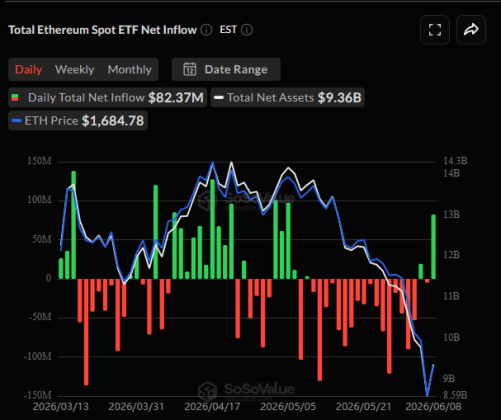
Since May 7th, Ethereum spot ETFs had been trapped in a persistent cycle of net outflows. During this period, the broader crypto market faced significant turbulence, with the price of ETH retreating from a high of $2,300 to a cycle low below $1,600. The atmosphere was one of exodus, as investors sought to de-risk amidst broader macroeconomic uncertainty.
The tide began to turn in early June. On June 4th, the streak of outflows was decisively broken as ETH spot ETFs recorded a net inflow of $19 million. While the subsequent day saw a minor retreat, the momentum returned with force on Monday, when the funds logged a significant $82 million in net inflows. This substantial influx suggests that institutional players are viewing the recent price correction as a strategic entry point rather than a signal to abandon the asset.
The Bitcoin Stagnation
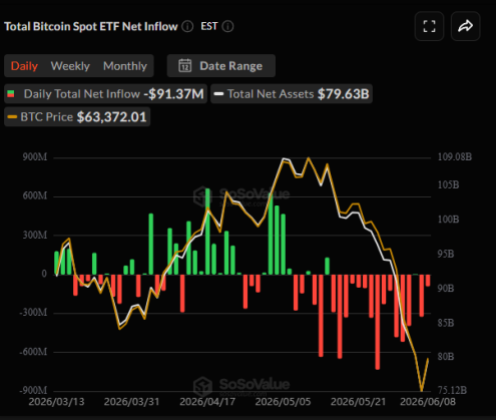
In contrast, Bitcoin’s recent narrative has been one of stagnation and withdrawal. While BTC did see a nominal inflow of $3 million on June 4th, analysts categorized this as effectively neutral, offering little to offset the broader trend. Following that momentary stability, the selling pressure returned with vigor. Monday witnessed an exit of $91 million from BTC spot ETFs, a figure that highlights a growing skepticism among some institutional holders regarding the immediate price trajectory of the world’s largest cryptocurrency.

Supporting Data and Market Analysis
The divergent trends are best observed through the lens of netflow volume. The data provided by SoSoValue indicates that while both assets have been subjected to macro-economic headwinds, the "Ethereum premium" is currently being tested.
Comparative Flow Analysis
- Ethereum: Following a sustained period of negative sentiment (May 7th – June 3rd), the reversal on June 4th ($19M) and the substantial surge on Monday ($82M) indicate that Ethereum is currently outperforming Bitcoin in terms of net institutional demand.
- Bitcoin: Despite its status as the market leader, the consistent daily outflows—culminating in the $91 million exit—suggest that institutional investors may be rebalancing their portfolios, potentially shifting capital from BTC into ETH or moving to cash positions to hedge against further downside volatility.
This data is crucial for retail investors, as it indicates that the "smart money" is not merely moving in lockstep. The willingness of institutional players to commit $82 million to Ethereum during a period of market instability suggests a strong conviction in the asset’s long-term utility, particularly as the Ethereum network continues to evolve through its ongoing roadmap.
Implications for the Broader Crypto Ecosystem
The recent divergence raises several questions regarding the future trajectory of the digital asset market.
Institutional Portfolio Rebalancing
The most immediate implication is the possibility of portfolio rebalancing. In the past, institutional portfolios were often dominated by Bitcoin, treated as "digital gold." The emergence of robust, liquid Ethereum ETFs provides a new avenue for diversification. If institutional investors view Ethereum as an infrastructure play—comparable to the "internet of value"—the shift in capital could represent a long-term strategic allocation rather than a short-term trade.
Regulatory and Macro-Economic Factors
Both assets remain sensitive to Federal Reserve interest rate policy and SEC oversight. However, the regulatory clarity provided by the existence of these ETFs has lowered the barrier to entry. As these funds continue to grow in AUM (Assets Under Management), their impact on price discovery will only intensify. Should the $82 million inflow into Ethereum prove to be the start of a trend, it could provide the necessary buying pressure to decouple ETH from the broader market downturn.
Market Resilience
Ethereum’s recovery to the $1,670 price level following its recent lows is a testament to the resilience of the ecosystem. While the asset remains down from its previous highs, the bounce-back, supported by institutional inflows, offers a level of technical support that could stabilize the market in the coming weeks. If Bitcoin continues to face net outflows, it may signal that investors are becoming more discerning, prioritizing assets with high developer activity and utility over those solely driven by speculative store-of-value narratives.
Expert Perspectives on Future Volatility
Industry analysts suggest that the current divergence is a natural evolution of a maturing asset class. Seasoned editors and market researchers emphasize that while ETFs are a tool for accessibility, they also bring the pressures of traditional financial markets to the crypto sphere.
"When we look at the flow data, we are seeing the behavior of capital that is subject to quarterly earnings, risk management mandates, and macro-economic hedging," says one lead market strategist. "The fact that Ethereum is seeing such a sharp spike in demand despite the overall ‘bleeding’ of the market suggests that there is an underlying bid for the asset that is currently stronger than the sell-side pressure."
Conclusion: A New Phase of Market Maturation
The latest data from SoSoValue marks a pivotal moment for the crypto market. The contrast between the $91 million outflow from Bitcoin and the $82 million inflow into Ethereum serves as a clear indicator that the crypto market is moving beyond a monolithic "risk-on/risk-off" environment.
Investors and observers alike should monitor these netflow trends closely over the coming weeks. If Ethereum continues to command institutional capital while Bitcoin remains stagnant, we may be witnessing the beginning of a cycle where Ethereum establishes itself as a primary pillar of institutional digital asset strategies. As the market navigates the remainder of the year, the performance of these spot ETFs will remain the most reliable indicator of where the world’s largest capital allocators believe the value of the digital future truly lies.
Disclaimer: This report is for informational purposes only and does not constitute financial advice. Investors should consult with qualified financial advisors before making any investment decisions. The editorial process at this publication ensures that all data is sourced from reputable platforms, though market conditions are subject to rapid change.