
Centralized Crypto Exchange Volumes Plummet 43.8% in April After Six Months of Unprecedented Growth
Main Facts: The Great Cool-Down in Centralized Crypto Trading
The explosive momentum that characterized the cryptocurrency markets through the late autumn and early winter of 2023 and the first quarter of 2024 has hit a significant speed bump. According to comprehensive new data from digital asset blockchain tracker CCData, the overall trading volume across centralized cryptocurrency exchanges (CEXs) suffered a dramatic downturn in April, snapping a robust six-month consecutive winning streak.
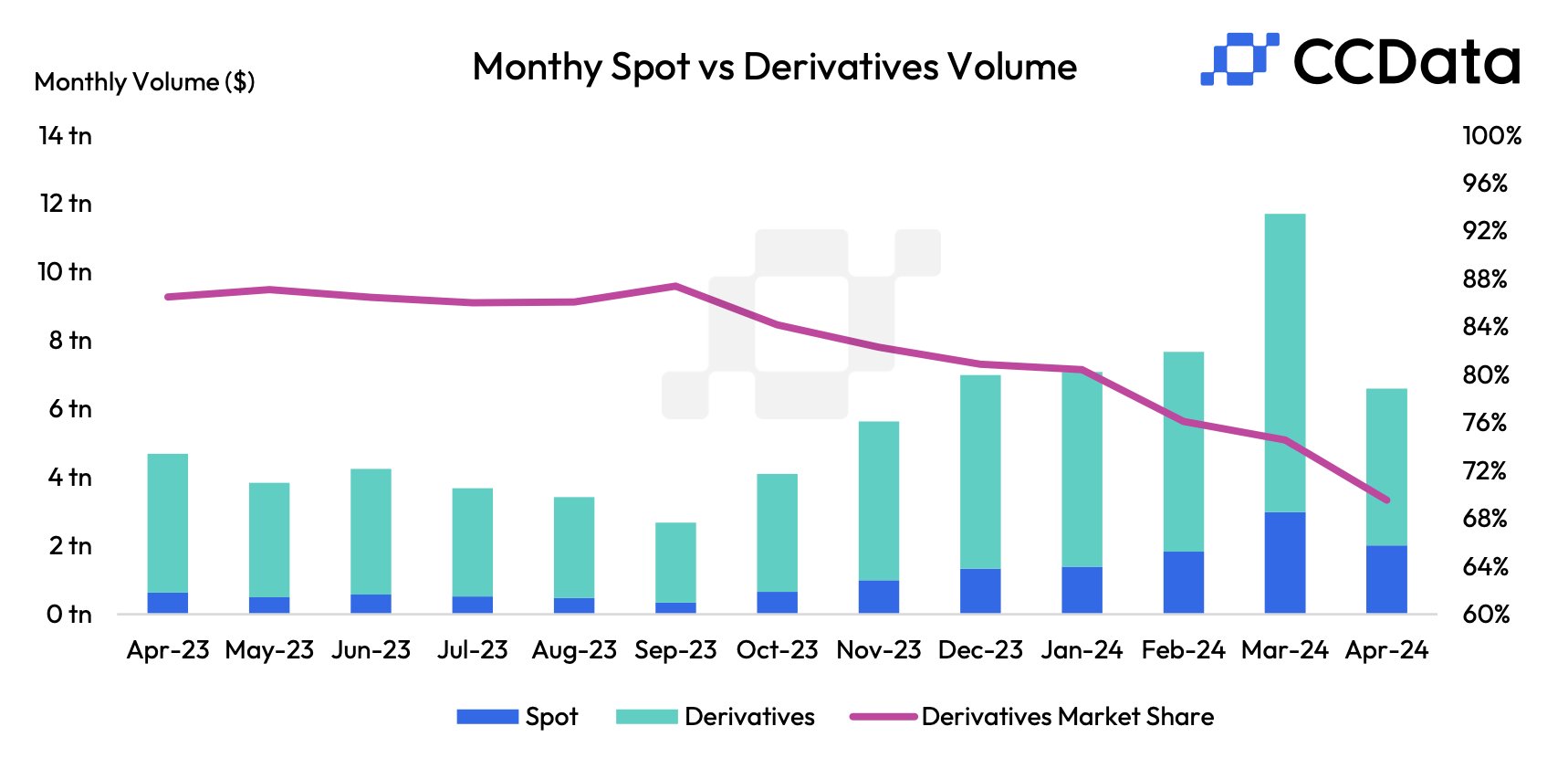
The combined trading volume for both spot markets and derivatives across major centralized platforms fell by a staggering 43.8%, plummeting to $6.58 trillion. This sharp contraction contrasts sharply with the frantic activity seen in preceding months, reflecting a broader macro and market-driven consolidation phase across the digital asset ecosystem.
Despite the eye-watering monthly percentage drop, a broader historical context reveals that April’s figures are not entirely catastrophic. While down significantly from the record-breaking heights of early 2024, the April volume remains higher than any single month recorded throughout the entirety of 2023—with the lone exception of December. Nevertheless, the contraction highlights a palpable shift in trader sentiment, reduced market volatility, and a cooling off from the speculative frenzy ignited by the approval and launch of U.S. spot Bitcoin exchange-traded funds (ETFs) and the subsequent Bitcoin halving event.
Chronology: How the Market Shifted from Q1 Euphoria to April’s Contraction
To fully understand the magnitude of April’s correction, it is essential to trace the trajectory of centralized exchange volumes over the preceding quarters:

- Late 2023 (The Recovery Phase): Spurred by growing institutional optimism regarding the anticipated approval of spot Bitcoin ETFs in the United States, centralized exchange volumes began a steady, uninterrupted climb. For six consecutive months, trading desks saw rising liquidity and escalating open interest.
- December 2023: Volumes crested to local highs for the year, establishing a strong baseline for the market entering the new year.
- February 2024 (The Acceleration): As market enthusiasm intensified, combined spot and derivatives volumes on CEXs surged to approximately $8 trillion, fueled by aggressive retail participation and institutional inflows.
- March 2024 (The Peak): Driven by Bitcoin’s relentless push to new all-time highs ahead of the fourth halving event, the combined volume of centralized exchanges reached an astronomical $11 trillion. This marked the zenith of the bull run’s first quarter.
- April 2024 (The Correction): Following the completion of the Bitcoin halving in mid-April and a general macroeconomic tightening of liquidity, trading activity evaporated rapidly. Volumes dropped by nearly half month-over-month, settling at $6.58 trillion.
- Early May 2024 (Sector Rotation and Stabilization): Data compiled up to May 10 reveals that while core trading volumes on major centralized platforms remain subdued, capital has begun rotating into specific narrative-driven sectors rather than exiting the market entirely.
Supporting Data: Breakdown of Exchange Performance and Sector Rotation
CCData’s detailed analytics provide a granular look at which platforms bore the brunt of the April downturn, as well as how specific crypto sectors performed during the cooling period.
Centralized Exchanges Hit Hardest
The contraction was felt across the board, but top-tier platforms experienced significant double-digit losses in transaction throughput.
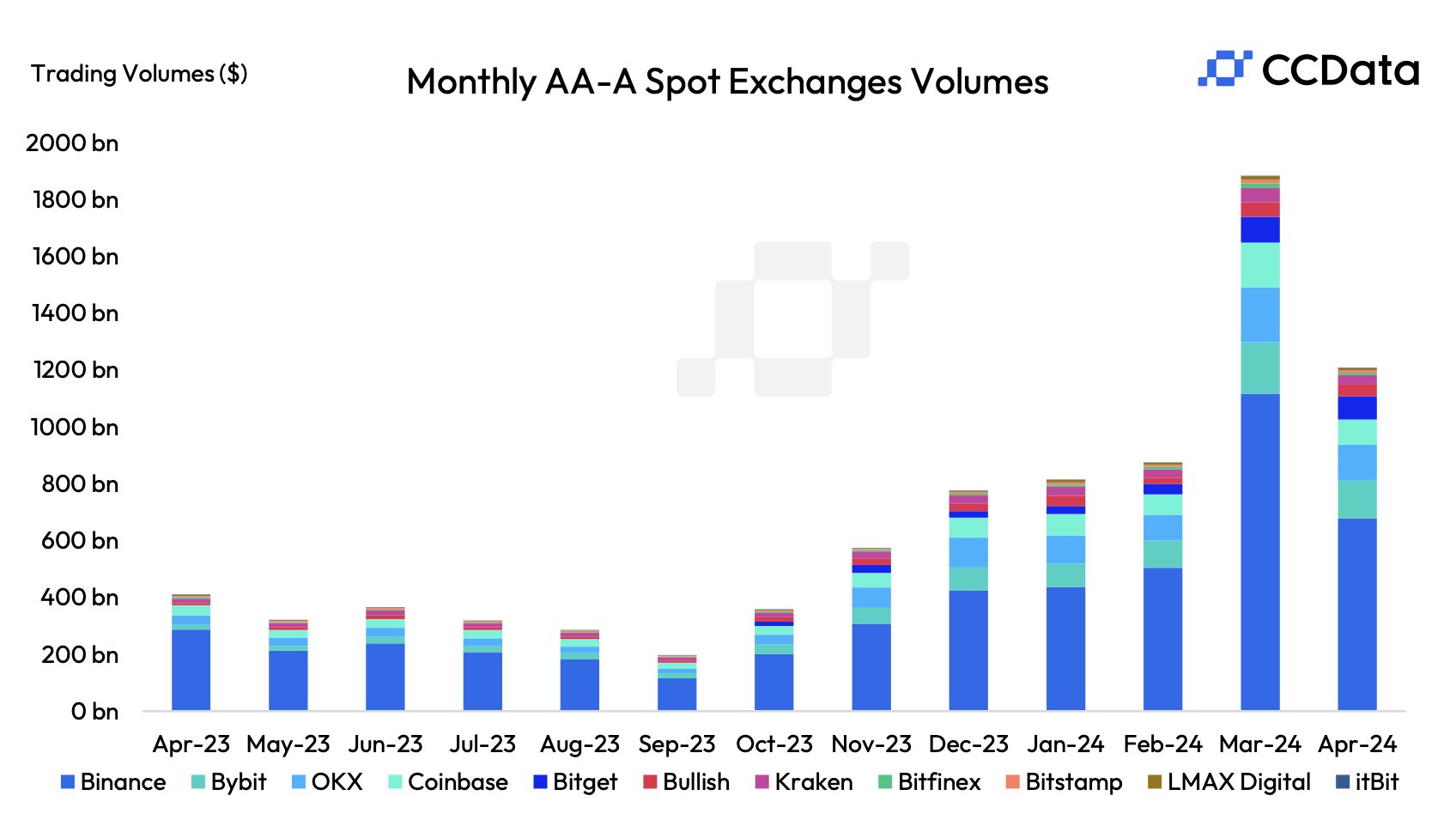
- Binance: As the world’s largest cryptocurrency exchange by volume, Binance (classified as a Grade A top-tier spot exchange) saw its monthly spot volume tumble to $679 billion, representing a 39.2% decrease compared to March. Despite the steep decline, Binance comfortably maintained its dominant market share.
- Bybit: Ranking among CCData’s elite Grade AA exchanges, Bybit recorded $133 billion in monthly volume. This marked a 26.9% decline, making it one of the more resilient major platforms during the contraction.
- OKX: Another major industry bellwether, OKX (Grade A), processed $126 billion in volume, translating to a 34.8% drop month-over-month.
Sector Performance Returns (Month-to-Date as of May 10)
While CEX spot and derivatives volumes slumped, on-chain and thematic token baskets experienced divergent fortunes. Rather than a uniform market-wide crash, capital rotated decisively into specific niches:
- Metaverse / Gaming: +32.4% (The top-performing sector, signaling renewed speculative interest in Web3 entertainment).
- Artificial Intelligence (AI): +17.4% (Continuing strong momentum tied to broader tech narratives).
- Meme Tokens: +16.2% (Proving that retail appetite for high-risk, community-driven assets remains alive despite lower overall exchange volume).
- Layer-1 (L1) Blockchains: +7.1%
- Decentralized Finance (DeFi): +6.7%
- Staking Tokens: +4.0%
- Exchange Tokens: +3.5%
- Infrastructure: +1.6%
- Layer-2 (L2) Scaling Solutions: -4.2% (Notably lagging behind the broader market despite ongoing network upgrades).
Official Responses and Market Analysis
Industry analysts and institutional researchers have interpreted the April volume drop not as a sign of an incoming bear market, but rather as a healthy and necessary consolidation period.
Market researchers note that after six consecutive months of aggressive expansion, liquidity reserves on centralized exchanges naturally deplete as leveraged positions are flushed out and traders transition from active day-trading to longer-term holding strategies ("hodling"). The reduction in spot and derivatives volume aligns with a macro environment where global central banks, particularly the U.S. Federal Reserve, maintain a "higher-for-longer" interest rate stance, causing macro traders to re-evaluate risk assets.
Furthermore, representatives from data intelligence firms point out that the massive figures seen in March were heavily front-run events driven by the Bitcoin ETF narrative. Once the ETFs were successfully integrated into traditional financial portfolios and the Bitcoin halving was officially priced in, a temporary vacuum in market catalysts naturally occurred.
Implications: What the April Slump Means for the Future of Crypto Trading
The 43.8% drop in CEX volume carries several profound implications for retail traders, institutional investors, and exchange operators alike:
1. Shift from Speculation to Selectivity
The divergence between falling exchange volumes and rising niche sectors (such as Metaverse/Gaming and AI tokens) indicates that market participants are becoming more selective. General speculative trading on major pairs (like BTC/USDT and ETH/USDT) has cooled, but targeted capital is aggressively chasing high-beta narratives.
2. Profit Margins for Centralized Exchanges
For industry giants like Binance, Bybit, and OKX, a nearly 44% reduction in monthly trading volume directly impacts fee-based revenues. Exchange operators may need to lean harder into non-trading revenue streams—such as Web3 wallet integrations, staking services, and institutional custody solutions—to offset cyclical downturns in spot and derivatives activity.
3. Maturation of the Market Cycle
Historical crypto market cycles often feature sharp parabolic moves followed by prolonged consolidation phases. April’s data suggests that the market is maturing, moving away from hyper-leveraged mania toward structural consolidation. While painful for short-term day traders relying on high volatility, this cooling phase builds a healthier technical foundation for future upside.
4. The Rise of Alternative Venues
While centralized exchanges saw massive volume contractions, the broader evolution of the digital asset landscape continues to challenge CEX dominance. The contrasting performance of Layer-1 and Layer-2 tokens highlights that activity is increasingly distributed across alternative execution layers, decentralized exchanges (DEXs), and application-specific chains.
Disclaimer: The information provided in this article is for informational purposes only and does not constitute financial advice. Cryptocurrency markets are highly volatile and carry substantial risk. Investors should conduct thorough due diligence before engaging in spot trading, derivatives, or high-risk digital asset investments.