Andreessen Horowitz’s "State of Crypto" Report Identifies Web3 Gaming as the Catalyst for Mainstream Digital Asset Adoption
SAN FRANCISCO — Prominent Silicon Valley venture capital titan Andreessen Horowitz (a16z) has released its highly anticipated annual "State of Crypto" report, offering a comprehensive look at the trajectory of blockchain technology, decentralized finance (DeFi), and digital assets. Among its core findings, the report pinpoints a single, high-growth sector as the primary engine for onboarding the next billion users into the crypto ecosystem: Web3 gaming.
As the broader digital asset landscape continues to mature past speculative trading cycles, institutional investors and developers alike are searching for tangible utility. According to a16zcrypto, the dedicated crypto arm of the multi-billion-dollar VC firm, interactive entertainment and blockchain-integrated gaming possess the unique cultural and economic pull necessary to bridge the gap between niche technology and mainstream consumer habits.
Main Facts: Unlocking the Next Wave of Crypto Adoption
The foundational thesis of the a16z report is built on a simple premise: everyday consumers are already accustomed to digital economies, making Web3 gaming a natural stepping stone toward broader blockchain adoption.
Key takeaways from the report include:
- The Web3 Gaming Surge: A16z identifies Web3 gaming as the most viable catalyst for large-scale digital asset adoption, noting that it provides practical, consumer-facing utility.
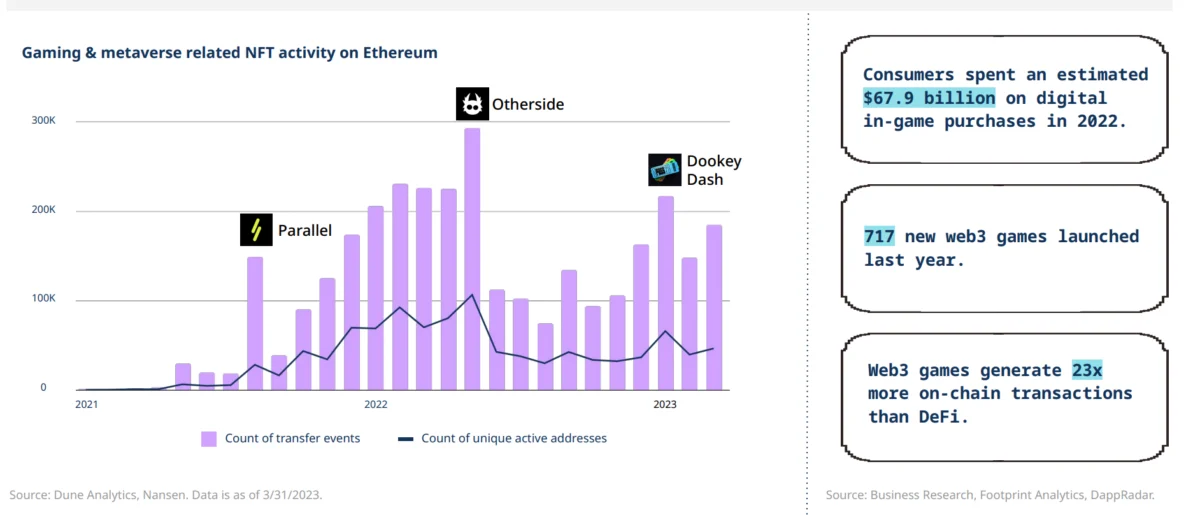
- Massive Economic Footprint: In 2022 alone, consumers poured an estimated $67.9 billion into digital in-game purchases, underscoring a massive existing market ripe for tokenization and player-owned economies.
- Explosive Development Activity: Over the past year, the ecosystem witnessed the launch of 717 new Web3 games, signaling aggressive developer confidence and capital deployment.
- On-Chain Activity Dominance: Web3 games are currently generating an astonishing 23 times more on-chain transactions than traditional decentralized finance (DeFi) protocols, demonstrating continuous, utility-driven network usage rather than purely speculative holding.
- Parallels to the Early Internet: The investment giant maintains that the crypto industry is still in its infancy, comparing its current state of adoption to the nascent stages of the internet during the 1990s.
Chronology: From Speculative Manias to Utility-Driven Growth
To understand where the crypto industry stands today, a16zcrypto’s report charts the historical progression of digital assets, drawing direct parallels to the evolution of the World Wide Web.
The 1990s Internet vs. Modern Crypto
In its comparative analysis, the venture capital firm overlays the growth curve of internet users—beginning in earnest around 1990—onto the adoption curve of crypto users, which it tracks starting in 2016.
- The Dial-Up Era (1990–1996): In the early 1990s, the internet was characterized by slow dial-up connections, complex user interfaces, and a general perception among the public that it was a novelty for academics and computer hobbyists. By 1996, however, the user base expanded rapidly, reaching nearly 100 million people as browsers became more user-friendly and commercial applications emerged.
- The Crypto Parallel (2016–2022): A16z views the 2016–2022 window through a similar lens. According to the report, the crypto ecosystem recorded approximately 20 million monthly active transacting addresses and roughly 120 million yearly transacting addresses by the end of 2022. While these numbers represent a fraction of the global population, the firm argues that infrastructure improvements, scaling solutions, and consumer-facing applications like Web3 games are laying the groundwork for an "inflection point" akin to the dot-com boom of the late ’90s.
Supporting Data: Numbers Behind the Web3 Gaming Boom
The assertions made in the a16zcrypto report are backed by hard metrics regarding consumer spending, network throughput, and development output.

The $67.9 Billion In-Game Economy
For decades, traditional gaming giants (such as Electronic Arts, Activision Blizzard, and Epic Games) have profited immensely from virtual goods. In 2022, global consumer spending on digital in-game purchases reached $67.9 billion.
Historically, these economies have been "closed-loop"—players spend real fiat currency to acquire virtual skins, weapons, or currency, but they do not truly own these assets, nor can they legally trade them outside the game’s walled garden. Web3 gaming disrupts this model by introducing true digital ownership via non-fungible tokens (NFTs) and decentralized tokens. Players can earn, trade, and sell their in-game items across open marketplaces, transforming passive entertainment into potentially rewarding economic participation.
Development and Transaction Metrics
The sheer volume of capital flowing into Web3 infrastructure is reflected in the launch of 717 new Web3 games over a single 12-month period. More importantly, these titles are not just sitting in development hell; they are actively engaging users.
By generating 23 times more on-chain transactions than DeFi, Web3 games are proving to be the primary drivers of blockspace demand. While DeFi protocols experience heavy transaction volumes primarily during high-volatility market events, games require constant, micro-transactions for actions such as trading items, leveling up characters, and moving assets between wallets—thus ensuring steady, organic network utilization.
Official Responses and Industry Perspectives
The release of the "State of Crypto" report has sparked widespread dialogue across both the traditional tech sector and the blockchain community. Industry leaders and venture capitalists have weighed in on a16z’s findings, offering nuanced perspectives on the challenges and opportunities facing Web3 gaming.
The Consumer Experience Hurdle
Critics and developers alike have long pointed out that early iterations of Web3 games suffered from a fatal flaw: they prioritized tokenomics over fun. Gameplay was often secondary to grinding for financial rewards—a model that sustainable economists refer to as a "Ponzi dynamic."
Responding to these criticisms, industry veterans note that a16z’s report highlights a vital transition. The 717 newly launched games represent a "second generation" of Web3 titles—games where AAA-quality development studios are putting gameplay first, integrating blockchain elements invisibly into the background so that users do not need to understand private keys or gas fees to enjoy the product.
Venture Capital Confidence
Andreessen Horowitz has consistently doubled down on its bullish outlook for decentralized technology, having raised multi-billion-dollar crypto funds dedicated explicitly to backing early-stage infrastructure and gaming startups. By publishing metrics that normalize crypto adoption against the early internet, a16z aims to reassure institutional LPs (Limited Partners) that short-term market volatility does not detract from the long-term technological S-curve.
Implications: What This Means for the Future of Tech and Finance
The implications of a16zcrypto’s findings extend far beyond the gaming industry, touching on regulatory landscapes, developer migration, and the future evolution of the internet.
1. Onboarding the Next Billion Users
The primary takeaway is demographic. Asking the average consumer to understand decentralized finance, yield farming, or cross-chain bridges is a steep hill to climb. However, asking a gamer to trade a rare sword or own their in-game achievements is entirely intuitive. Web3 gaming serves as a "Trojan horse" for crypto adoption, gradually familiarizing millions of mainstream consumers with digital wallets, seed phrases, and self-sovereignty without them ever realizing they are interacting with blockchain infrastructure.
2. A Shift in Venture Capital Focus
With DeFi facing increased regulatory scrutiny globally—particularly in the United States—venture capital firms are naturally pivoting toward sectors that offer clearer utility and consumer engagement. Web3 gaming, intellectual property rights, and decentralized social media (DeSo) represent regulatory "greener pastures" where innovation can flourish while providing tangible value to everyday users.
3. Redefining Digital Ownership
As virtual reality (VR), augmented reality (AR), and spatial computing continue to converge with gaming, the demand for portable digital identity and assets will skyrocket. If a16z’s projections hold true, the infrastructure being built today for Web3 gaming will form the economic backbone of the future metaverse, ensuring that users—rather than centralized corporations—retain true ownership of their digital lives.
Disclaimer: The information provided in this article is for informational purposes only and does not constitute financial or investment advice. Readers should conduct their own thorough research before engaging in high-risk investments involving cryptocurrencies, digital assets, or Web3 gaming tokens.