Andreessen Horowitz’s ‘State of Crypto’ Report Identifies Web3 Gaming as the Catalyst for Mass Digital Asset Adoption
SAN FRANCISCO — Prominent Silicon Valley venture capital titan Andreessen Horowitz (a16z) believes the key to unlocking mainstream adoption for the digital asset industry lies not in traditional finance or decentralized lending, but in the booming world of interactive entertainment.
In its comprehensive and highly anticipated "State of Crypto" report released by its crypto-focused arm, a16z crypto, the firm outlines a compelling thesis: Web3 gaming stands uniquely positioned to serve as the onboarding gateway for millions of new everyday users into the blockchain ecosystem.
While the broader cryptocurrency market often hyper-focuses on market volatility, regulatory battles, and macroeconomic trends, a16z’s latest data points toward a quieter, more organic revolution happening at the intersection of gaming, digital ownership, and distributed ledger technology.
Main Facts: The Web3 Gaming Paradigm Shift
The core finding of the a16z crypto report is straightforward yet profound: traditional gaming economies already possess the psychological and financial frameworks necessary to embrace blockchain architecture, even if players do not initially realize they are interacting with crypto infrastructure.
According to the report, Web3 games are not merely a niche experiment; they are rapidly scaling sectors commanding massive consumer engagement.
- The Onboarding Engine: a16z explicitly states that "Web3 games are a huge opportunity to welcome new users to crypto," shifting the narrative from speculative trading to utility-driven consumer interaction.
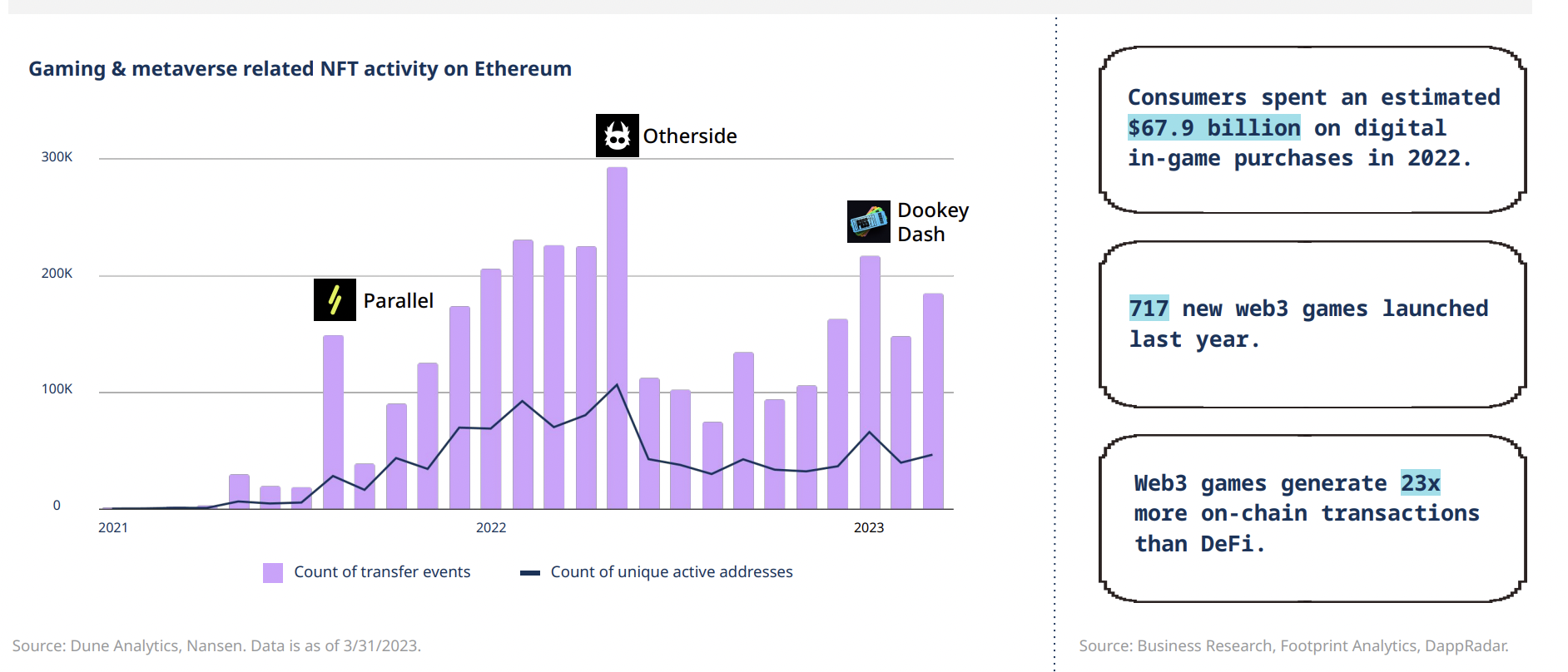
- On-Chain Dominance: Demonstrating a massive leap in transactional activity, Web3 games are currently generating 23 times more on-chain transactions than the entire decentralized finance (DeFi) sector combined.
- Proliferation of Projects: The sector has seen explosive development, with approximately 717 new Web3 games launching over the preceding 12-month period.
Rather than forcing users to understand the complex mechanics of gas fees, private keys, and cold storage wallets, Web3 game developers are increasingly embedding blockchain tech seamlessly into the background. This allows gamers to trade, earn, and truly own in-game assets—such as skins, virtual land, and currency—without friction, mirroring the familiarity of traditional gaming ecosystems while offering true digital property rights.
Chronology: Tracing the Evolution of Crypto and Web3 Gaming
To understand how a16z arrived at its current outlook, it is essential to examine the timeline of both the internet’s early days and the relatively nascent history of blockchain technology.

The 1990s Internet Parallel
Andreessen Horowitz frequently compares the current trajectory of the crypto industry to the genesis of the commercial internet in the 1990s.
- 1990–1995: The internet was largely confined to academic institutions, government bodies, and early technology enthusiasts. It was plagued by slow dial-up speeds, complex interfaces, and widespread skepticism regarding its commercial viability.
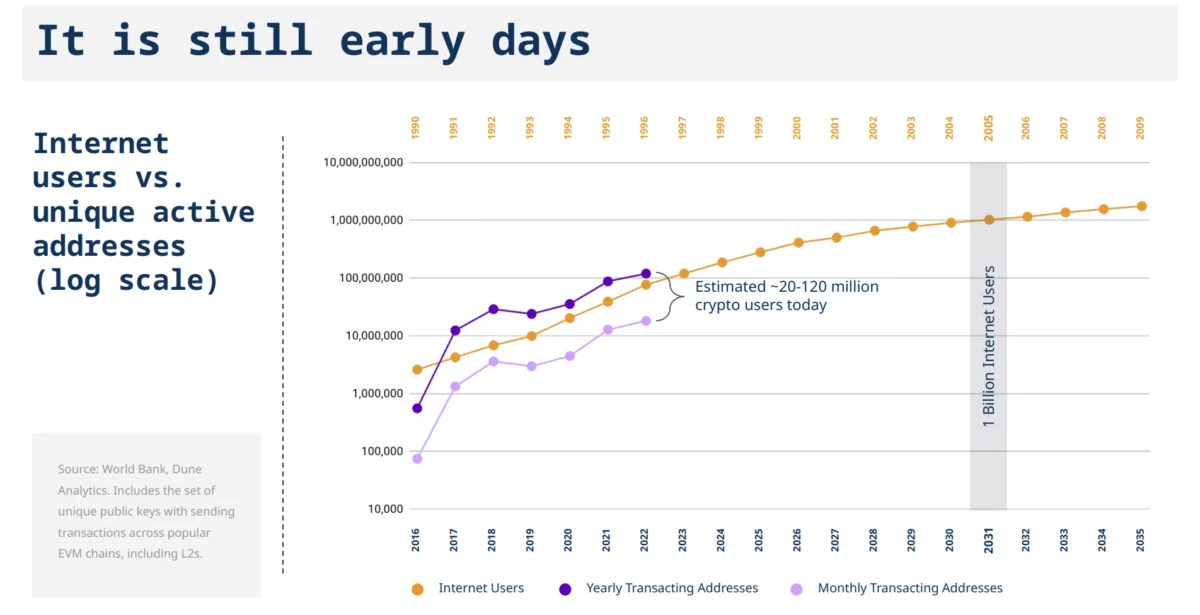
- 1996: Global internet adoption reached a critical inflection point, crossing the threshold to approximately 100 million users as browsers like Netscape (co-founded by Marc Andreessen) popularized the World Wide Web.
The Crypto Timeline
- 2016: a16z uses this year as the baseline for modern crypto adoption, comparing it conceptually to the internet circa 1990. At this stage, blockchain was primarily associated with Bitcoin maximalism and dark-web associations.
- 2021–2022: The explosive rise of play-to-earn (P2E) models—epitomized by games like Axie Infinity—brought speculative mania to Web3 gaming. While many early P2E models suffered from unsustainable tokenomics and crashed alongside the broader bear market, they proved that millions of users were willing to engage with blockchain-based games.
- 2023 (Report Release): The industry transitioned away from raw speculation toward sustainable game design. Developers began prioritizing fun gameplay loops over financial incentives, paving the way for institutional backing and higher-quality productions. By the end of 2022, the ecosystem recorded an estimated 20 million monthly transacting crypto addresses and 120 million yearly transacting addresses.
Supporting Data: By the Numbers
The "State of Crypto" report relies heavily on hard data to substantiate its optimistic outlook. By analyzing global consumer spending, transactional throughput, and historical user-growth curves, a16z presents a quantitative case for the future of digital assets.
1. Massive In-Game Consumer Spending
The global gaming industry is a financial juggernaut, vastly outstripping the movie and music industries combined. According to a16z’s data, consumers spent an estimated $67.9 billion on digital in-game purchases in 2022 alone.
- Historically, this multi-billion-dollar economy has been entirely extractive. When a player purchases a skin in traditional games like Fortnite or Counter-Strike, that digital asset is locked inside a walled garden. The player cannot sell it on an open market, transfer it to another game, or truly own it.
- Web3 gaming introduces true digital ownership via non-fungible tokens (NFTs) and smart contracts, allowing players to recapture value from the billions they already spend annually on virtual goods.
2. Transactional Volume: Gaming vs. DeFi
For years, Decentralized Finance (DeFi)—including automated market makers, lending protocols, and yield farms—was considered the undisputed engine of blockchain activity. However, the a16z report highlights a massive shift in user behavior:
- Web3 games are now driving 23x more transactions on-chain than DeFi protocols.
- This metric underscores that while DeFi attracts capital, gaming attracts frequency. Players execute micro-transactions constantly—trading items, leveling up characters, and recording achievements—creating a high-velocity transactional environment ideal for scalable layer-1 and layer-2 blockchains.
3. User Adoption Curve: Crypto vs. Early Internet
When comparing active user addresses to historical internet adoption, the numbers reveal that crypto is growing at a comparable—if not accelerated—pace relative to infrastructural development:
- In 1996, the internet boasted roughly 100 million users globally.
- By 2022, the crypto ecosystem registered roughly 120 million yearly transacting addresses, proving that blockchain technology has achieved a baseline level of global penetration roughly equivalent to the mid-90s web.
Official Responses and Industry Reactions
The release of the a16z "State of Crypto" report sent ripples across the venture capital, gaming, and blockchain sectors, drawing commentary from prominent founders, developers, and economic analysts.
Industry veterans have largely praised a16z’s focus on gaming as a pragmatic pivot away from hyper-financialized crypto products. For years, the narrative surrounding cryptocurrency was dominated by complex financial instruments that alienated mainstream consumers. By framing gaming as the "Trojan horse" for Web3, venture capitalists are signaling a shift toward user experience (UX) and consumer-facing utility.
Game developers, however, remain cautiously optimistic. Traditional gaming communities have historically pushed back against blockchain integration, often citing concerns over scams, environmental impacts, and predatory monetization models. In response to the report, several independent game studios emphasized that Web3 mechanics must remain strictly optional and invisible to the end-user.
"Gamers do not want to feel like they are working, nor do they want to feel like they are trading stocks while playing a fantasy role-playing game," noted one independent game director commenting on the report. "If blockchain technology is used correctly, players won’t even know the word ‘crypto’ is involved; they will simply appreciate that they truly own their digital inventory."
Implications: What Web3 Gaming Means for the Future of Tech
The convergence of gaming and cryptocurrency carries profound implications for the future of the digital economy, software development, and user sovereignty.
1. Redefining Digital Property Rights
If a16z’s thesis plays out, the concept of digital ownership will fundamentally change. Just as physical goods come with receipts and titles that allow resale and transfer, future digital assets will no longer be locked to a single corporate ecosystem. A sword earned in one game could theoretically be traded, sold, or even imported into an entirely different virtual world built by a different developer.
2. Scalability and Infrastructure Demands
The revelation that Web3 games generate 23 times more on-chain transactions than DeFi places immense pressure on blockchain infrastructure. Legacy networks with high gas fees and slow confirmation times are entirely unsuited for gaming. Consequently, this trend will likely accelerate investment into:
- High-throughput Layer-1 blockchains (e.g., Solana, Aptos, Sui).
- Gaming-specific Layer-2 scaling solutions and application-specific rollups.
- Account abstraction technology, which removes the need for seed phrases and allows seamless logins via traditional email or social media accounts.
3. Regulatory Scrutiny and Consumer Protection
As gaming and crypto intertwine, regulatory bodies worldwide will inevitably cast a sharper eye on in-game economies. The ability to buy, sell, and trade tokenized assets that hold real-world monetary value blurs the line between video games and regulated financial markets. Developers will need to navigate complex compliance landscapes regarding anti-money laundering (AML), know-your-customer (KYC) protocols, and age restrictions, particularly in jurisdictions like the United States and the European Union.
Conclusion
Andreessen Horowitz’s report paints a vivid picture of an industry transitioning from speculative adolescence to consumer-facing maturity. By identifying Web3 gaming as the primary catalyst for mass adoption, a16z is betting that the next hundred million crypto users will not arrive via a desire to trade tokens or yield-farm, but through the universal human love of play. If the gaming industry can successfully harness blockchain technology without sacrificing entertainment value, the 1990s internet parallel may soon look conservative compared to the digital revolution unfolding today.