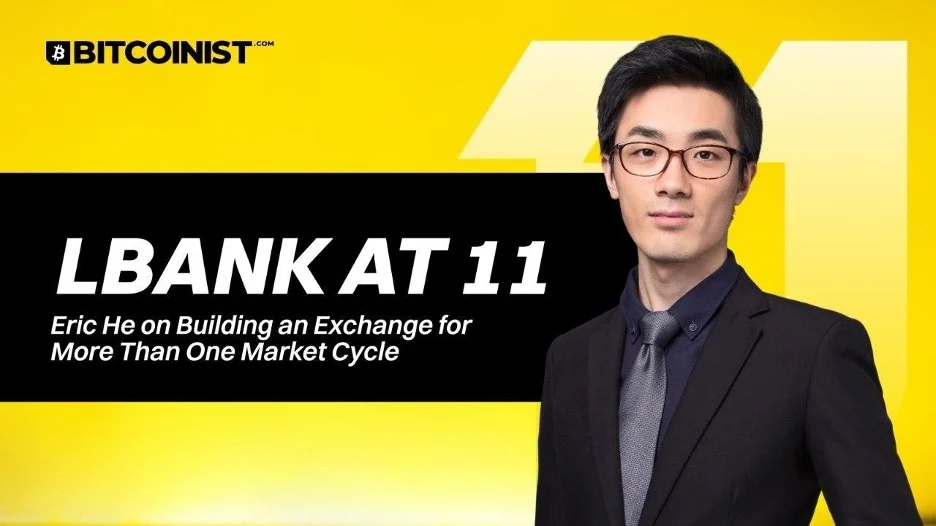
LBank at 11: Eric He on Building an Exchange for More Than One Market Cycle | Bitcoinist.com
Navigating the volatile landscape of the digital asset industry for over a decade is a rare feat. In the fast-paced world of cryptocurrency, eleven years represents far more than a simple milestone; it is a historical arc that encompasses multiple boom-and-bust cycles, evolving asset narratives, high-profile exchange failures, and the ongoing convergence between traditional finance (TradFi) and onchain markets.
To mark this 11-year anniversary, global cryptocurrency exchange LBank has released significant operational data, reporting over 30 million registered users and a staggering $23.81 billion in daily trading volume. In an exclusive, wide-ranging interview with Bitcoinist, Eric He, LBank’s Community Angel & Risk Management Advisor, looked past the superficial hype of short-term token trends to address a more fundamental question: How can a modern digital asset exchange successfully balance speed, global access, robust security, and durable trust as the financial markets become increasingly complex?
Main Facts: LBank’s 11-Year Milestone and Scale
The cryptocurrency exchange sector has undergone a profound structural transformation over the past decade. Platforms that once focused exclusively on niche, crypto-native altcoins are now operating as global multi-asset gateways. LBank’s recent disclosures underscore this shift, illustrating a platform that has scaled dramatically across both centralized crypto markets and traditional financial bridges.
- User Base and Volume: LBank officially surpassed 30 million registered users globally, backed by a massive $23.81 billion in daily trading volume.
- TradFi and Equity Integration: Demonstrating the growing overlap between traditional equities and digital assets, LBank reported a monthly TradFi trading volume of $3 billion. Furthermore, the platform captured a stock market share peaking at 27.32%, with U.S. stock spot market share registering at a remarkable 340% premium compared to the top-ten industry average.
- Product Adoption: Specialized ecosystem products have driven massive engagement. Copy trading capital has scaled to $15 billion, LBank Cash has processed over 10 million transactions, and the BK Genie wealth-management tool has served more than 1.5 million active traders.
- Ecosystem Rewards: To foster community engagement and reward long-term users, LBank has allocated $70 million in total rewards—including $15 million in cumulative Earn subscriptions and $55 million distributed through Token Splash campaigns and airdrops. Notably, sixteen listed assets on the platform have historically delivered returns exceeding 100x.
Chronology: The Evolution of Exchange Infrastructure
The Early Years: Access and Availability
When LBank was founded eleven years ago, the existential questions facing crypto exchanges were relatively rudimentary. Users primarily asked whether a specific asset was available for purchase and if the platform could execute a trade reliably. The digital asset ecosystem operated largely in isolation from traditional banking and global equity markets, driven by retail speculation and nascent technological experiments.
The Era of Volatility and Resilience
As the market matured, it was repeatedly tested by systemic shocks, regulatory shifts, and technological disruptions. According to Eric He, favorable market conditions allow any platform to claim growth, but true operational resilience is only proven when volatility spikes and consumer confidence wavers. Over the past decade, LBank shifted its development philosophy away from static milestones toward continuous infrastructure upgrades. The exchange evolved from a simple crypto gateway into a sophisticated multi-asset trading engine designed to withstand severe market stress.
The Convergence Phase (Present Day)
Today, the boundaries between decentralized finance (DeFi), centralized exchanges (CEX), and Wall Street are rapidly dissolving. The listing of tokenized U.S. equities, the integration of artificial intelligence (AI) narratives, and the rise of culturally fluent Web3 intellectual property (IP) partnerships mark a new chapter for exchanges. LBank’s 11th anniversary—celebrated under the banner "Come As You Are"—symbolizes this modern phase: a balancing act of preserving individual trader diversity while enforcing institutional-grade security and transparent risk controls.
Supporting Data: Liquidity Depth and Market Metrics
In a competitive exchange ecosystem where dozens of platforms vie for market share, raw volume figures can sometimes obscure underlying liquidity quality. LBank has emphasized verifiable order-book depth and cross-market metrics as the true test of execution capabilities, particularly within the burgeoning sector of tokenized U.S. equities.
Market Depth in Tokenized Equities
Tokenized U.S. equities have emerged as a primary battleground for digital asset exchanges. However, LBank argues that mere technical listing is insufficient without deep, actionable liquidity. Independent market reports highlight LBank’s dominance in this sector:
- HOOD-Related Pairs: LBank’s HOODON order-book depth was recorded at 4.42 times that of Gate.io.
- HOODX Pairs: Depth reached 2.23 times the liquidity offered by Gate.io.
- HOODB Pairs: LBank maintained a liquidity depth 22.8% higher than global industry giant Binance.
These metrics validate the platform’s monthly TradFi trading volume of $3 billion, proving that institutional and retail participants are utilizing the platform for genuine around-the-clock, cross-market execution rather than speculative novelty.
Ecosystem Milestones
- $15 Billion in total capital managed through copy trading features.
- 10 Million+ transactions securely processed via LBank Cash.
- 1.5 Million+ traders serviced through BK Genie.
- $70 Million deployed in cumulative user rewards and incentives.
Official Responses: Insights from Eric He
In his exclusive interview with Bitcoinist, Eric He provided deep philosophical and strategic insights into how LBank approaches risk management, technological integration, and user education.
On Core Principles and Volatility
Reflecting on the exchange’s eleven-year journey, He dismissed the notion that growth numbers alone define a platform’s success. Invoking the maritime metaphor that "a ship is safest in port, but that is not what ships are built for," He emphasized that true capability is measured during market downturns.
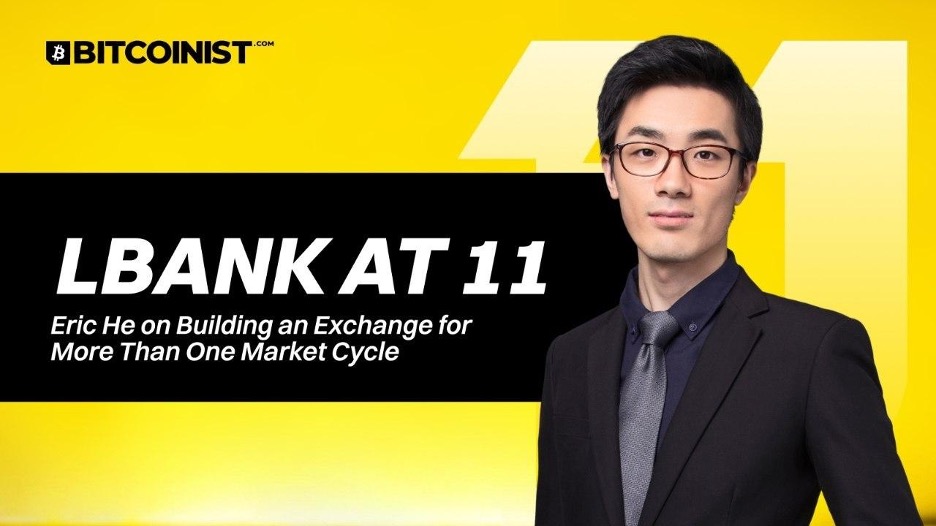
"The real test comes when volatility rises and confidence is fragile: can the platform keep operating reliably, and can it keep risk management ahead of volume?" He noted. "The number that matters most is not our 30 million registered users, but whether they choose to stay with LBank through the next market cycle."
On Tokenized Equities and TradFi Integration
Addressing the shift toward tokenized real-world assets (RWAs), He stressed that LBank views tokenized equities not merely as shelf-fillers, but as vital bridges connecting traditional finance with crypto-native liquidity. Through ongoing collaborations with protocols like Ondo Finance, xStocks, and bStocks, LBank aims to provide around-the-clock market access.
"It is not enough for an asset to be technically tradable," He explained. "Users need to execute trades in a market with deeper, more actionable liquidity. Tokenized equities should connect with crypto-native liquidity, trading tools, and education—not sit in an isolated tab."
On Cultural IP and "Youth-Oriented" Strategy
LBank has drawn considerable industry attention for its youth-oriented branding and high-profile intellectual property partnerships, most notably with Pudgy Penguins. He clarified that this strategy goes far beyond superficial marketing or leveraging fear-of-missing-out (FOMO):
"Being youth-oriented is not about using brighter colors… It is about understanding how a new generation discovers assets, forms identity, participates in communities, and makes sense of complex financial ideas. A cultural asset like Pudgy Penguins helps make something abstract—liquidity—more tangible."
On Artificial Intelligence and Cross-Market Convergence
As companies like OpenAI and Anthropic loom on the horizon of public equity markets, AI is rapidly becoming a structural force across both traditional and digital asset economies. He outlined LBank’s dual-track approach to artificial intelligence: monitoring external asset demand driven by AI technology cycles, while internally deploying AI-driven surveillance tools to detect unusual fund flows, account anomalies, and phishing attempts.
"AI can make information more available, but it cannot make investment decisions for users," He cautioned. "The system worth building is not an ‘AI trader’ that bets for users, but one that helps them see more clearly, trade with more discipline, and protect their assets more effectively."
On Security and the Crypto Resilience Initiative
Addressing historical industry failures surrounding asset security, He stated unequivocally that security cannot rely on blind trust. LBank recently launched the Crypto Resilience Initiative, partnering with prominent blockchain security firms such as CertiK and SlowMist.
"We do not promise ‘absolute security,’" He admitted candidly. "We are building defenses that can keep evolving and can be tested under pressure. Security is a system, not a single team’s task."
Implications: The Four Coordinates of LBank’s Future
Looking toward the next decade, LBank has established four foundational coordinates to guide its strategic expansion: Globalization, Security, User-Centricity, and the Super-Ecosystem.
- Globalization Beyond Borders: True globalization means ensuring that a user in a metropolitan financial center enjoys the exact same baseline of liquidity and operational trust as a user in a developing regional market.
- Institutional-Grade Security: Prioritizing proactive risk management and continuous threat intelligence over reactive post-incident damage control.
- Simplifying Complexity: Hiding backend technical complexity behind intuitive user interfaces while maximizing transparent risk disclosures.
- The Super-Ecosystem: Unifying the institutional asset flows of traditional finance, the raw capital energy of cryptocurrency, and the cultural resonance of Web3 intellectual property into a cohesive, mutually reinforcing environment.
As the cryptocurrency market continues to mature through regulatory scrutiny, technological innovation, and shifting macroeconomic tides, exchanges like LBank are redefining what it means to be a global financial institution. By prioritizing structural liquidity, robust security frameworks, and disciplined trader education, the platform aims to prove that its second decade will be defined not just by longevity, but by enduring utility and user trust.