Raoul Pal Predicts Crypto Market Cap to Explode to $300 Trillion in a Decade, Outpacing the Internet and Oil
Global Financial Markets — In a wide-ranging interview during a Google Tech Talks session, macroeconomics expert and former Goldman Sachs executive Raoul Pal delivered an ultra-bullish forecast for the digital asset ecosystem. According to Pal, the cryptocurrency and Web3 sectors are on the cusp of an unprecedented financial expansion, projecting that the current roughly $1 trillion market cap could skyrocket to an astounding $300 trillion within the next decade.
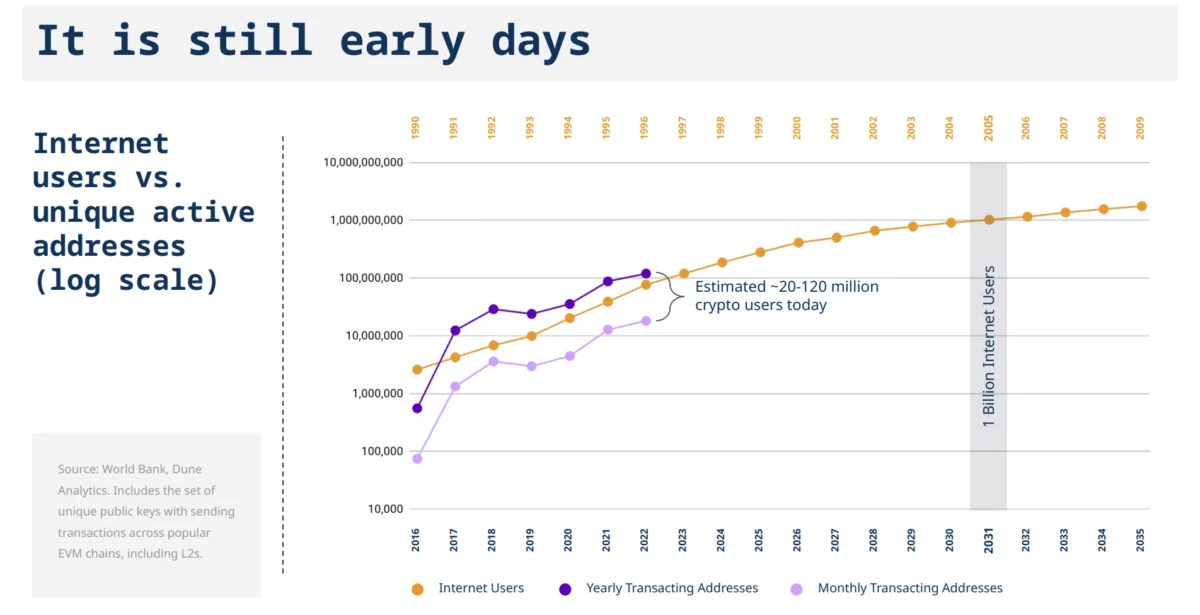
Pal, a well-known financial strategist and the founder of Global Macro Investor and Real Vision, argued that the pace of adoption, underlying technology, and systemic value-accrual mechanics of blockchain protocols make this valuation explosion not only possible, but historically inevitable. He compared the current phase of Web3 to the early days of the commercial internet, asserting that the digital asset revolution is unfolding at a much faster pace and on a significantly larger scale.
Main Facts
The core thesis of Pal’s presentation centers on structural value accrual, institutional adoption, and macroeconomic catalysts. Key highlights from his Google Tech Talks appearance include:
- Massive Valuation Target: Pal forecasts that the digital asset market capitalization will surge from its current neighborhood of $1 trillion to between $200 trillion and $300 trillion over the next 10 to 15 years.
- Institutional and Web2 Infiltration: Major traditional financial institutions and Web2 giants are already deeply involved in the crypto space behind closed doors, though many are moving cautiously due to lingering regulatory uncertainties.
- Unprecedented Scale: Pal emphasizes that the wealth generation and market penetration of crypto will ultimately eclipse traditional mega-industries, including the global oil market and the initial rollout of the internet.
- Venture Capital Deployment: The past 18 months have seen approximately $60 billion in venture capital flow into the crypto and Web3 ecosystem. Pal expects this capital to yield a wave of product rollouts and innovations over the coming 6 to 12 months.
Chronology: From Niche Asset Class to Global Financial Layer
To understand Pal’s aggressive timeline, it is helpful to contextualize the historical trajectory of the cryptocurrency market and how it has matured into an institutional-grade asset class:
- 2009–2017 (The Genesis and Retail Era): Bitcoin’s launch in 2009 introduced decentralized digital currency, followed by the birth of alternative cryptocurrencies and the 2017 Initial Coin Offering (ICO) boom. During this period, the market was heavily driven by retail speculators, with little to no institutional participation.
- 2020–2021 (The Institutional Awakening and DeFi Summer): Amid global macroeconomic stimulus during the COVID-19 pandemic, institutional investors, corporate treasuries (such as MicroStrategy and Tesla), and major asset managers began allocating capital to Bitcoin and Ethereum. Decentralized Finance (DeFi) and Non-Fungible Tokens (NFTs) brought mainstream attention to broader Web3 capabilities.
- 2021–2022 (The Venture Capital Surge): Despite looming macroeconomic headwinds and rising inflation, venture capital firms poured an estimated $60 billion into crypto-native startups and infrastructure projects over an 18-month span, building the foundation for future scalability.
- Present Day (The Regulatory Standoff and Quiet Accumulation): The market operates under a cloud of regulatory scrutiny—particularly in the United States—which has caused legacy financial institutions to proceed with extreme caution. However, according to Pal, this institutional participation is happening beneath the surface, preparing for a massive unveiling once regulatory clarity is achieved.
- The 10-Year Horizon (2024–2035): Pal predicts that as macroeconomic conditions stabilize, regulatory frameworks mature, and VC-backed products hit the market, the sector will enter a hyper-growth phase matching the valuation scale of traditional asset classes.
Supporting Data and Market Analysis
Pal’s projection of a $300 trillion market cap often startles traditional financial analysts, but he grounds his argument in comparative economics. Traditional asset markets—including global equities, real estate, sovereign debt, and derivatives—are individually valued in the hundreds of trillions of dollars.
The Mechanics of Protocol Value Accrual
Unlike traditional tech companies or internet protocols where value primarily accrues to equity holders at the application layer, blockchain protocols possess native tokenomics that allow value to accrue directly at the base layer. This unique economic model captures network value dynamically, which Pal believes will compress the timeline required to reach multi-trillion-dollar valuations.
The $60 Billion VC Catalyst
In the interview, Pal highlighted the massive influx of venture capital over the prior 18 market cycles. Because crypto operates on accelerated development cycles compared to traditional corporate environments, the roughly $60 billion injected by venture capitalists between 2021 and 2022 is expected to materialize into market-ready applications, layer-2 scaling solutions, and enterprise integrations. These innovations are projected to continually push the technology adoption curve forward exponentially.
Official Responses and Industry Reception
While Raoul Pal’s remarks were made during a private-sector tech talk, they reflect a broader sentiment growing among macro strategists, fintech executives, and crypto proponents.
- The TradFi Dilemma: Financial institutions find themselves caught between fear of missing out (FOMO) on the fastest-growing asset class in history and fear of regulatory reprisal. Major asset managers, such as BlackRock and Fidelity, have increasingly signaled long-term commitment through spot Bitcoin and Ethereum exchange-traded funds (ETFs), validating Pal’s assertion that traditional finance is laying down tracks behind the scenes.
- Regulatory Pushback: Critics and regulatory bodies, including the U.S. Securities and Exchange Commission (SEC), maintain that the digital asset space remains plagued by volatility, fraud, and non-compliance. Regulatory agencies argue that robust oversight is necessary before institutional capital can safely enter the space at scale—a hurdle that temporarily slows the velocity of Pal’s timeline but does not invalidate the underlying trajectory.
Implications for Investors and the Global Economy
If Pal’s macroeconomic forecast proves accurate, the transition of $300 trillion into decentralized protocols and digital assets will fundamentally reshape the global financial architecture.
- Redefining Wealth Generation: The speed and scale of value creation will likely surpass any previous industrial revolution. Investors positioned in foundational layer-1 and layer-2 protocols could see exponential portfolio growth.
- Mainstream Integration: Web3 technologies will transition from speculative financial instruments to the invisible backend infrastructure of global commerce, identity verification, and data management.
- Macroeconomic Shift: As sovereign fiat currencies face ongoing inflationary pressures and mounting national debts, decentralized, scarce digital assets like Bitcoin may increasingly serve as the ultimate global reserve and safe-haven assets.
Ultimately, Pal’s forecast serves as a reminder that despite short-term market cycles, regulatory friction, and macroeconomic volatility, the long-term structural thesis for blockchain technology and Web3 remains robust, pointing toward a future where digital assets are deeply integrated into the fabric of the global economy.