Andreessen Horowitz Defies Market Stagnation with Mammoth $4.5 Billion Crypto Fund, Signaling a New ‘Golden Era’ for Web3
SILICON VALLEY — Amid a sprawling crypto winter characterized by plunging asset valuations, widespread market uncertainty, and macroeconomic headwinds, venture capital titan Andreessen Horowitz (a16z) has made a definitive statement of confidence. The Silicon Valley-based investment powerhouse has officially launched a colossal $4.5 billion digital asset fund, its fourth and largest crypto-focused vehicle to date.
While retail investors and jittery market participants pull back capital in response to widespread stagnation, a16z is doubling down on the long-term thesis of decentralized technologies. According to the firm’s leadership, the historic capital injection is designed to capitalize on what they describe as the dawn of the "golden era" of Web3 development—a structural market shift that looks past short-term price volatility to fund the foundational architecture of the next-generation internet.
Main Facts: A Landmark Capital Allocation in a Bear Market
The scale of the fund underscores a monumental vote of confidence in the blockchain sector. Of the $4.5 billion total capital commitment, a16z has earmarked $1.5 billion specifically for seed investments, while the remaining $3.0 billion will be channeled into venture-stage growth opportunities.
This latest vehicle pushes Andreessen Horowitz’s cumulative crypto-focused capital raised to over $7.6 billion across four funds. It follows the firm’s previous $2.2 billion crypto fund launched in June 2021, cementing a16z’s status as the single largest dedicated venture capital investor in the digital asset ecosystem.
Rather than contracting operations during a downturn, a16z plans to deploy the capital aggressively across a diverse array of web3 sub-sectors, including:
- Decentralized Finance (DeFi) protocols aiming to rebuild traditional financial infrastructure.
- Next-generation metaverse gaming and immersive digital worlds.
- Non-Fungible Token (NFT) communities and creator-economy platforms.
- Decentralized Autonomous Organizations (DAOs) and novel governance models.
- Layer-2 scaling solutions and Zero-Knowledge (ZK) cryptography, which promise to solve Ethereum’s scalability and privacy bottlenecks.
Chronology: The Evolution of Computing and a16z’s Crypto Bet
To understand the strategic timing of this $4.5 billion fund, industry analysts look to the historical framework outlined by a16z General Partner Chris Dixon. The firm views blockchain technology not merely as a speculative asset class, but as the logical successor in a multi-decade progression of technological revolutions.
- The 1980s: The Personal Computer (PC) revolution democratizes computing power.
- The 1990s: The advent of the commercial Internet connects global information systems.
- The 2000s: Mobile computing puts powerful computers in billions of pockets, birthing the app economy.
- The 2010s: The birth and maturation of programmable blockchains, spearheaded by Bitcoin’s resilience and Ethereum’s smart contract capabilities.
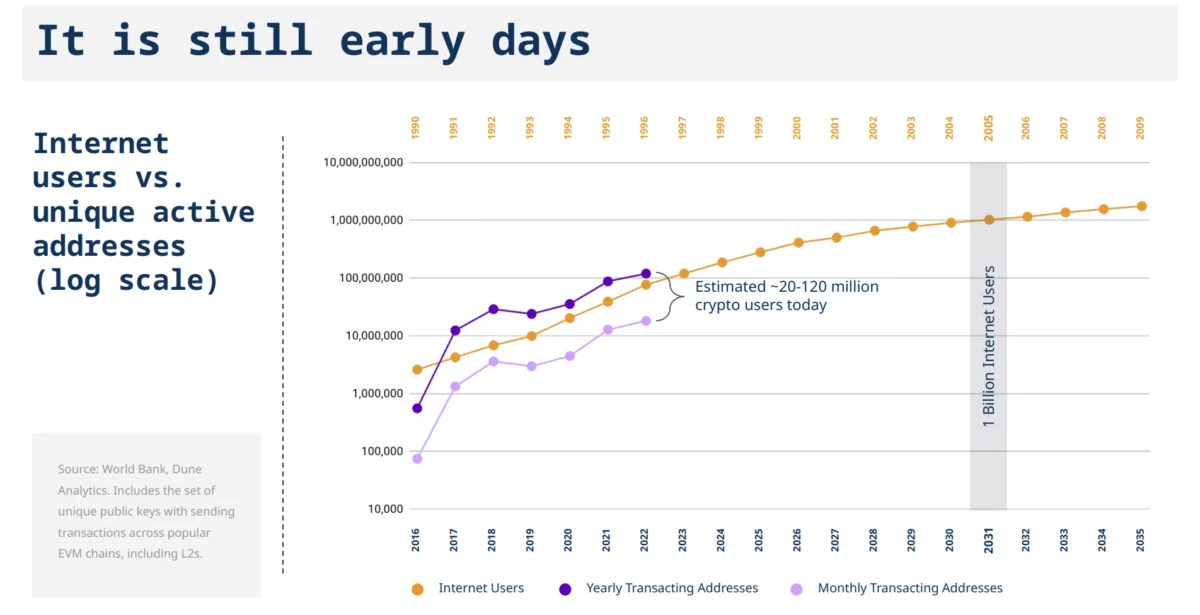
- The Present Era: A transition toward Web3, characterized by programmable blockchains reaching critical infrastructure mass and onboarding tens of millions of active users.
Over the past twelve months, a16z observed an unprecedented migration of world-class engineering, cryptography, and product talent from traditional tech giants—such as Google, Meta, and Apple—into the decentralized sector. This massive influx of human capital served as the primary catalyst for finalizing the mammoth fund during an otherwise bleak macroeconomic climate.
Supporting Data: Why Bear Markets Breed Innovation
Market downturns in the cryptocurrency sector have historically been viewed by institutional insiders as cleansing mechanisms. While speculative capital flees to safety, developmental progress accelerates away from the glare of public price tickers.
Historically, some of the most influential companies in the modern tech and crypto landscape were forged or heavily built out during severe market contractions:
- The 2008 Financial Crisis: Spawned Bitcoin, laying the groundwork for decentralized, trustless digital money.
- The 2014–2015 Crypto Winter: Saw the foundational development of Ethereum’s smart contract platform, foundational DeFi primitives, and early layer-1 alternatives.
- The 2018–2019 Bear Market: Incubated the infrastructure for automated market makers (AMMs), decentralized exchanges like Uniswap, and the initial wave of scalable layer-2 networks.
By deploying $4.5 billion during the current market correction, a16z aims to repeat this historical pattern, positioning itself as the primary financial backer for the builders who will define the next decade of internet architecture.
Official Responses and Executive Insights
The launch of Fund IV has sparked widespread discussion across the global tech and financial sectors. Leadership at Andreessen Horowitz has been vocal about the strategic necessity of investing through the trough of the market cycle.
In a comprehensive blog post detailing the fund’s launch, Chris Dixon articulated the firm’s vision for the decentralization movement:
"Since the advent of computing in the 1940s, there has been a major computing cycle every 10-15 years… We believe blockchains will power the next major computing cycle, which we call crypto or Web3… Programmable blockchains are sufficiently advanced, and a diverse range of apps have reached tens of millions of users. More importantly, a massive wave of world-class talent has entered Web3 over the last year."
Expanding on these sentiments in a high-profile interview with CNBC, a16z General Partner Arianna Simpson emphasized that bearish market conditions offer a distinct competitive advantage for disciplined venture capitalists:
"Bear markets are often when the best opportunities come about when people are actually able to focus on building technology rather than getting distracted by short-term price activity."
Simpson noted that when asset prices are surging, founders are often distracted by speculative market hype, token price fluctuations, and transient community noise. Conversely, a quiet market forces entrepreneurial teams to hone their product-market fit, fortify code security, and solve engineering challenges that matter over a 10-to-20-year horizon.
Implications: What a $4.5 Billion War Chest Means for the Future of Web3
The injection of $4.5 billion into the digital asset ecosystem carries profound implications for founders, competing venture firms, and the broader regulatory landscape.
1. Sustained R&D in Zero-Knowledge (ZK) Technology
A significant portion of the capital is expected to target zero-knowledge proofs—a cryptographic method that allows one party to prove to another that a statement is true without conveying any information apart from the statement’s validity. ZK-rollups are widely regarded as the holy grail for scaling blockchains like Ethereum, enabling high transaction throughput while maintaining robust decentralization and privacy. With a16z’s backing, ZK research teams can accelerate commercialization significantly.
2. Shifting Power Dynamics in Venture Capital
By amassing nearly $8 billion exclusively for crypto investments, a16z solidifies its role as a market maker that can dictate industry standards, influence protocol governance, and fund capital-intensive infrastructure projects that smaller angel investors or traditional VC firms cannot touch. This positions a16z not just as a financial investor, but as an active ecosystem architect.
3. Regulatory Navigation and Compliance
A fund of this magnitude requires institutional-grade oversight, putting a16z in constant dialogue with regulators globally. By funding projects that focus on enterprise utility, decentralized identity, and compliant DeFi frameworks, the firm is signaling to policymakers that Web3 is maturing past its Wild West phase into a structured, highly regulated financial technology frontier.
Conclusion
Andreessen Horowitz’s $4.5 billion commitment is more than just a financial transaction; it is a calculated bet on the inevitability of decentralized networks. While macroeconomic headwinds and market cycles will continue to fluctuate in the short term, a16z’s massive war chest ensures that the pipeline for Web3 innovation, infrastructure development, and talent retention will remain robust for years to come.