Andreessen Horowitz’s ‘State of Crypto’ Report Identifies Web3 Gaming as the Catalyst for Mainstream Digital Asset Adoption
SAN FRANCISCO — In the ever-evolving landscape of financial technology and blockchain innovation, venture capital titan Andreessen Horowitz (a16z) has positioned its bets on an unlikely yet powerful catalyst to drive the next massive wave of mainstream crypto adoption: Web3 gaming.
According to the firm’s comprehensive "State of Crypto" report released by its dedicated crypto arm, a16zcrypto, the intersection of interactive entertainment and decentralized ledger technology represents a monumental opportunity. While traditional finance (TradFi) and decentralized finance (DeFi) continue to battle regulatory headwinds and market volatility, the gaming sector is quietly building the infrastructure required to onboard hundreds of millions of everyday users into the digital asset ecosystem.
The report offers a deep dive into the current metrics of blockchain technology, drawing intriguing parallels between the modern crypto landscape and the embryonic days of the internet during the 1990s. As industry leaders search for sustainable models of utility beyond speculative trading, Web3 gaming has emerged as a frontrunner capable of bridging the gap between complex blockchain mechanics and consumer-friendly entertainment.
Main Facts: The Web3 Gaming Paradigm Shift
At its core, the a16zcrypto report underscores a fundamental shift in how blockchain technology is being consumed. For years, the public narrative surrounding digital assets has been dominated by volatile token prices, speculative trading, and complex financial instruments. However, a16z argues that blockchain’s true potential lies in its ability to provide backend infrastructure for consumer-facing industries—chief among them being gaming.
Key takeaways from the report include:
- Massive Market Potential: Web3 games are identified as the single largest opportunity to introduce mainstream consumers to crypto wallets, tokens, and on-chain transactions organically.
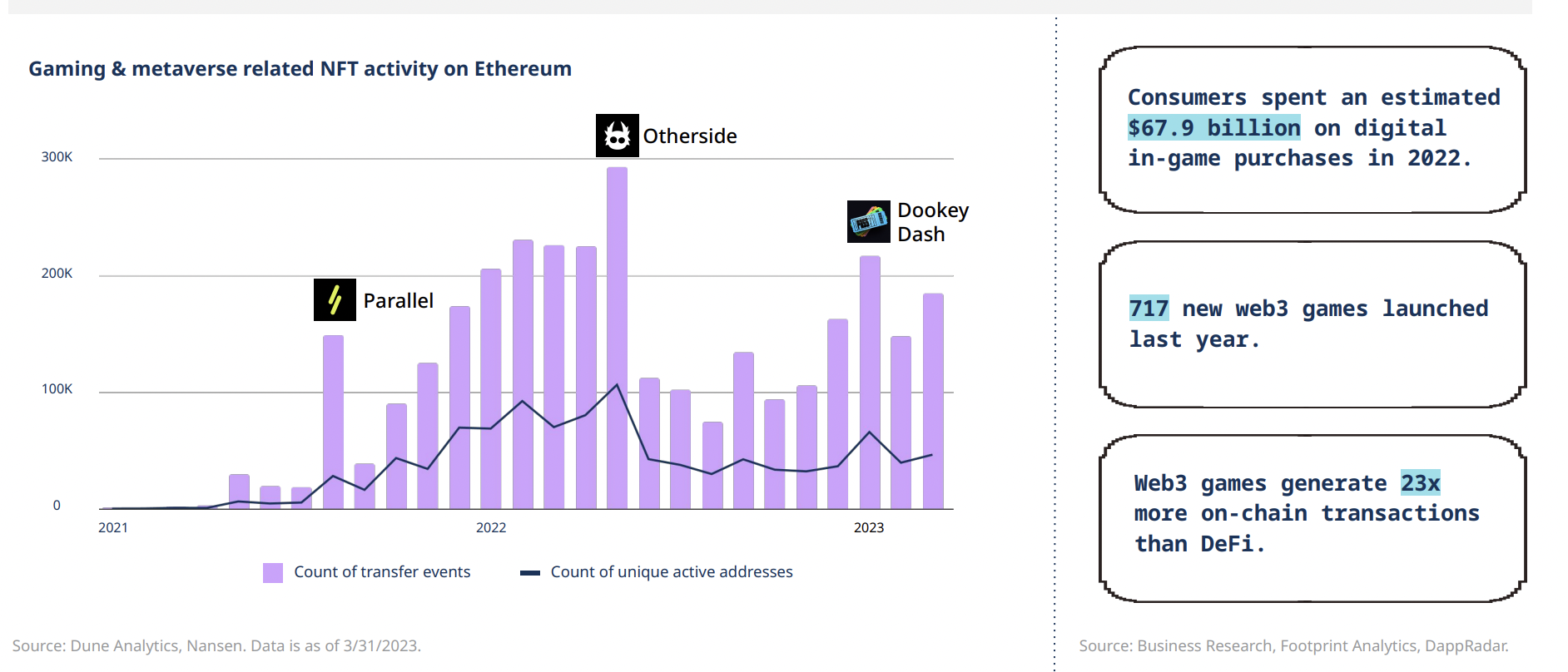
- Economic Scale: Consumers spent an estimated $67.9 billion on digital in-game purchases globally in 2022 alone, proving that gamers are already accustomed to spending real capital on virtual goods.
- Surging Development: The last year has witnessed the launch of 717 new Web3-focused games, demonstrating robust developer confidence and continued venture capital deployment despite broader macroeconomic downturns.
- High Engagement: Web3 gaming ecosystems are currently generating 23 times more on-chain transactions than traditional decentralized finance (DeFi) protocols, highlighting a vastly more active user base.
Rather than forcing users to learn the intricacies of public-private key cryptography and gas fees upfront, Web3 gaming wraps these elements in engaging gameplay, player-owned economies, and tangible digital property rights. Players can earn, trade, and utilize in-game assets—such as skins, land, and weapons—as non-fungible tokens (NFTs) or tokens, transforming entertainment into a potentially productive economic activity.
Chronology: From Niche Experiments to Institutional Focus
To understand how Web3 gaming reached this pivotal juncture, it is essential to trace the chronology of blockchain adoption and how venture capital perception has matured over the past decade.
1. The Genesis of Blockchain and Speculation (2009–2016)
In the years following the launch of Bitcoin in 2009 and the advent of Ethereum in 2015, the cryptocurrency space was primarily defined by peer-to-peer electronic cash systems and experimental smart contracts. During this era, blockchain was viewed through a strictly financial lens. User interfaces were notoriously difficult to navigate, and applications were limited to basic value transfers and early decentralized applications (dApps).
2. The DeFi Summer and NFT Boom (2020–2021)
The crypto industry experienced its first major cultural breakout with the "DeFi Summer" of 2020, followed closely by the explosive popularity of NFTs in 2021. For the first time, millions of retail users began interacting directly with blockchains. However, these applications were largely speculative, plagued by high transaction fees (gas wars), and frequently targeted by exploiters. The average internet user still viewed crypto as a risky casino rather than a useful utility.

3. The Pivot to Infrastructure and Gaming (2022–Present)
Recognizing that speculative financial products alone could not sustain long-term growth, developers and venture capitalists began shifting their focus toward infrastructure that could support high-frequency, low-latency consumer applications. Web3 gaming emerged from the drawing boards. Instead of simple "play-to-earn" models—which often suffered from unsustainable tokenomics reminiscent of Ponzi schemes—modern developers began focusing on "play-and-earn" or purely fun games that quietly integrated blockchain rails in the background.
It is within this current phase that a16zcrypto published its "State of Crypto" report, formalizing the institutional thesis that gaming will serve as the Trojan horse for mass blockchain adoption.
Supporting Data: Comparing Crypto to the 1990s Internet Boom
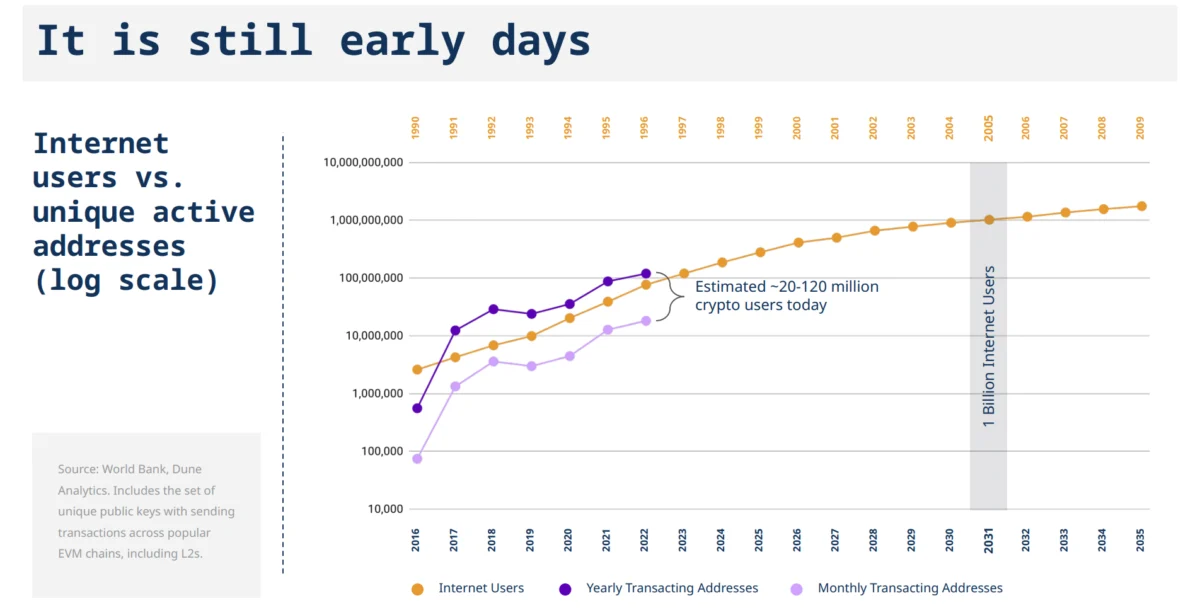
To contextualize where the digital asset industry stands today, the a16zcrypto report utilizes historical data visualization, drawing a direct comparison between the growth curves of the internet in the 1990s and cryptocurrency adoption starting in 2016.
[1990s Internet Adoption] ──► Scaled from early dial-up networks to 100M+ users by 1996.
[Modern Crypto Adoption]  ──► Scaled from 2016 baseline to 120M+ yearly transacting addresses by 2022.
User Metrics and Transaction Volume
According to the report, the crypto industry recorded an estimated 20 million monthly active transacting addresses and 120 million yearly transacting addresses in 2022.
To put these figures into perspective, the report compares them to the adoption rate of the internet. In 1996—roughly six years after the World Wide Web became publicly accessible—there were nearly 100 million internet users globally. The parallels are striking: both technologies started as complex, highly technical tools utilized primarily by hobbyists, cryptographers, and academics before hitting an exponential inflection point driven by consumer-friendly applications.
Furthermore, the data regarding on-chain activity reveals a telling narrative about where user attention actually resides. While DeFi protocols command billions of dollars in Total Value Locked (TVL), their daily transaction volume is dwarfed by the sheer frequency of interactions generated by gaming ecosystems. Because games require continuous micro-transactions, inventory updates, and player-to-player trades, they produce 23 times more on-chain transactions than pure financial applications. This high-frequency usage stresses-tests blockchain scaling solutions (Layer 2s, app-chains, and high-throughput blockchains), ultimately benefiting the entire Web3 technology stack.
Official Responses and Industry Reactions
The release of the a16zcrypto report has sent ripples through both the traditional gaming community and the broader blockchain sector, eliciting a wide range of reactions from industry leaders, developers, and market analysts.
Venture Capital and Institutional Perspectives
Andreessen Horowitz has consistently proven to be one of the most aggressive institutional backers of Web3 technology, having raised billions of dollars across multiple dedicated crypto funds. Speaking on the release of the report, partners at a16z emphasized that venture capital is shifting away from pure-play token speculations and moving toward studios that prioritize player experience over financial engineering.
"The early days of crypto were about building the foundation of a parallel financial system," notes a16zcrypto in its briefing. "The next era will be about consumer applications. Gamers are the most digitally native demographic on the planet. They already understand digital ownership, virtual currencies, and community-driven economies. Integrating blockchain into gaming is a natural evolution."
The Traditional Gaming Backlash
Despite the enthusiasm from Silicon Valley venture capitalists, the traditional gaming industry has historically pushed back against blockchain integration. Major gaming conglomerates, including Valve (operator of Steam) and various AAA game publishers, have faced severe community backlash when attempting to introduce NFTs or cryptocurrency rewards into their titles.
Gamer sentiment has often categorized Web3 games as predatory, over-financialized cash grabs that prioritize speculation over fun gameplay. In response to these criticisms, modern Web3 game developers have pivoted their messaging. The emphasis is now placed on "invisible crypto"—where blockchain infrastructure operates silently in the background to secure in-game assets and player rights without forcing players to interact with crypto exchanges or manage seed phrases.
Implications: What Web3 Gaming Means for the Future of Tech
The thesis presented by Andreessen Horowitz carries profound implications not only for the cryptocurrency market, but also for the broader technology, entertainment, and regulatory landscapes.
1. For Game Developers and Studios
The influx of venture capital and the validation from firms like a16z signal that Web3 gaming is here to stay, despite market cycles. However, studios face immense pressure to deliver products that can compete with traditional AAA titles. To succeed, developers must realize that gameplay must come first; the blockchain elements must act as an enhancement to the player experience rather than its core selling point. Successful execution could lead to true digital ownership, where players can permanently own their in-game items and port them across different virtual worlds or trade them freely on open marketplaces.
2. For Blockchain Infrastructure and Scalability
The sheer transaction volume demanded by gaming ecosystems will continue to push blockchain developers to their limits. High gas fees and sluggish confirmation times are fatal to a gaming experience. Consequently, the success of Web3 gaming is inextricably linked to the maturation of Layer 2 scaling solutions, zero-knowledge (ZK) rollups, and application-specific blockchains designed to handle millions of daily interactions seamlessly and cost-effectively.
3. For Regulatory Frameworks
As gaming increasingly incorporates financial mechanics—such as tokenized economies, marketplaces, and player earnings—regulators around the globe will take a closer look at the sector. Lawmakers in jurisdictions like the United States, the European Union, and Asia will need to distinguish between speculative financial securities and in-game utility tokens used within closed-loop or decentralized gaming economies. Over-regulation could stifle innovation and drive gaming studios offshore, while sensible regulatory clarity could unlock trillions of dollars in economic activity.
4. For Mainstream Consumer Adoption
Ultimately, Web3 gaming may prove to be the bridge that crosses the chasm from early adopters to the general public. Just as the average internet user in the late 1990s did not need to understand TCP/IP networking protocols to send an email or browse a website, the future consumer of Web3 games will not need to know what a blockchain is to enjoy the benefits of verifiable digital ownership. By embedding decentralized technology into the entertainment products people already love, Andreessen Horowitz believes the stage is set for the next hundred million crypto users to enter the fold.