
Macro Strategist Raoul Pal Predicts Crypto Market Cap Will Skyrocket to $300 Trillion in a Decade
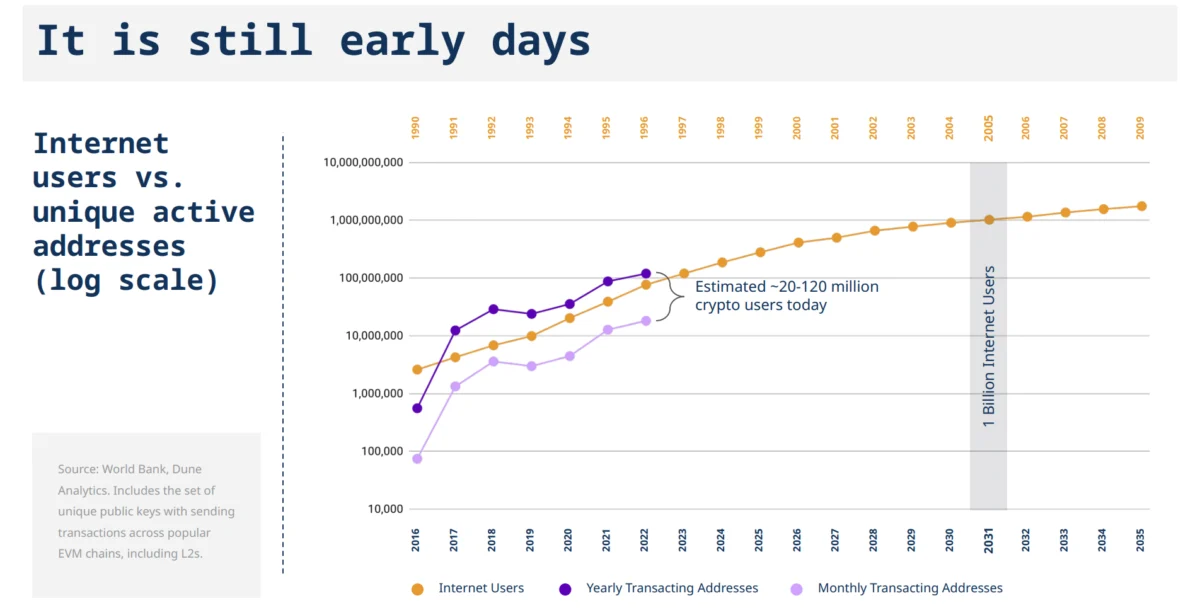
GLOBAL FINANCIAL MARKETS — In a wide-ranging discussion during a recent Google Tech Talks appearance, macroeconomics expert and former Goldman Sachs executive Raoul Pal delivered a staggering long-term forecast for the digital asset economy. According to Pal, the cumulative market capitalization of cryptocurrencies and Web3 projects is poised to explode from its current baseline of roughly $1 trillion to an unprecedented $300 trillion over the next ten to fifteen years.
If realized, this meteoric rise would outpace the historical growth trajectories of both the internet and the global oil industry, positioning decentralized digital networks as one of the largest asset classes in human history. Pal attributes this impending expansion to structural value-accrual mechanisms unique to blockchain protocols, massive institutional venture capital backing, and the inevitable integration of traditional finance (TradFi) and Web2 giants once macroeconomic headwinds abate.
Main Facts: The $300 Trillion Horizon
The core thesis of Pal’s presentation centers on a simple comparative metric: traditional global asset markets—such as equities, real estate, and global debt—each sit within the $200 trillion to $300 trillion valuation range. Because blockchain networks function not merely as communication tools, but as self-contained economic systems capable of capturing and retaining value at the protocol layer, Pal argues that crypto will naturally scale to match or exceed these traditional financial sectors.
- Current Valuation vs. Future Projection: The broader digital asset market currently hovers around the $1 trillion valuation mark following prolonged macroeconomic contraction. Pal forecasts a 300x expansion within a decade to fifteen years.
- The Value-Accrual Mechanism: Unlike the traditional internet (Web2), which largely funneled value upward to a handful of centralized gatekeepers like Google, Meta, and Amazon, Web3 protocols natively accrue value to their foundational layers and token holders.
- Institutional Undercurrents: Major legacy financial institutions and prominent Web2 technology companies are already deeply engaged in the sector. However, their public participation remains cautious due to ongoing regulatory uncertainty.
Chronology: The Evolution of Crypto’s Institutional Adoption
To understand how the market could transition from a $1 trillion valuation to a staggering $300 trillion economy, it is essential to trace the historical timeline of institutional and venture capital involvement over the past several years:
1. The Retail Era and Early Speculation (2009–2017)
For its first decade, the cryptocurrency market was driven primarily by retail investors, cryptography enthusiasts, and early adopters. Bitcoin established a decentralized store of value, while the launch of Ethereum in 2015 introduced smart contracts, laying the groundwork for programmable money and decentralized applications (dApps).
2. The Institutional Awakening and DeFi Summer (2020–2021)
The COVID-19 pandemic triggered unprecedented global monetary stimulus, prompting institutional treasuries, hedge funds, and family offices to seek inflation hedges. During this period, Decentralized Finance (DeFi) and Non-Fungible Tokens (NFTs) captured global attention, proving that blockchain technology could support complex financial instruments outside traditional banking infrastructure.
3. The Venture Capital Influx (2021–2022)
During the peak of the 2021 market cycle, venture capital firms poured an unprecedented $60 billion into crypto and Web3 startups over an 18-month window. This massive liquidity injection laid the groundwork for deep infrastructure development, scaling solutions (Layer 2s), cross-chain interoperability protocols, and enterprise-grade tooling.
4. Macroeconomic Volatility and Regulatory Gridlock (2022–Present)
Surging global inflation forced central banks worldwide, led by the U.S. Federal Reserve, to aggressively hike interest rates. This macroeconomic tightening triggered a severe crypto winter, characterized by high-profile industry bankruptcies and intense regulatory scrutiny, particularly from the U.S. Securities and Exchange Commission (SEC). Despite this surface-level stagnation, foundational building has continued unabated behind closed doors.
Supporting Data: Venture Capital, Infrastructure, and Adoption Metrics
Pal’s bullish outlook is heavily underscored by quantitative metrics regarding capital allocation and product development velocity.
- The $60 Billion VC Catalyst: The tens of billions of dollars injected into crypto startups during the previous cycle have not vanished; rather, they have been deployed to fund research, talent acquisition, and technological innovation. Because crypto development cycles move significantly faster than traditional tech sectors, Pal notes that this capital will yield a wave of consumer-ready products and infrastructure breakthroughs over the next 6 to 12 months.
- Historical Precedents: To put a $300 trillion valuation in perspective, it vastly exceeds the global market capitalization of gold (roughly $13 trillion) and even the peak annual revenues of the global energy sector. Pal asserts that digital assets represent a fundamentally new asset class—financial internet architecture—making direct historical comparisons inadequate.
- The Web2-to-Web3 Pipeline: Virtually every major financial institution—from JPMorgan Chase and Goldman Sachs to BlackRock and Fidelity—has explored tokenization, blockchain settlements, or spot exchange-traded funds (ETFs). Their delayed public deployment is not a rejection of the technology, but a strategic pause awaiting regulatory clarity.
Official Responses and Industry Perspectives
While macro analysts like Raoul Pal focus on liquidity cycles and macroeconomic trends, reactions from regulatory bodies and traditional finance leaders present a complex backdrop to this growth narrative.
- The Regulatory Stance: Regulatory agencies worldwide continue to urge caution. In jurisdictions like the United States, regulators have emphasized investor protection, classifying many digital tokens as unregistered securities. This stance has created friction, forcing some crypto enterprises to expand operations overseas. However, industry advocates argue that comprehensive regulatory frameworks will ultimately provide the legal certainty institutional giants require to deploy capital at scale.
- Wall Street’s Pivot: Traditional financial institutions are increasingly adopting a pragmatic "hate the game, play the player" approach. The launch of spot Bitcoin and Ethereum ETFs in major global markets signals that Wall Street is actively positioning itself to capture fees from digital asset management, bridging the gap between legacy capital and decentralized networks.
- Tech Sector Integration: Silicon Valley veterans and Web2 executives are quietly integrating blockchain primitives—such as decentralized identity, cryptographic verification, and tokenized incentives—into next-generation software architecture, validating Pal’s observation that legacy tech is already inside the ecosystem.
Implications: What a $300 Trillion Crypto Economy Means for the Future
A transition to a multi-hundred-trillion-dollar digital asset market carries profound implications for global economics, sovereign monetary policy, and individual privacy.
1. The Redefinition of Global Wealth Storage
If digital assets absorb capital from traditional real estate, bond, and equity markets, cryptocurrencies will transition from speculative risk-on assets into the foundational plumbing of global wealth storage. Sovereign nations may increasingly adopt decentralized currencies or central bank digital currencies (CBDCs) built on public-private hybrid chains.
2. Accelerated Innovation Cycles
The maturation of the $60 billion in venture capital deployed over recent years will likely usher in mainstream consumer applications that abstract away the technical complexities of wallets, gas fees, and private keys. This user-experience revolution is widely considered the missing link for mass adoption.
3. Macroeconomic Uncoupling
As the utility and network effects of Web3 expand, digital assets may eventually decouple from traditional macroeconomic cycles. While Pal notes that current market movements remain tied to global liquidity and interest rate policies, a mature $300 trillion economy would function as an independent, self-sustaining financial matrix operating 24/7/365 without geographic borders or banking hours.
Disclaimer: The opinions and forecasts discussed in this article are for informational purposes only and do not constitute financial advice. Investors should conduct thorough due diligence before participating in high-risk digital asset markets.