Beyond the Bear Market: Why Crypto Analysts Argue Digital Assets Remain "Inevitable" Despite a Brutal Year
Main Facts: The Resilience of Blockchain Amid Industry Turmoil
Despite a tumultuous and bruising year characterized by high-profile corporate collapses, widespread regulatory scrutiny, and a severe contraction in venture capital funding, prominent cryptocurrency analysts and market strategists maintain an unwavering outlook on the future of digital assets.
The host of the widely followed market analysis channel InvestAnswers, speaking to a subscriber base exceeding 443,000 on YouTube, asserted that the maturation of blockchain technology, decentralized infrastructure, and global adoption trends render the broader adoption of cryptocurrency an economic inevitability. Grounding his perspective in recent analytical literature—specifically the comprehensive Crypto Theses for 2023 report compiled by Ryan Selkis, founder and CEO of crypto intelligence firm Messari—the strategist emphasized that the fundamental utility of decentralized networks continues to expand beneath the noise of market volatility and fraudulent behavior.
While 2022 will be remembered in financial history as an annus horribilis for digital assets, marked by the vaporization of billions of dollars in market capitalization and the unravelling of over-leveraged centralized lending platforms, proponents argue that a clear dichotomy has emerged. On one side lies the speculative frenzy and bad-actor malfeasance that dominated mainstream headlines; on the other lies the quiet, relentless construction of foundational digital infrastructure.
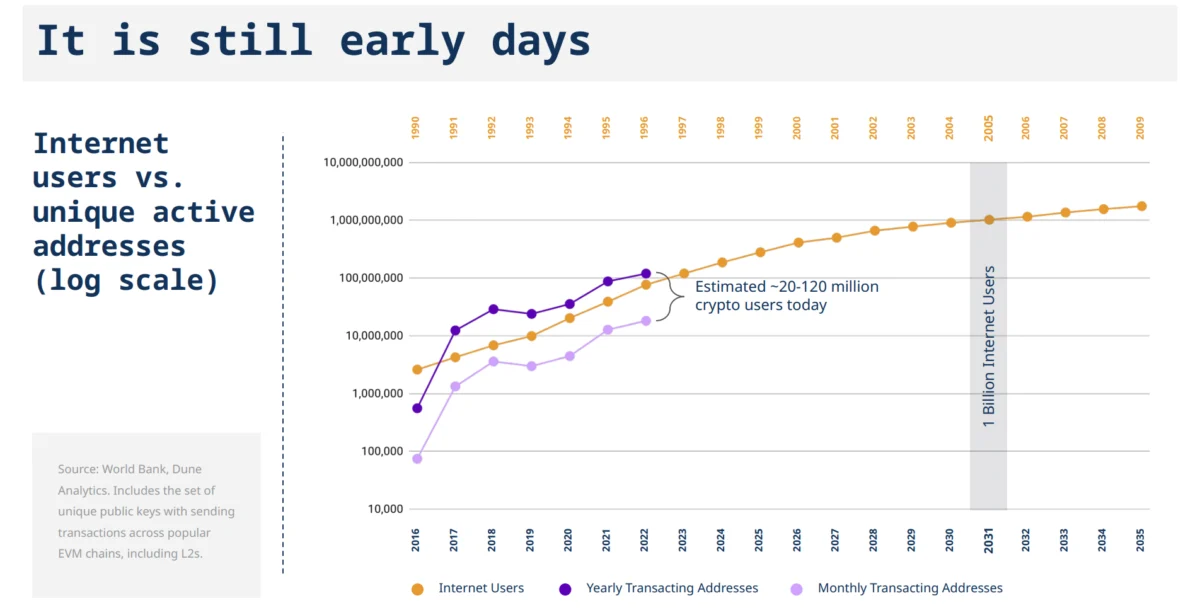
According to industry insiders, decentralized finance (DeFi), stablecoin growth, Web3 computing power, and tokenized governance frameworks are proceeding at an astronomical pace. These developments, experts claim, are laying the groundwork to onboard the next billion users into the global digital economy, regardless of short-term macroeconomic headwinds or bearish price action.
Chronology: A Retrospective of 2022’s Trials and Long-Term Milestones
To understand why market strategists remain bullish on structural adoption despite recent trauma, it is essential to trace the chronology of the events that shaped the digital asset landscape leading into this pivotal juncture:
- Q1–Q2 2022: The Macroeconomic Squeeze and Initial Contagion: As central banks worldwide—led by the U.S. Federal Reserve—began aggressive interest rate hikes to combat surging inflation, speculative risk assets faced immediate pressure. The collapse of the Terra (LUNA) ecosystem and its algorithmic stablecoin (UST) in May wiped out roughly $40 billion in investor wealth nearly overnight, triggering a domino effect across interconnected lending desks.
- Summer 2022: The Fall of Centralized Giants: The contagion rapidly exposed severe risk mismanagement among prominent centralized finance (CeFi) lenders and hedge funds. High-profile entities such as Celsius Network, Voyager Digital, and Three Arrows Capital (3AC) filed for Chapter 11 bankruptcy protection or liquidation, freezing customer assets and triggering widespread panic among retail and institutional participants alike.
- Late 2022: The FTX Catastrophe: In November 2022, the industry suffered its most devastating blow when FTX, once the world’s second-largest cryptocurrency exchange, experienced a fatal liquidity crisis driven by alleged fraud and the commingling of customer funds. The subsequent bankruptcy of FTX and its sister trading arm, Alameda Research, profoundly damaged public trust and invited intense global regulatory scrutiny.
- Post-Crisis Realignment (Late 2022–Present): Despite the wreckage of CeFi, developers and institutional builders shifted focus back toward core technological innovations. Decentralized protocols proved largely resilient to the contagion, operating transparently on-chain without the opacity that doomed their centralized counterparts. Concurrently, venture capital deployment pivoted away from speculative consumer applications toward foundational layer-1 scalability, security infrastructure, and enterprise-grade tooling.
Supporting Data: Adoption Metrics, Stablecoins, and Infrastructure Growth
Skeptics frequently point to plunging token prices and diminished trading volumes as proof of an industry in terminal decline. However, underlying network data and industry reports present a more nuanced picture of sustained, albeit slower, expansion.
1. Stablecoin Resilience and Utility
Despite the collapse of algorithmic stablecoin models, fiat-backed stablecoins such as Tether (USDT) and USD Coin (USDC) have continued to process staggering volumes of transactions, rivaling or exceeding traditional legacy payment networks. In emerging economies plagued by severe local currency devaluation and hyperinflation, stablecoins have increasingly functioned as a practical digital dollar substitute, preserving purchasing power and facilitating cross-border commerce without relying on traditional correspondent banking infrastructure.
2. Macro Adoption and Emerging Economies
Bitcoin’s trajectory continues to evolve beyond a speculative asset class. While El Salvador made history in 2021 by adopting Bitcoin as legal tender, subsequent developments throughout 2022 and 2023 demonstrated a broader trend of sovereign exploration and institutional integration across developing nations in Latin America, Africa, and Southeast Asia.
3. Venture Capital Realignment
Data compiled by firms like Messari indicates that while venture capital deployment experienced a sharp downward correction from the euphoric highs of 2021, capital is still flowing into vital sectors. Rather than funding high-risk marketing campaigns or unsustainable tokenomics models, institutional investors are increasingly backing infrastructure projects focused on:
- Zero-Knowledge (ZK) rollups and layer-2 scalability solutions.
- Cross-chain interoperability protocols.
- Institutional custody and compliance toolkits.
- Decentralized identity (DID) frameworks.
Official Responses and Regulatory Landscapes
The structural failures of 2022 fundamentally altered the regulatory posture of governments and international financial watchdogs worldwide. Regulators who were previously viewed as slow to act mobilized aggressively in the wake of the FTX collapse to protect consumers and establish clear jurisdictional boundaries.
The Regulatory Crackdown
In the United States, regulatory bodies such as the Securities and Exchange Commission (SEC) and the Commodity Futures Trading Commission (CFTC) intensified enforcement actions against unregistered digital asset offerings, staking programs, and centralized exchanges. Lawmakers on Capitol Hill introduced numerous bipartisan bills aimed at defining whether specific cryptocurrencies should be classified as securities or commodities, and setting stringent auditing, reserve-backing, and anti-money laundering (AML) standards for custodial entities.
Industry Reception
While compliance costs have surged—leading some smaller crypto startups to relocate operations to more crypto-friendly jurisdictions like the European Union (under the landmark Markets in Crypto-Assets—MiCA framework), Singapore, and the United Arab Emirates—major institutional players have welcomed the clarity. Traditional financial institutions argue that comprehensive regulatory guardrails are a necessary prerequisite for mass institutional capital allocation, serving to separate legitimate technological innovation from predatory financial engineering.
Implications: What a Decentralized Future Means for Global Finance
The core thesis presented by long-term strategists is that cryptocurrency and blockchain technology represent an evolutionary upgrade to the global financial architecture, rather than a transient speculative fad. Several profound implications arise from this perspective:
The Triumph of Transparency Over Trust
The contrast between centralized financial failures (such as FTX and Celsius) and decentralized financial protocols (such as Aave, Uniswap, and MakerDAO) has underscored the core philosophy of Web3: "Don’t trust, verify." While centralized intermediaries failed due to opaque balance sheets and human corruption, decentralized protocols executed code autonomously, remaining solvent and accessible throughout the worst market crises in crypto history. This demonstrated the viability of automated market makers and programmatic lending.
Scaling to One Billion Users
The primary engineering challenge facing the blockchain space has historically been the trilemma of achieving decentralization, security, and scalability simultaneously. As development shifts toward modular blockchain architectures, sharding, and advanced layer-2 execution environments, transaction fees are plummeting while throughput speeds approach those of traditional payment rails like Visa or Mastercard. Analysts argue that as these technical frictions disappear, the end-user experience will abstract away underlying blockchain mechanics entirely, paving the way for mainstream onboarding on a global scale.
The Convergence of Traditional Finance (TradFi) and DeFi
Far from operating in perpetual isolation, traditional financial institutions are increasingly exploring how tokenization and blockchain rails can improve settlement efficiency, reduce operational overhead, and create new asset classes. Major global asset managers—including financial giants like BlackRock, Fidelity, and Franklin Templeton—have initiated tokenized fund products and explored real-world asset (RWA) tokenization, signaling a long-term convergence between legacy financial systems and decentralized ledger technology.
Conclusion
The road to mainstream adoption has proven significantly more volatile, hazardous, and contentious than early proponents anticipated. The painful lessons of 2022 exposed the dangers of unbridled leverage, lack of consumer protection, and unchecked centralization. Yet, as market analysts and infrastructure builders emphasize, the underlying technological value proposition remains entirely intact.
By stripping away excess speculation and punishing bad actors, the industry has arguably emerged leaner, more resilient, and more focused on building sustainable tools. If current developmental trajectories hold, the foundational infrastructure being laid today will indeed form the bedrock of a more open, transparent, and globally accessible financial system for the decades to come.