Andreessen Horowitz Defies Market Downturn with Massive $4.5 Billion Crypto Fund to Fuel the ‘Golden Era’ of Web3
SILICON VALLEY — Amid a bruising crypto market correction characterized by widespread price stagnation, macroeconomic headwinds, and shaken investor confidence, prominent Silicon Valley venture capital firm Andreessen Horowitz (a16z) is doubling down on the future of decentralized technology. The firm has officially announced the launch of a staggering $4.5 billion crypto fund—its fourth and largest digital asset-focused vehicle to date.
Despite the prevailing bearish sentiment dominating public markets, a16z’s leadership is projecting a long-term, highly bullish outlook. According to the firm, current market conditions offer an ideal environment for strategic, foundational investments in what they describe as the "golden era" of Web3 development.
Main Facts: Breaking Down the $4.5 Billion Capital Injection
The newly unveiled $4.5 billion fund brings Andreessen Horowitz’s total capital raised for cryptocurrency and blockchain investments to over $7.6 billion across four distinct funds. Of the latest allocation, a massive $1.5 billion has been earmarked specifically for seed investments, while the remaining $3 billion will be directed toward venture-stage rounds.
This capital deployment places a16z at the absolute vanguard of venture-backed blockchain funding globally. Rather than pulling back in the face of asset devaluation, the firm intends to aggressively finance promising early-to-mid-stage startups across a broad spectrum of the digital asset economy:
- Decentralized Finance (DeFi): Next-generation protocols seeking to rebuild global financial infrastructure on transparent, trustless frameworks.
- Web3 Social Media & Creator Economies: Decentralized protocols empowering content creators to own their data, audiences, and monetization channels.
- Layer-1 and Layer-2 Scaling Solutions: Innovations focusing on network throughput, gas optimization, and zero-knowledge (ZK) rollups to solve Ethereum and multi-chain scalability hurdles.
- Metaverse & Gaming: Immersive virtual worlds and Play-to-Earn (or Play-and-Own) gaming ecosystems that integrate digital property rights.
- NFT Communities & Digital Identity: Advanced non-fungible token applications stretching far beyond speculative art into utilities like ticketing, membership access, and decentralized identity verification.
- Decentralized Autonomous Organizations (DAOs): Infrastructure, governance tools, and legal frameworks designed to optimize community-led decision-making and treasury management.
Historical Chronology: The Evolution of a16z Crypto
To understand the magnitude of this $4.5 billion injection, it is necessary to examine how Andreessen Horowitz systematically built its crypto empire over the last decade.
- 2013–2016 (Early Exploration): Under the guidance of co-founders Marc Andreessen and Ben Horowitz, the firm made its maiden voyages into the crypto sector by investing in foundational companies like Coinbase during its early funding rounds. At the time, cryptocurrency was viewed by mainstream Silicon Valley largely as a niche cryptographic curiosity.
- 2018 (Crypto Fund I): Recognizing the paradigm shift occurring in decentralized computing, a16z launched its dedicated Crypto Fund I, raising $300 million. This fund institutionalized their commitment, backing protocols and infrastructure that would eventually power the 2020–2021 decentralized finance explosion.
- 2020 (Crypto Fund II): As DeFi gained mainstream traction, a16z closed its second crypto fund at $515 million, capturing the early wave of yield farming, automated market makers (AMMs), and emerging layer-1 competitors to Ethereum.
- June 2021 (Crypto Fund III): Marking a monumental leap in scale, a16z announced Crypto Fund III, raising $2.2 billion. This positioned the firm as the single most influential institutional player in Web3, providing capital to dominant players across NFT marketplaces, gaming guilds, and cross-chain bridges.
- May 2022 (Crypto Fund IV): Defying broader macroeconomic indicators and crypto market pullbacks, the firm announced its $4.5 billion fourth fund, cementing its position as the undisputed heavyweight champion of blockchain venture capital.
Supporting Data: Historical Precedents and Macro Market Realities
The timing of a16z’s announcement has sparked robust debate across financial markets. Traditional investors often retreat during prolonged crypto winters, viewing volatility as a sign of structural failure. However, historical data tells a vastly different story regarding venture capital returns.
The "Crypto Winter" Innovation Cycle
Industry data consistently shows that some of the most resilient and revolutionary technological companies are born during bear markets. For instance:
- Ethereum was conceptualized and launched during the prolonged 2014–2016 bear market following the Mt. Gox collapse.
- Chainlink, Aave (then LEND), and Uniswap either launched or underwent critical development phases during the painful 2018–2019 crypto winter.
- Major institutional adoption frameworks, regulatory compliance tools, and custody solutions (such as Fidelity Digital Assets and Bakkt) were established during periods of depressed asset prices.
When asset prices plummet and speculative retail participants exit the market, noise levels drop significantly. Builders are left alone to focus on code optimization, developer tooling, and security auditing. By deploying $4.5 billion precisely when valuations are suppressed, a16z is effectively purchasing equity and token allocations at a significant discount compared to the frothy valuations seen at the height of the 2021 bull run.
Official Responses and Strategic Vision
In a comprehensive blog post announcing the fund, a16z general partner Chris Dixon framed the launch within the broader historical context of technological computing cycles. Dixon argues that humanity undergoes a major computing paradigm shift roughly every 10 to 15 years:
- 1980s: Personal Computers (PCs)
- 1990s: The Commercial Internet
- 2000s: Mobile Computing & Smartphones
- 2010s–Present: Blockchains and Web3
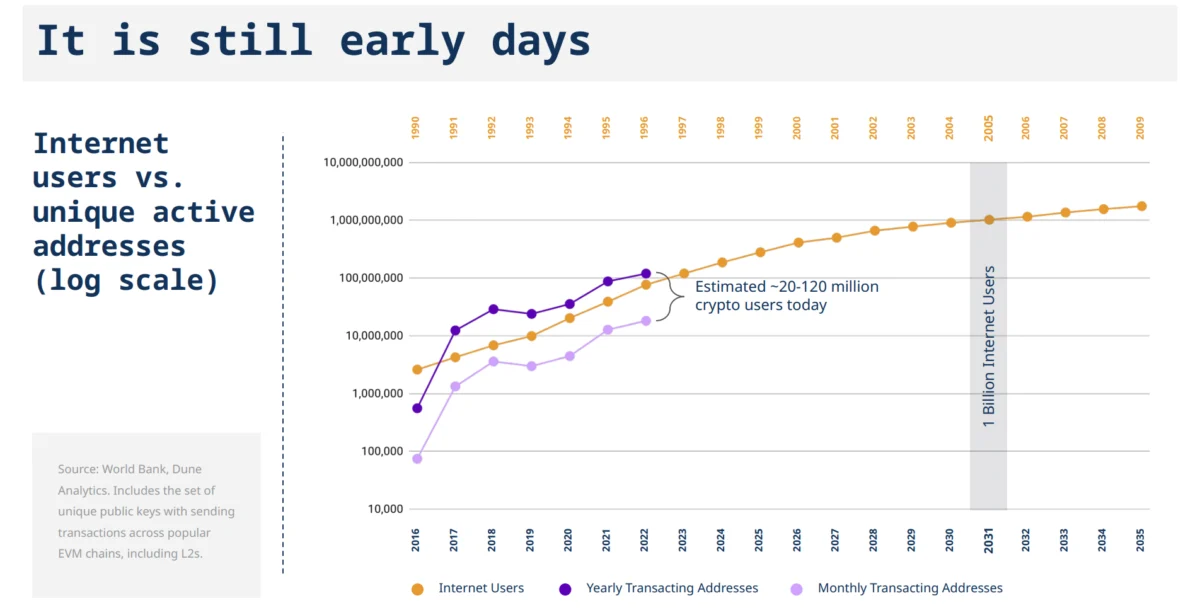
"We believe blockchains will power the next major computing cycle, which we call crypto or Web3," Dixon wrote. "We think we are now entering the golden era of Web3. Programmable blockchains are sufficiently advanced, and a diverse range of apps have reached tens of millions of users. More importantly, a massive wave of world-class talent has entered Web3 over the last year. They are brilliant and passionate and want to build a better internet."
Echoing these sentiments in a televised interview with CNBC, a16z partner Arianna Simpson emphasized that bear markets serve as a natural filter, stripping away speculative distractions and focusing engineering talent on genuine product-market fit.
"Bear markets are often when the best opportunities come about when people are actually able to focus on building technology rather than getting distracted by short-term price activity," Simpson stated.
The firm’s thesis relies heavily on decentralization as an antidote to the monopolistic data-harvesting practices of Web2 tech giants. By returning ownership of data and digital assets back to the end-users through cryptographic tokens and smart contracts, a16z believes Web3 will fundamentally alter how global commerce, media, and social interaction operate.
Industry Implications: What a $4.5 Billion War Chest Means for the Future
The injection of $4.5 billion into the Web3 ecosystem carries profound implications for founders, competing venture firms, regulators, and the broader global economy.
1. Sustained Talent Retention
With venture funding secured at this scale, top-tier engineering talent graduating from institutions like Stanford, MIT, and Carnegie Mellon will continue to find robust financial backing within the blockchain space. Rather than drifting back to traditional Web2 monoliths (such as Meta, Google, or Apple), software engineers can confidently build decentralized alternatives with multi-year runway support.
2. Accelerated R&D in Scaling and Privacy
A significant portion of the fund will undoubtedly flow into zero-knowledge (ZK) cryptography. ZK-rollups represent the holy grail of blockchain scaling, allowing networks to process thousands of transactions per second while preserving absolute user privacy. With a16z backing these initiatives, the timeline for solving Ethereum’s scalability and high-gas fee bottlenecks could be dramatically compressed.
3. Regulatory Navigation and Institutional Compliance
As a premier venture capital institution managing billions in assets, a16z maintains deep political and regulatory engagement in Washington, D.C., and global financial capitals. The deployment of this fund will likely include legal, compliance, and policy R&D to help portfolio companies navigate increasingly stringent regulatory frameworks, bridging the gap between decentralized protocols and traditional financial compliance.
4. A Vote of Confidence for the Broader Market
While retail traders fixate on daily chart movements, interest rate hikes, and inflationary pressures, a16z’s $4.5 billion commitment serves as a psychological anchor for the entire digital asset industry. It signals to institutional allocators—pension funds, endowments, and sovereign wealth funds—that smart money views current market weakness not as a terminal decline, but as a generational buying and building opportunity.
Conclusion
Andreessen Horowitz’s $4.5 billion gambit is a clear declaration that the evolution of digital assets transcends short-term market cycles. By betting heavily on the builders, developers, and visionaries dedicating their careers to decentralized infrastructure, a16z is positioning itself at the epicenter of the next internet revolution. As the industry moves past speculative excess and into foundational utility, this massive capital deployment may well be remembered as the catalyst that sparked the true golden era of Web3.