
Bitcoin Miners Face Historic Crunch: 20% Operating at a Loss as Q1 Liquidations Shatter Records
By Financial Markets Desk
Published: April 2026
Main Facts
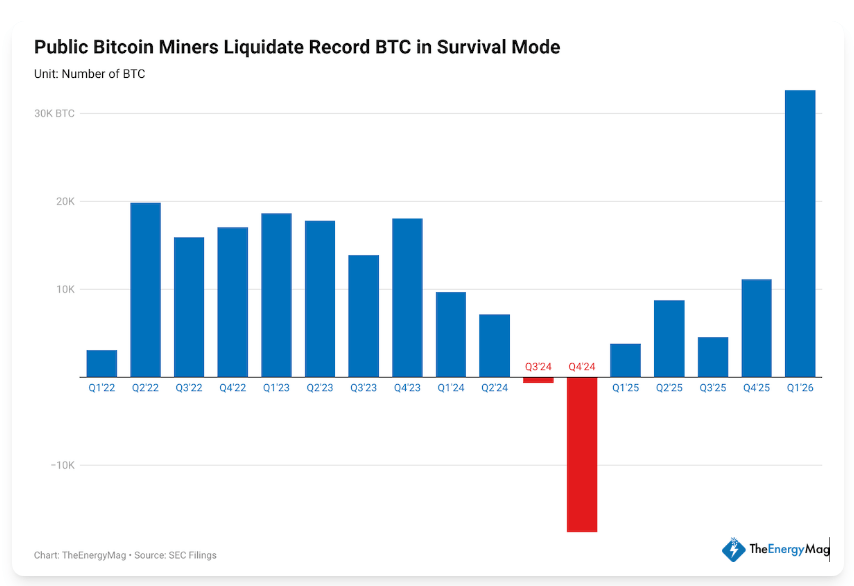
The Bitcoin mining sector is enduring one of the most punishing fiscal environments in its recent history. As of early 2026, approximately 20% of the global Bitcoin mining industry is operating at a net loss. This alarming metric underscores the severe structural stress currently rippling across the digital asset infrastructure. Publicly traded mining giants—including industry heavyweights MARA, CleanSpark, Riot, Cango, Core Scientific, and Bitdeer—have found themselves forced into aggressive liquidation strategies, selling off substantial portions of their digital asset treasuries merely to cover operational expenditures, service debt, and keep their facilities powered.
At the heart of this operational crisis is the collapse of "hashprice"—a crucial industry metric defined as the daily revenue a miner generates per unit of computing power. According to metrics compiled by Hashrate Index, hashprice has been on a relentless downward trajectory since July 2025, bottoming out at roughly $33 per petahash per second per day ($33/PH/s/day). Meanwhile, the industry-wide breakeven point for standard operations, particularly for fleets utilizing older-generation ASIC hardware, hovers around $35. That seemingly narrow two-dollar deficit on paper has translated into millions of dollars in monthly operational losses, pushing a significant fraction of global computing power into the red and triggering widespread capital preservation measures.

Chronology
To fully understand the severity of the current crisis, one must trace the timeline of compounding pressures that culminated in the historic sell-offs of early 2026.
- Mid-2025 (The Turning Point): The slide in hashprice begins in earnest. Even as global economic indicators fluctuate, mining revenues fail to keep pace with the exponential expansion of network security and rising hardware maintenance costs.
- Late 2023 to December 2025 (The Slow Drain): Long before the current capitulation, miner reserves were already quietly bleeding out. Data from analytics platform CryptoQuant demonstrates that collective miner holdings peaked well above 1.86 million BTC at the close of 2023, slowly trickling downward month after month as firms dipped into reserves to fund facility expansions and face shifting macroeconomic realities.
- The First Quarter of 2026 (The Breaking Point): Publicly traded miners offload more than 32,000 BTC in a frantic three-month span. This staggering figure eclipses the total volume those same companies liquidated across all four quarters of 2025 combined. Furthermore, it easily shatters the previous quarterly liquidation record of roughly 20,000 BTC, which was set back in Q2 2022 during the catastrophic collapse of the Terra-Luna ecosystem.
- April 2026 (Continued Capitulation Signals): Industry insiders and major corporate treasuries begin adjusting their strategies. While high-cost miners scale back operations or sell off remaining inventories, corporate balance-sheet buyers like Strategy signal that they are ready to step into the liquidity vacuum.
Supporting Data
The macroeconomic and on-chain metrics driving the current market conditions paint a vivid picture of supply-and-demand friction within the Bitcoin ecosystem.
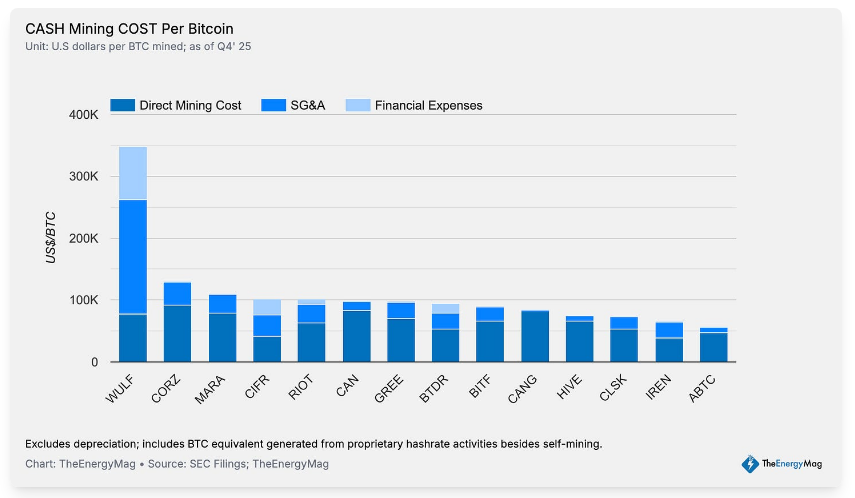
- Hashprice vs. Breakeven Thresholds: With hashprice depressed at $33 per petahash per second daily against an average breakeven baseline of $35, the profit margins that sustained miners through previous cycles have evaporated. Older machine models—such as the Antminer S19 series or equivalent legacy hardware—are increasingly being unplugged because their electricity consumption costs outweigh their daily BTC generation.
- Record-Breaking Liquidations: The collective offloading of over 32,000 BTC in Q1 2026 by MARA, CleanSpark, Riot, Cango, Core Scientific, and Bitdeer highlights an institutional pivot from accumulation to survival. To put this into perspective, this single-quarter volume surpasses the dark days of mid-2022 by over 60%.
- Depleting Miner Reserves: CryptoQuant metrics confirm that total miner-held BTC reserves have dropped from over 1.86 million BTC at the end of 2023 down to approximately 1.8 million BTC by mid-2026. This multi-year downward trend indicates that miners have been structurally under-earning or over-leveraged for an extended period, consuming their balance-sheet safety nets long before the Q1 2026 liquidity crunch.
- Trading and Market Context: On the broader charts, BTC/USD has faced persistent downward pressure, testing trader resilience near the $75,000 threshold. TradingView volume indicators show elevated sell-side pressure coinciding directly with periods of miner treasury transfers to centralized exchanges.
Official Responses and Industry Analyses
Financial institutions, asset managers, and corporate leaders have not hesitated to weigh in on the unfolding crisis.
In its comprehensive Q1 2026 Bitcoin Mining Report, prominent asset manager CoinShares issued a stark warning to the market. The report suggests that relief may not be immediate, explicitly cautioning that higher-cost mining operators should prepare for extended capitulation phases through the first half of the year. Unless Bitcoin experiences a rapid and substantial price recovery that shifts the hashprice significantly above the $35 breakeven line, secondary and tertiary players risk hostile takeovers, restructuring, or complete shutdowns.
Conversely, while traditional production entities pull back, institutional treasury buyers are capitalizing on the depressed price action. Strategy—unquestionably the world’s largest corporate holder of Bitcoin—continues to aggressively expand its balance sheet. Maintaining his characteristic public profile, co-founder Michael Saylor signaled to markets that another major acquisition was imminent. By sharing the firm’s historical BTC accumulation charts on social media channels with the caption "Think bigger," Saylor effectively telegraphed to global markets that institutional corporate buyers are more than willing to absorb the excess supply being forced onto the order books by struggling mining operations.
Implications
The structural friction currently plaguing the Bitcoin mining sector carries profound implications for the broader cryptocurrency landscape, touching upon network security, geographic decentralization, and market dynamics.
1. Network Hashrate and Difficulty Adjustments
As 20% of the industry operates at a loss, undercapitalized miners are forced to power down inefficient rigs. This contraction in active hashrate will naturally trigger downward difficulty adjustments on the Bitcoin blockchain. While this dynamic inherently lowers operational costs for surviving miners—making it slightly easier for efficient operators to survive—it also highlights the Darwinian nature of proof-of-work security.
2. Geographic and Corporate Consolidation
The ongoing squeeze is expected to accelerate industry consolidation. Well-capitalized publicly traded miners with access to cheap, long-term renewable energy contracts (such as hydro, nuclear, or localized natural gas flares) will likely acquire distressed competitors at a discount. Smaller, independent, and residential miners, however, face existential threats, potentially leading to increased centralization of hashpower among a handful of corporate balance sheets.
3. Supply Dynamics and Price Stabilization
The massive wave of miner capitulation has temporarily flooded the market with fresh selling pressure, acting as an artificial ceiling on Bitcoin’s price appreciation. However, as miner reserves approach historical lows and corporate entities like Strategy absorb the surplus liquidity, the structural overhang from miners is projected to diminish. Once the weakest miners have fully flushed their inventories, the supply side of the market will experience a healthier equilibrium, paving the way for potential price stabilization and renewed upward momentum once macro headwinds abate.