Bitcoin’s Tactical Recovery: Navigating Liquidation Zones and Bullish Re-entry
Bitcoin’s recent price action has provided a renewed sense of optimism for market bulls, yet the mood across crypto-trading desks remains one of cautious skepticism. Rather than signaling an immediate, euphoric return to all-time highs, the current market structure is being treated by institutional and retail traders alike as a series of critical level-by-level tests. As Bitcoin fights to stabilize above key support thresholds, the primary question for market participants is whether this rebound represents a genuine reversal or merely a temporary relief rally destined to trap over-leveraged longs.
Main Facts: The Anatomy of a Tentative Rebound
The current market environment for Bitcoin is characterized by a "show-me" mentality. After a period of downward pressure that saw sentiment turn decidedly bearish, the recent reclaim of the $63,500 support level has acted as a primary catalyst for a shift in short-term bias.
At its core, the current recovery is defined by the following:
- The Reclaim: Bitcoin has successfully moved back above the $63,500 mark, a zone that previously acted as a breakdown point.
- Structural Integrity: The formation of a higher low near $62,400 has provided a structural foundation for the current upward grind, effectively invalidating the most aggressive bearish narratives that were calling for a deeper retest of the $60,000 psychological barrier.
- Liquidity-Driven Strategy: Market analysts are increasingly shifting away from traditional technical support and resistance levels, opting instead to utilize "liquidation maps." These maps, which visualize where traders are most heavily leveraged, provide a more granular view of where price action is likely to be "magnetized" by forced liquidations.
Chronology: From Breakdown to Tactical Re-entry
The path to the current setup has been far from linear. To understand where Bitcoin is headed, one must look at the recent sequence of events that defined the current market structure.
Phase 1: The Bearish Pivot
In the preceding weeks, the market experienced a sharp breakdown, with price action slipping through the $64,000 support. During this period, bearish sentiment dominated, and many traders assumed that the previous range-highs were permanently off the table. The market began to price in a "washout" scenario, where long positions were liquidated in rapid succession.
Phase 2: The Higher Low Foundation
Mid-week, as selling pressure reached a local exhaustion point, the market found a floor near $62,400. This was the first sign that institutional bid support was active beneath the surface. By establishing a higher low, Bitcoin shifted its short-term market structure from a series of lower highs to a constructive, ascending pattern.
Phase 3: The Reclaim of $63,500
Following the formation of the base, price momentum pushed back through the $63,500 pivot. This reclaim served as a critical psychological turning point, forcing short-sellers to reconsider their positions and providing bulls with a clearly defined "line in the sand" to manage risk.
Supporting Data: The Liquidation Map Perspective
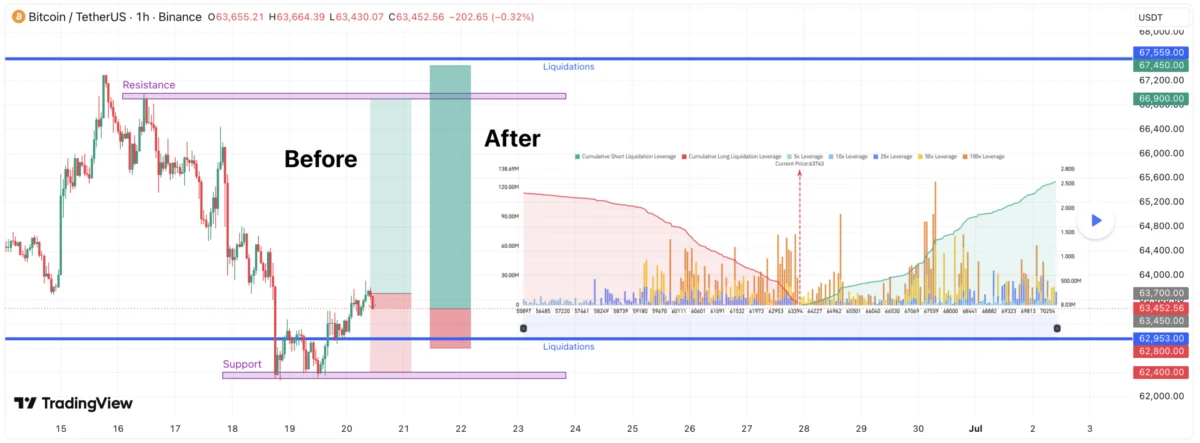
The most sophisticated analysis currently circulating comes from analysts utilizing liquidation maps, such as the setup outlined by analyst kiv1n. By analyzing where large clusters of short and long liquidations reside, traders are adjusting their strategies to avoid being caught in "liquidity sweeps."
The Refined Trade Setup
The original trade plan—targeting an entry at $63,700 and a stop at $62,400—has been discarded in favor of a more data-driven approach:
- Revised Entry: $63,450.
- Target: $67,450.
- Tightened Stop-Loss: $62,800.
The logic behind this adjustment is purely quantitative. By shifting the stop-loss to $62,800, the analyst is positioning the trade just beneath a localized cluster of long liquidations located at approximately $62,953. This serves a dual purpose: it allows for normal market volatility while ensuring that if the price breaks the $62,800 level, it confirms a structural failure, allowing the trader to exit before the market "flushes" deeper into the $61,000 range.
Conversely, the upside target of $67,450 is strategically placed just shy of a massive liquidity magnet sitting at $67,559. By front-running this area, the analyst aims to capitalize on the momentum of a potential short-squeeze while avoiding the inevitable profit-taking that occurs when price hits heavy liquidity clusters.

Official Commentary: Insights from Market Observers
Prominent market commentators have weighed in on the fragility of the current setup. That Martini Guy, a well-known voice on X, recently highlighted that many traders were "too convinced" that the earlier breakdown was the start of a prolonged downtrend.
His commentary suggests that the market’s propensity to over-react to short-term bearish data points is exactly what creates these "reclaim" opportunities. By holding the $63,500 zone, Bitcoin is essentially rejecting the bearish thesis. "The sequence we are seeing—a higher low followed by a reclaim—is the textbook definition of a recovery phase," the commentator noted.
However, this optimism is tempered by a sobering reality: until Bitcoin can clear the previous range high of $67,200, the market remains trapped within a broader consolidation range. The consensus among the analyst community is that while the current setup is bullish, it is a conditional bullishness.
Implications: What to Watch for in the Coming Sessions
The implications of this setup are twofold: if the bulls hold, we could see a rapid move toward the $67,000 region; if the level fails, the recent rally will be dismissed as a "dead cat bounce."
1. The Importance of the $62,800–$63,500 Zone
This narrow band is currently the most significant area on the chart. It acts as the "defense line" for the bulls. Any significant closing price below $62,800 would likely trigger a cascade of long liquidations, effectively negating the current bullish structure and potentially opening the door for a retest of $60,000.
2. The Short-Squeeze Potential
If the market continues to grind upward, the concentration of short positions sitting above $67,000 becomes a potent fuel source. A "squeeze" occurs when short-sellers are forced to buy back their positions to cover losses, creating a feedback loop that drives the price higher. The $67,500 area is where this squeeze is most likely to encounter significant resistance.
3. Institutional Accumulation vs. Retail Sentiment
While retail traders are focused on the liquidation maps, institutional players are likely using this period of uncertainty to accumulate positions in anticipation of broader market catalysts. The divergence between the "fearful" retail sentiment and the "constructive" price action suggests that the smart money may be buying the dip that the majority of the market is currently afraid to touch.
Conclusion: A High-Stakes Balancing Act
Bitcoin is currently operating in a tactical environment where precision is paramount. The shift toward liquidation-based analysis highlights a market that is increasingly data-driven and sensitive to the placement of stop-losses.
While the reclamation of $63,500 is a significant win for the bulls, the path of least resistance remains subject to the market’s ability to defend its new support levels on subsequent pullbacks. The coming days will be decisive. Investors should remain vigilant, watching for a clean break above $67,200 to confirm that the recovery has legs, or a breakdown below $62,800 to signal that the bears have successfully regained control of the narrative.
In the world of cryptocurrency, where sentiment can turn on a dime, this current setup is a reminder that market direction is rarely about luck—it is about managing risk in the face of liquidity, understanding the mechanics of forced liquidations, and waiting for the market to confirm its intent before committing significant capital.
This report was compiled by the News Desk and finalized by our senior editorial team. All data points and trade setups discussed are for informational purposes and should not be construed as financial advice.