
Centralized Crypto Exchanges Suffer Record 43.8% Volume Drop in April, Ending Six-Month Bullish Streak
A significant cooldown hit digital asset markets in April as macroeconomic pressures and shifting investor sentiment brought an abrupt halt to months of explosive growth across centralized trading platforms.
Main Facts
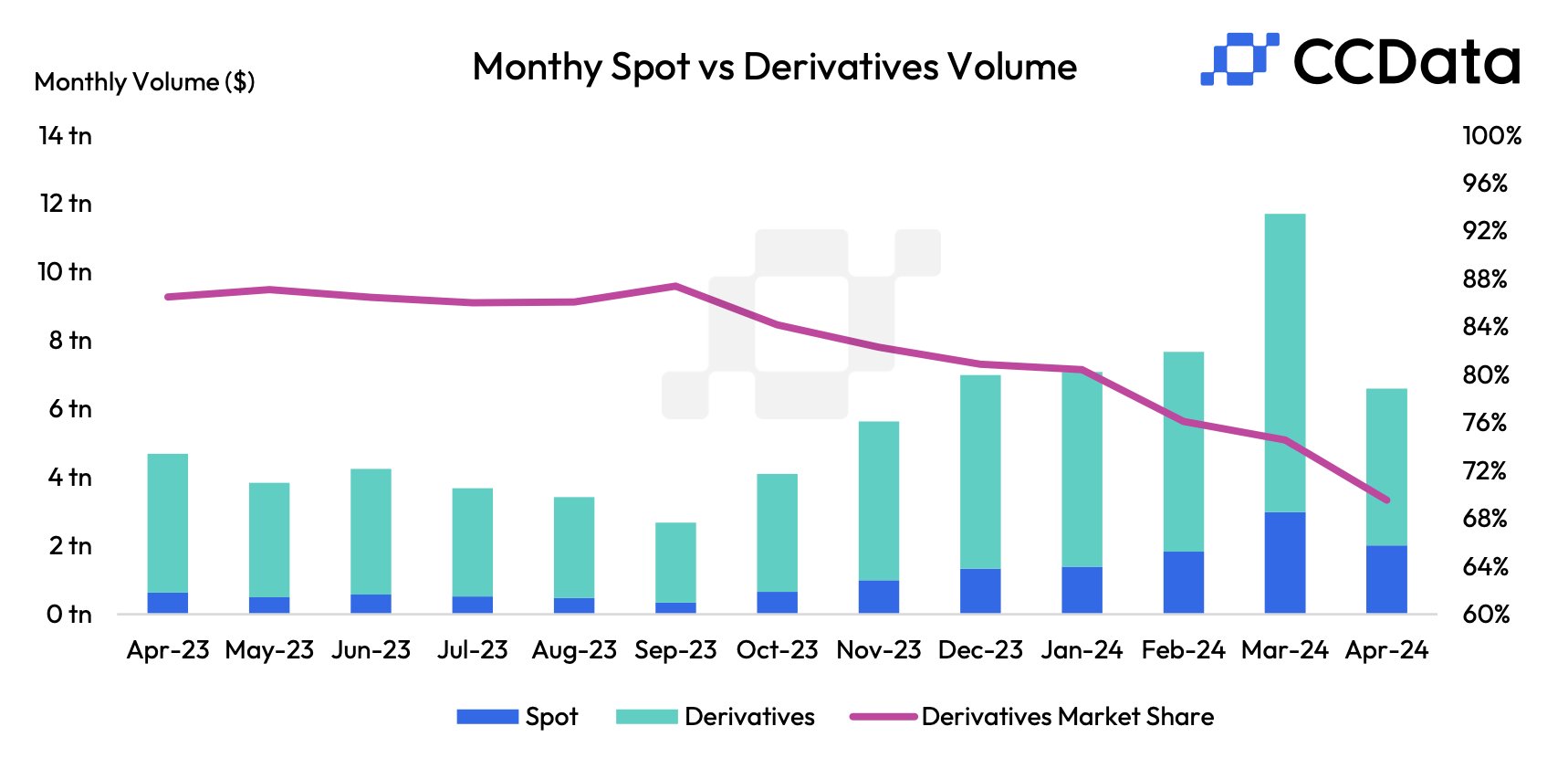
The explosive momentum that characterized the cryptocurrency market through the late winter and early spring of 2024 encountered a substantial roadblock in April. New data compiled and published by prominent blockchain research and market data tracker CCData reveals that the combined trading volume of spot and derivatives markets on centralized cryptocurrency exchanges (CEXs) experienced a steep decline, plummeting by 43.8% to $6.58 trillion.
This dramatic contraction brings an immediate end to an impressive six-consecutive-month winning streak that had previously propelled centralized exchange activity to unprecedented heights. To put the scale of the correction into perspective:
- March 2024 Volume: Approximately $11 trillion
- February 2024 Volume: Approximately $8 trillion
- April 2024 Volume: $6.58 trillion
Despite the staggering month-over-month drop, historical context provides a more nuanced view of the market’s health. CCData’s long-term comparative metrics indicate that despite April’s sharp pullback, the overall trading volume remains notably higher than any individual month recorded throughout the entirety of 2023, with the sole exception of December.
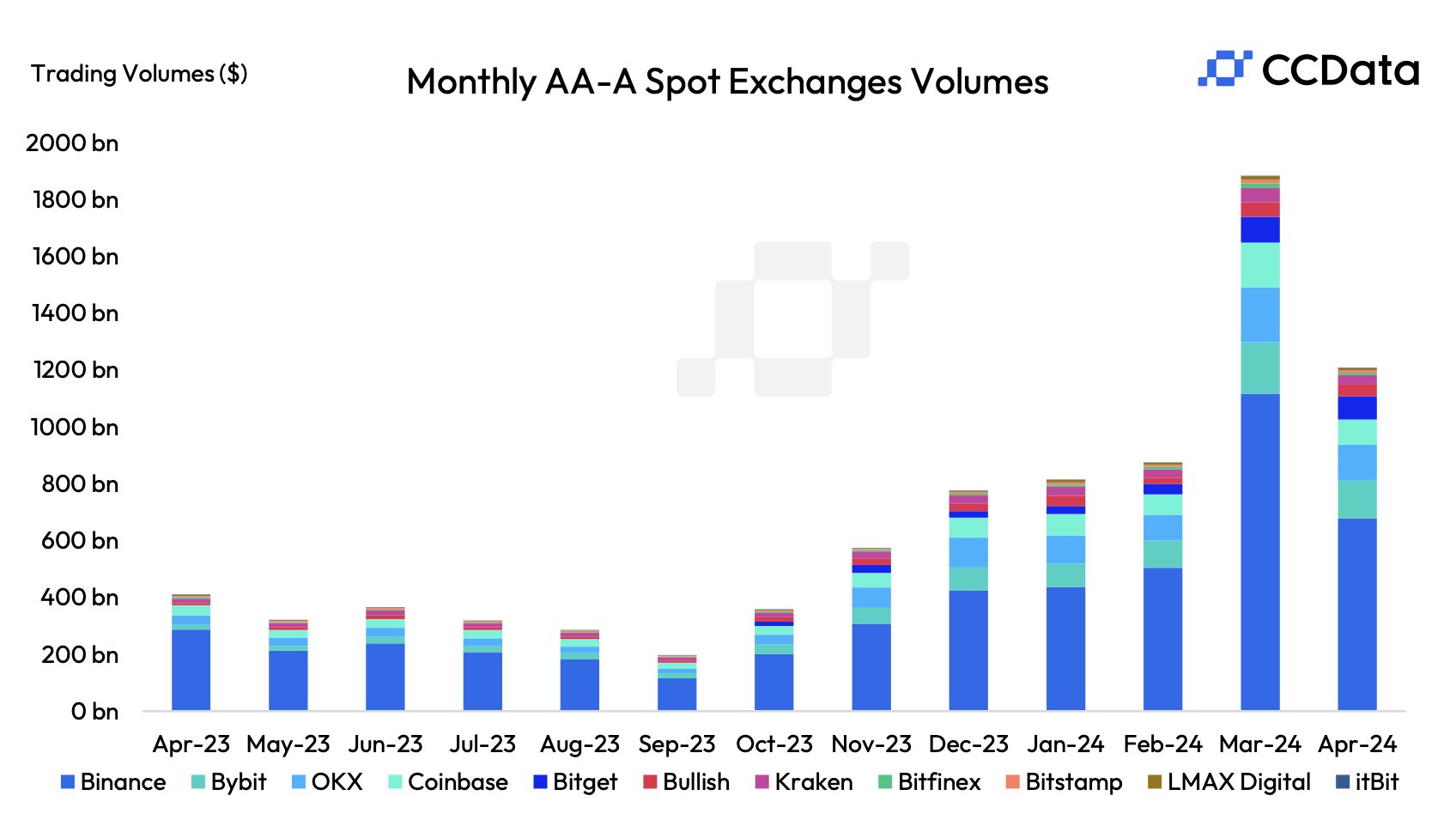
The downturn was felt universally across the industry, but top-tier platforms—including global heavyweights like Binance, Bybit, and OKX—bore the brunt of the reduction in absolute trading activity. Concurrently, sector-specific performance data shows a massive bifurcation in investor interest, with speculative assets like metaverse gaming, artificial intelligence (AI) tokens, and meme coins driving resilient double-digit month-to-date returns, while foundational scaling technologies like Layer-2 networks lagged behind.

Chronology
To understand how the crypto market arrived at April’s dramatic volume contraction, it is vital to trace the timeline of market dynamics leading up to and immediately following the close of the month:
- Late 2023 to January 2024: The crypto market entered a sustained multi-month accumulation and expansion phase, spurred largely by mounting institutional anticipation surrounding the approval and launch of spot Bitcoin Exchange-Traded Funds (ETFs) in the United States.
- February 2024: Market activity accelerated dramatically. Centralized exchange volumes bounced upward, crossing the $8 trillion threshold as retail and institutional liquidity flooded back into digital assets, driven by surging Bitcoin prices that eventually challenged historic all-time highs.
- March 2024: Trading activity reached a frantic peak. Combined spot and derivatives volumes on CEXs skyrocketed to roughly $11 trillion. Speculative mania hit high gear, characterized by massive meme coin rallies, high-frequency leveraged trading, and widespread ecosystem participation.
- April 2024: Market fatigue, macroeconomic headwinds, and a post-halving consolidation phase took hold. Trading volumes fell off a cliff, dropping nearly 44% down to $6.58 trillion as market participants stepped to the sidelines to reassess risk profiles.
- Early May 2024 (As of May 10): CCData’s updated sector basket returns exposed a shifting landscape of speculative rotation. While overall exchange volumes remained subdued, capital aggressively rotated into specific niche sectors—specifically metaverse/gaming (up 32.4%), AI (up 17.4%), and meme tokens (up 16.2%)—while infrastructural Layer-2 scaling solutions dipped into negative territory (-4.2%).
Supporting Data
A deeper dive into CCData’s comprehensive reporting illuminates precisely which platforms and asset categories were impacted the most during this transitional market phase.
Centralized Exchange (CEX) Performance Breakdown
The contraction was not isolated to minor platforms; rather, the industry’s most dominant exchanges experienced multi-billion-dollar reductions in monthly throughput:
- Binance (Grade A): Retaining its crown as the world’s largest cryptocurrency exchange by volume, Binance’s top-tier spot exchange operations processed $679 billion in April. However, this figure represents a severe 39.2% decrease compared to March metrics.
- Bybit (Grade AA): Securing the second position among reporting top-tier platforms, Bybit handled $133 billion in spot and derivatives transactions, marking a 26.9% decline month-over-month.
- OKX (Grade A): Rounding out the top three, OKX recorded $126 billion in volume, suffering a 34.8% reduction from the previous month’s highs.
Sector-Specific Basket Performance Returns (As of May 10, 2024)
While core exchange trading volumes slumped, capital that remained active within the digital asset ecosystem gravitated heavily toward high-beta, narrative-driven sectors. CCData’s asset basket tracking highlights the stark divergence in returns:
- Metaverse/Gaming: +32.4% (Top performer)
- Artificial Intelligence (AI): +17.4%
- Meme Tokens: +16.2%
- Layer-1 (L1) Blockchains: +7.1%
- Decentralized Finance (DeFi): +6.7%
- Staking Assets: +4.0%
- Exchange Tokens: +3.5%
- Infrastructure: +1.6%
- Layer-2 (L2) Scaling Solutions: -4.2% (Worst performer)
Official Responses and Industry Insights
Market analysts and data providers have offered various interpretations of the April data, framing the contraction not necessarily as a sign of a structural bear market, but rather as a natural, healthy cooling period following an overheated Q1.
Representatives from CCData emphasized in their public market updates that the dramatic shift in volume mirrors historical patterns observed during previous market cycles, where parabolic price expansion is almost invariably followed by periods of consolidation, lower volatility, and reduced retail participation.
Furthermore, prominent trading desks and exchange representatives have privately noted that the impending macroeconomic uncertainty—including shifting monetary policy expectations from the U.S. Federal Reserve and persistent inflation concerns—forced institutional market makers to reduce leverage and tighten risk parameters throughout April. This institutional retreat directly correlates with the sharp declines seen in derivatives and spot volumes across dominant platforms like Binance, OKX, and Bybit.
Implications
The staggering 43.8% drop in centralized exchange volume carries several profound implications for the broader cryptocurrency ecosystem moving forward:
1. Liquidity Redistribution and Market Maturity
While a $6.58 trillion monthly volume figure remains historically massive, the sudden evaporation of nearly $4.5 trillion in monthly throughput highlights the fragility of retail-driven momentum. Exchanges must adapt to lower revenue environments by diversifying their product offerings, enhancing compliance frameworks, and focusing on long-term user retention strategies rather than relying solely on speculative trading frenzies.
2. Narrative-Driven Speculation Trumps Infrastructure
The standout performance of metaverse, AI, and meme token baskets—despite an overall cooling market—demonstrates that retail and speculative capital remains highly agile. Paradoxically, while speculative tokens surged by double digits, fundamental scaling layers like Layer-2 networks registered negative returns (-4.2%). This divergence suggests that market participants are currently chasing short-term asymmetric upside rather than long-term utility plays.
3. Regulatory Scrutiny and Exchange Migration
As centralized platforms experience fluctuating volumes and heightened regulatory scrutiny globally, traders continue to weigh the security trade-offs between centralized convenience and decentralized self-custody. Sustained lower volumes on CEXs can sometimes precede a migration of user funds toward decentralized finance (DeFi) protocols, though April’s data showed relatively subdued performance across traditional DeFi baskets compared to high-beta narratives like gaming and AI.
Conclusion
April 2024 will likely be remembered by market historians as the month the crypto market caught its breath. While the 43.8% plunge in CEX volume looks dramatic on paper, it serves as a necessary reality check for an industry that had expanded at a breakneck pace. As summer approaches, market participants will be closely watching whether foundational metrics stabilize or if capital will continue to chase niche speculative sectors in search of the next major market catalyst.
Disclaimer: The information provided in this article is for informational and educational purposes only and does not constitute financial or investment advice. Cryptographic assets and digital tokens carry a high degree of risk. Readers should conduct thorough due diligence and consult with a licensed financial advisor before executing any trades or investments.