

Crypto Adoption Outpacing Early Internet Growth as Path to 4 Billion Users Stays on Track, Says Raoul Pal
Main Facts
Cryptocurrency adoption is currently tracking ahead of the historical growth curve set by the internet during its formative years, according to macroeconomic expert and Real Vision CEO Raoul Pal. In a recent market update, the former Goldman Sachs executive pointed to a proprietary long-term adoption model that has accurately mapped user growth over the last half-decade.
Based on this trajectory, Pal predicts that the global digital asset ecosystem will surpass the significant milestone of one billion users by the end of 2025. Looking further ahead into the next decade, the model suggests that crypto adoption could scale to approximately four billion users—representing roughly half of the global human population—by the year 2030.
Pal’s analysis draws a direct comparative parallel between the expansion rate of early web technologies in the 1990s and 2000s and the explosive growth of blockchain-based networks since 2016. While the internet previously held the title of the fastest-adopting technology in human history, crypto metrics indicate that decentralized networks are expanding at an even more rapid pace. Despite regulatory headwinds, macroeconomic uncertainties, and frequent market volatility, the underlying data demonstrates that digital asset onboarding has maintained a remarkably consistent upward trajectory.
Chronology of Digital Asset Growth: From Niche Experiment to Global Scale
To understand the weight of Pal’s long-term projections, it is helpful to review the chronological timeline of how cryptocurrency transitioned from a cryptographic experiment into a globally recognized asset class.
2008–2015: The Genesis and Incubation Phase
- January 2009: The Bitcoin network goes live with the mining of the Genesis Block by the pseudonymous creator Satoshi Nakamoto. For the first several years, cryptocurrency remains a niche hobby primarily shared among cryptographers, libertarian economists, and computer science enthusiasts.
- 2010–2013: The first commercial transactions involving Bitcoin take place (most notably the famous 10,000-pizza purchase), and early exchanges like Mt. Gox emerge. User numbers remain relatively small, measured in the tens of thousands.
- 2014–2015: Following the collapse of Mt. Gox and a prolonged bear market, skepticism peaks. However, underlying developer activity continues to grow, laying the groundwork for the launch of alternative layer-1 platforms like Ethereum.
2016–2020: The Institutional Awakening and Retail Expansion
- 2016: Industry analysts estimate that global crypto users officially cross the one-million milestone. This serves as the baseline year for Pal’s comparative adoption models.
- 2017–2018: The initial coin offering (ICO) boom brings mainstream retail attention to the space, pushing Bitcoin to nearly $20,000 and onboarding millions of new speculators.
- 2019–2020: A multi-year consolidation phase is disrupted by the onset of the COVID-19 pandemic. Central bank monetary easing prompts institutional giants, publicly traded corporations (such as MicroStrategy), and payment behemoths (like PayPal and Visa) to integrate digital assets, laying the rails for massive scale.
2021–Present: The Mainstream Paradigm Shift
- 2021: The total crypto market capitalization hits an all-time high of $3 trillion. Decentralized finance (DeFi) and non-fungible tokens (NFTs) introduce millions of new users to web3 interfaces.
- 2023–2024: Despite a harsh crypto winter following macro-driven interest rate hikes, user metrics continue to climb. The approval and launch of spot Bitcoin and Ethereum exchange-traded funds (ETFs) in major markets like the United States signal a permanent integration of digital assets into traditional financial plumbing.
Supporting Data: Comparing Internet and Crypto Adoption Curves
The core of Raoul Pal’s thesis relies on comparative data analytics. During the early phases of the internet, adoption expanded at a blistering pace as dial-up connections and commercial browsers penetrated households globally.
According to Pal’s breakdown:

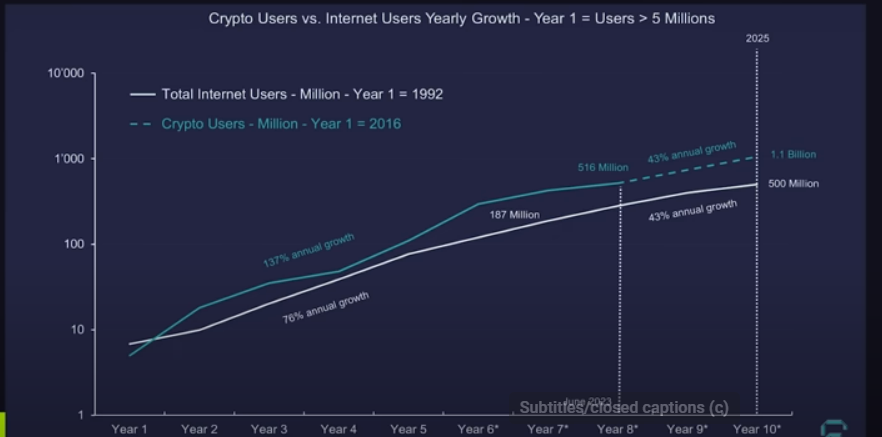
- The Internet’s Early Velocity: During its initial growth phase, the internet expanded at an average rate of 76% per year. Once it matured past its eighth year of widespread commercial availability, that growth rate naturally moderated to approximately 43% per year.
- Crypto’s Current Velocity: In contrast, the broader cryptocurrency ecosystem has been compounding at an average annual growth rate of 137% per year since hitting the one-million-user mark in 2016.
- Current Standing: At the time of Pal’s analysis, the global crypto user base stands at approximately 516 million users. To put this in perspective, at the exact same relative stage in its lifecycle, the internet had only accumulated 187 million users.
Projecting Forward to 2025 and 2030
Even if one assumes that crypto adoption will not maintain its current hyper-accelerated growth rate and will instead slow down to match the historical maturation curve of the internet, the numbers remain extraordinary.
- The 2025 Milestone: By applying the internet’s historical deceleration rates to current blockchain user data, Pal’s model projects that crypto will successfully onboard over 1.1 billion users by the end of 2025. Pal himself notes that this is likely a conservative estimate, given the global proliferation of smartphones and fintech applications that make onboarding significantly easier today than it was in the late 1990s.
- The 2030 Milestone: Looking toward the start of the next decade, projecting the internet’s growth curve onto digital assets yields an estimated 4 billion users by 2030. This milestone would mean that half of the projected global population will be interacting with blockchain technology, cryptocurrencies, or tokenized applications.
Official Responses and Industry Perspectives
Pal’s bullish long-term outlook aligns with broader sentiments shared by venture capitalists, fintech leaders, and institutional strategists across the global financial sector. While traditional banking institutions historically dismissed Bitcoin as a passing fad or speculative bubble, the prevailing institutional narrative has shifted dramatically toward integration and tokenization.
Major financial institutions, including BlackRock, Fidelity, and JPMorgan, have publicly validated the underlying architecture of blockchain technology. BlackRock CEO Larry Fink, once a vocal critic of Bitcoin, has frequently highlighted the potential for digital assets to tokenize traditional financial assets, reduce settlement friction, and serve as an international hedge against currency devaluation.
Furthermore, fintech pioneers point to emerging markets in Latin America, Southeast Asia, and Sub-Saharan Africa as primary catalysts for grassroots adoption. In countries suffering from hyperinflation—such as Argentina, Venezuela, and Nigeria—citizens increasingly turn to stablecoins and Bitcoin as economic lifelines and stores of value. This organic, utility-driven adoption vastly differs from the speculation-driven onboarding seen in Western markets, providing a resilient foundation for long-term user growth.
Implications of Reaching 4 Billion Crypto Users
The realization of Pal’s projection—achieving a four-billion-user milestone by 2030—carries profound economic, technological, and societal implications for the world:
1. The Redefinition of Global Finance
A user base of four billion people means that decentralized networks will no longer exist at the fringes of the global economy; they will be the infrastructure. Cross-border remittances, international trade settlements, and micro-transactions will likely bypass legacy SWIFT banking rails in favor of instantaneous, low-cost blockchain settlements.
2. Shifts in Monetary Sovereignty
As hundreds of millions of citizens in emerging economies adopt dollar-pegged stablecoins and sovereign-free assets like Bitcoin, central banks will face unprecedented pressure to reform their domestic monetary policies. Capital controls imposed by authoritarian regimes will become increasingly difficult to enforce, empowering individuals with absolute self-custody over their wealth.
3. Technological Scalability and Infrastructure Demands
Onboarding half of the world’s population onto public blockchains will require massive leaps forward in technological infrastructure. Layer-2 scaling solutions (such as Ethereum rollups, Bitcoin Lightning Network, and alternative high-throughput blockchains) must become capable of handling billions of daily transactions seamlessly, without compromising on decentralization or security.
4. Regulatory Harmonization
A system utilized by half the world cannot be ignored or easily banned by individual governments. A user base of this scale forces regulatory clarity. Policymakers will be compelled to move away from hostile enforcement-only frameworks and toward comprehensive, consumer-friendly regulatory standards that protect users while fostering continued innovation.
Disclaimer: The insights and data models discussed in this article are for informational purposes only and do not constitute financial or investment advice. The cryptocurrency market involves substantial risk, and readers should conduct thorough due diligence before committing capital to digital assets.