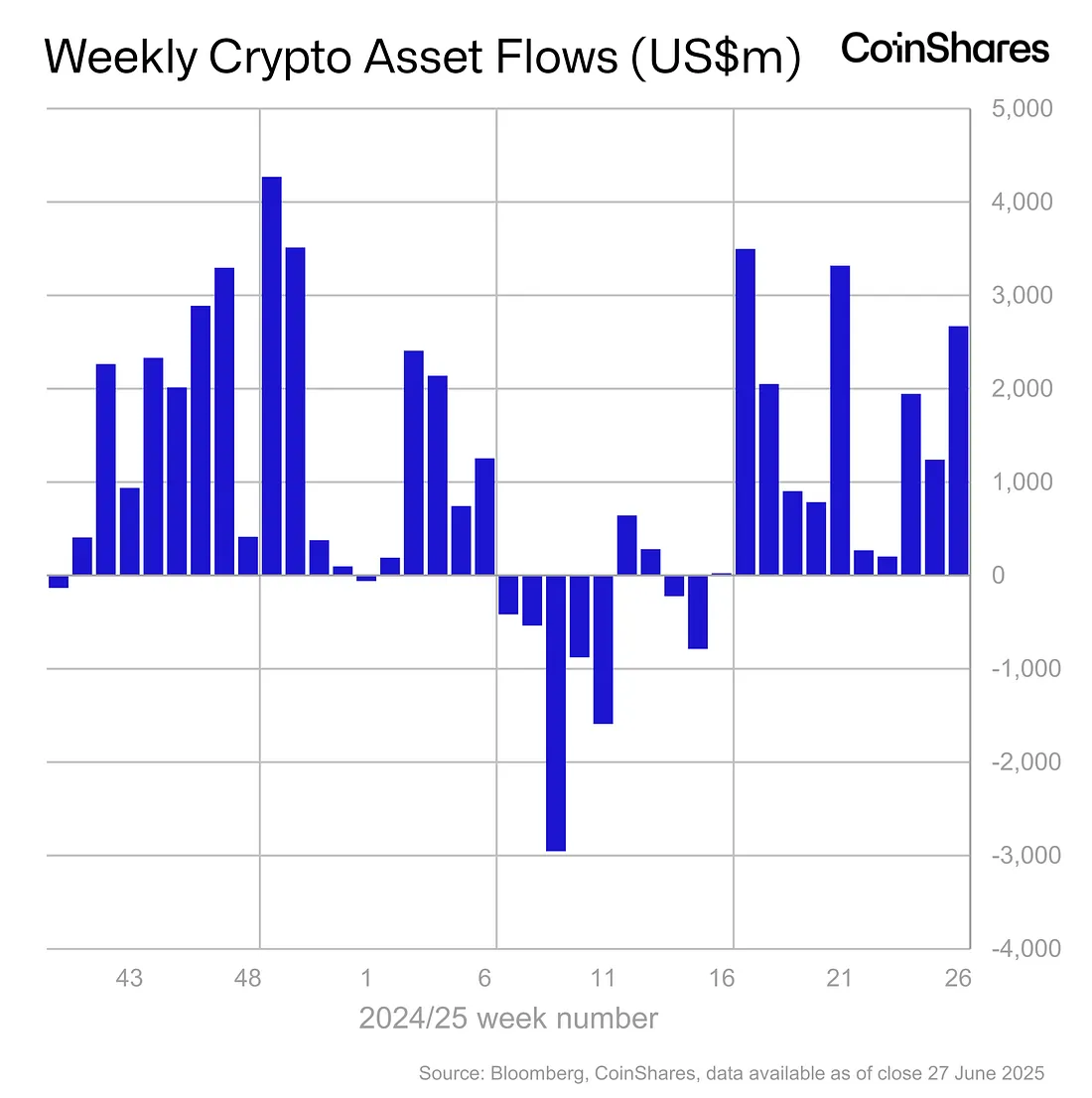
Crypto Investment Surge: Institutional Appetite Hits Historic Highs as Inflows Near $7 Billion YTD
The digital asset landscape is witnessing a seismic shift in investor sentiment, as institutional capital pours into cryptocurrency investment vehicles at a rate not seen since the early months of the year. According to the latest Digital Asset Fund Flows Weekly Report from CoinShares, the leading European digital asset manager, the sector has secured a robust fourth consecutive week of inflows, cementing a bullish trend that is rapidly approaching historic record-breaking levels.
The Main Facts: A Billion-Dollar Week
The crypto market’s recent momentum culminated in a massive inflow of $882 million globally over the past week. This influx of capital has propelled the Year-to-Date (YTD) total inflows to a staggering $6.7 billion. As market analysts observe the trajectory, it is evident that the industry is closing in on the $7.3 billion peak established in early February 2024.
This wave of investment is not merely a reflection of speculative interest; it represents a fundamental recalibration of institutional portfolios. Bitcoin (BTC) remains the undeniable titan of this movement, capturing the vast majority of the capital, while newer, high-performance chains like SUI are carving out significant niches for themselves.
Chronology of the Rally
To understand the significance of the current surge, one must look at the timeline of the 2024 institutional cycle:
- January 2024: The launch of spot Bitcoin ETFs in the United States fundamentally changed the investment landscape, providing a regulated bridge between traditional finance (TradFi) and the crypto ecosystem.
- February 2024: Initial hype and massive adoption led to a record-breaking $7.3 billion in inflows.
- March – September 2024: A period of volatility and market consolidation followed, characterized by varying levels of outflows and modest inflows as investors waited for clearer macroeconomic signals.
- October 2024: The current rally began in earnest, characterized by four consecutive weeks of sustained buying pressure.
- The Present: With cumulative net inflows into US-listed ETFs hitting $62.9 billion—surpassing the previous record of $61.6 billion—the market has officially entered a new phase of institutional maturity.
Supporting Data: Regional and Asset-Specific Trends
The data provided by CoinShares paints a clear picture of geographic preferences. The United States continues to lead the global charge, recording $840 million in inflows. This dominance reflects the efficacy of the U.S. ETF market in capturing institutional liquidity.
Germany and Australia followed, with $44.5 million and $10.2 million respectively. Conversely, the market saw minor outflows from Canada and Hong Kong, totaling $8 million and $4.3 million. While these figures are small in comparison to the massive inflows elsewhere, they highlight a regional divergence in risk appetite and regulatory outlook.
Asset Performance Breakdown
- Bitcoin (BTC): The clear winner, attracting $867 million in inflows. The asset has reached a critical milestone, proving its resilience as a "digital gold" equivalent in institutional portfolios.
- SUI: Demonstrating its growing popularity as a scalable smart-contract platform, SUI-based investment products saw $11.7 million in new capital.
- Ethereum (ETH): Surprisingly muted, Ethereum saw only $1.5 million in inflows, suggesting that while the market is bullish on the asset class as a whole, specific interest in Ethereum is currently lagging behind Bitcoin’s dominance.
Official Analysis: The "Why" Behind the Inflows
CoinShares researchers attribute this sharp uptick to a "perfect storm" of macroeconomic and geopolitical factors. In their report, the firm outlines three primary drivers:
- M2 Money Supply Expansion: Globally, the increase in M2 money supply—a measure of the total money supply including cash, checking deposits, and easily convertible near-money—has historically acted as a precursor to asset inflation. As fiat liquidity increases, investors look toward non-correlated assets like Bitcoin to preserve value.
- Stagflationary Risks in the US: The persistent concern over stagflation—a combination of stagnant economic growth and high inflation—has led investors to seek hedges outside of traditional equities and bonds. Crypto, particularly Bitcoin, is increasingly being viewed as a "hard asset" that can withstand inflationary pressure.
- Bitcoin as a Strategic Reserve: A pivotal development has been the legislative progress in several US states regarding the treatment of Bitcoin as a strategic reserve asset. This institutional endorsement provides a level of legitimacy that was previously absent, encouraging more conservative funds to allocate capital to the asset class.
Implications for the Future
The implications of these record-breaking flows are profound. We are no longer looking at a market driven solely by retail "FOMO" (fear of missing out). Instead, we are observing a structural shift where institutional capital is treating digital assets as a permanent component of a diversified portfolio.
The Institutionalization of Crypto
The fact that US-listed ETFs have surpassed their previous cumulative net inflow record is a powerful signal. It suggests that the "easy money" phase of the ETF launch is over, and we are now in a phase of steady, long-term accumulation. Major wealth management firms and pension funds are likely behind this latest push, as they begin to move past their initial due diligence phases.
Market Volatility and Risk Management
While the inflows are bullish, they do not eliminate risk. The crypto market remains highly sensitive to macroeconomic shifts. Should the US Federal Reserve pivot on interest rates or if there is a sudden contraction in global liquidity, the same vehicles that saw massive inflows could experience rapid outflows.
Furthermore, the disparity between Bitcoin and Ethereum inflows is a point of concern for some market analysts. While Bitcoin acts as the "risk-off" digital asset, Ethereum’s relative underperformance suggests that investors are currently favoring security and scarcity over the utility and dApp-ecosystem focus that Ethereum provides.
Regulatory Trajectory
The mention of US states approving Bitcoin as a strategic reserve is perhaps the most significant long-term trend. If this becomes a trend, we could see a "race to the top" where jurisdictions compete to attract crypto-capital by offering clearer regulatory frameworks and tax incentives. This would further entrench digital assets into the global financial architecture.
Final Perspective
As the year draws to a close, the data from CoinShares confirms that institutional demand for crypto remains robust and resilient. With $6.7 billion in YTD inflows, the market is poised to shatter previous records. However, investors are cautioned that while the trend is positive, the inherent volatility of the crypto market necessitates rigorous due diligence.
The transition from a speculative fringe asset class to an institutional-grade financial instrument is well underway. Whether this momentum will sustain itself through the end of the year depends on how the market digests upcoming economic data and whether the current regulatory tailwinds continue to provide the stability that large-scale capital requires. For now, the narrative is clear: the institutions are here, and they are buying.
Disclaimer: The information provided in this article is for informational purposes only and does not constitute financial, investment, or legal advice. Digital assets are subject to high volatility and significant risk of loss. Investors should conduct their own research and consult with a professional financial advisor before making any investment decisions.