
Crypto Market Cool-Down: Centralized Exchange Volumes Plummet After Half-Year Rally
The high-octane momentum that propelled the cryptocurrency market during the first quarter of 2024 has hit a significant speed bump. After six consecutive months of aggressive expansion, the global digital asset landscape experienced a sharp contraction in April. According to the latest data from blockchain intelligence firm CCData, the combined trading volume across centralized crypto exchanges (CEXs) suffered a dramatic 43.8% decline, signaling a potential shift in investor sentiment and market participation.
The Core Data: A Multi-Trillion Dollar Contraction
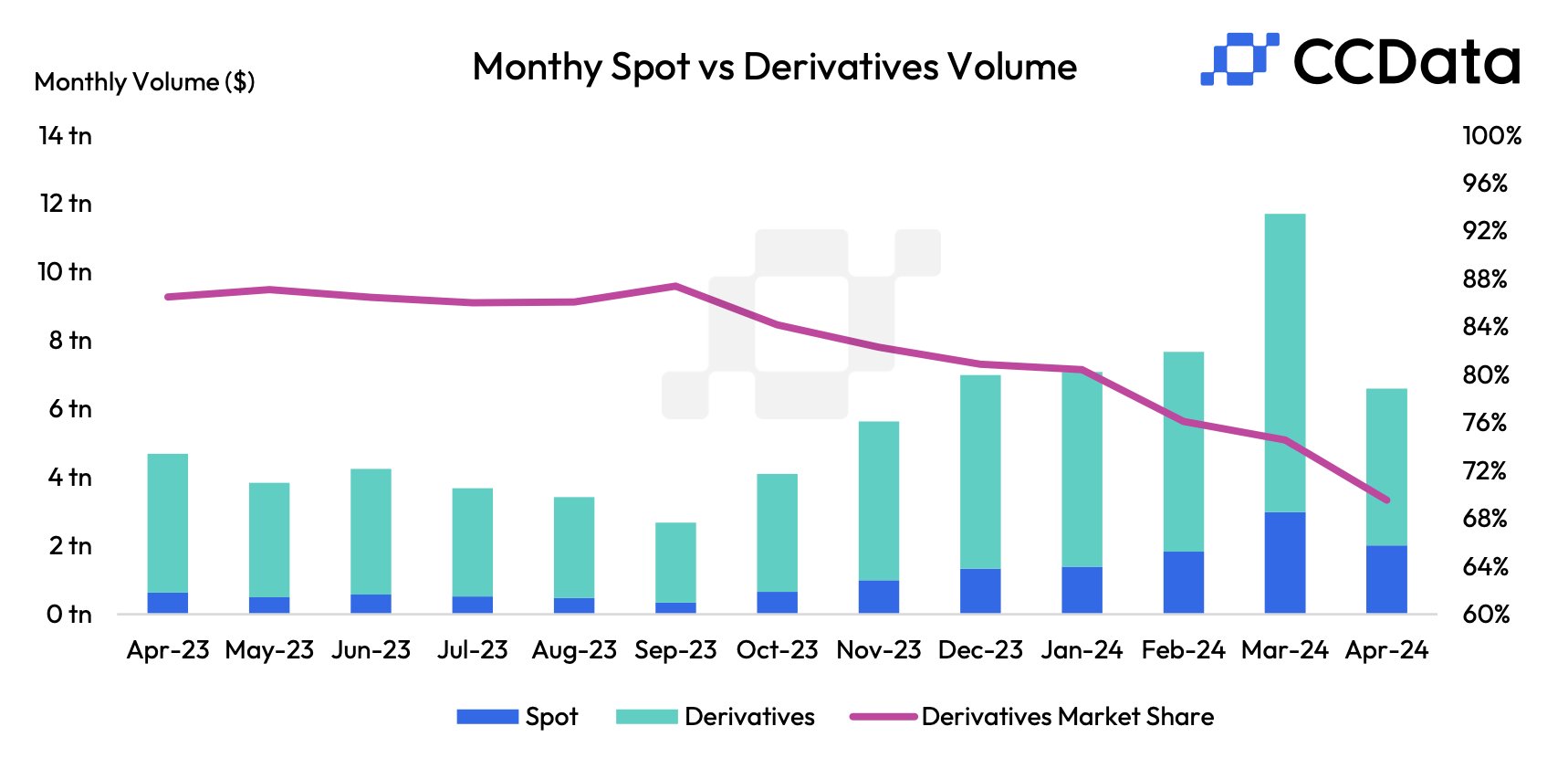
The numbers, as reported by CCData, reflect a profound cooling period for the centralized sector. In March, the aggregate volume of spot and derivatives trading on centralized platforms reached a staggering $11 trillion. By the close of April, that figure had plummeted to $6.58 trillion.
This decline marks the first significant reversal in a trend that had seen consistent growth since the autumn of 2023. While a drop of this magnitude—nearly 44%—might appear alarming at first glance, market analysts urge a nuanced perspective. When contextualized against the historical performance of the preceding year, the April figures remain robust. In fact, despite the sharp month-over-month decline, the volume generated in April 2024 is still substantially higher than almost every month recorded throughout 2023, with the sole exception of December.
The Impact on Industry Titans
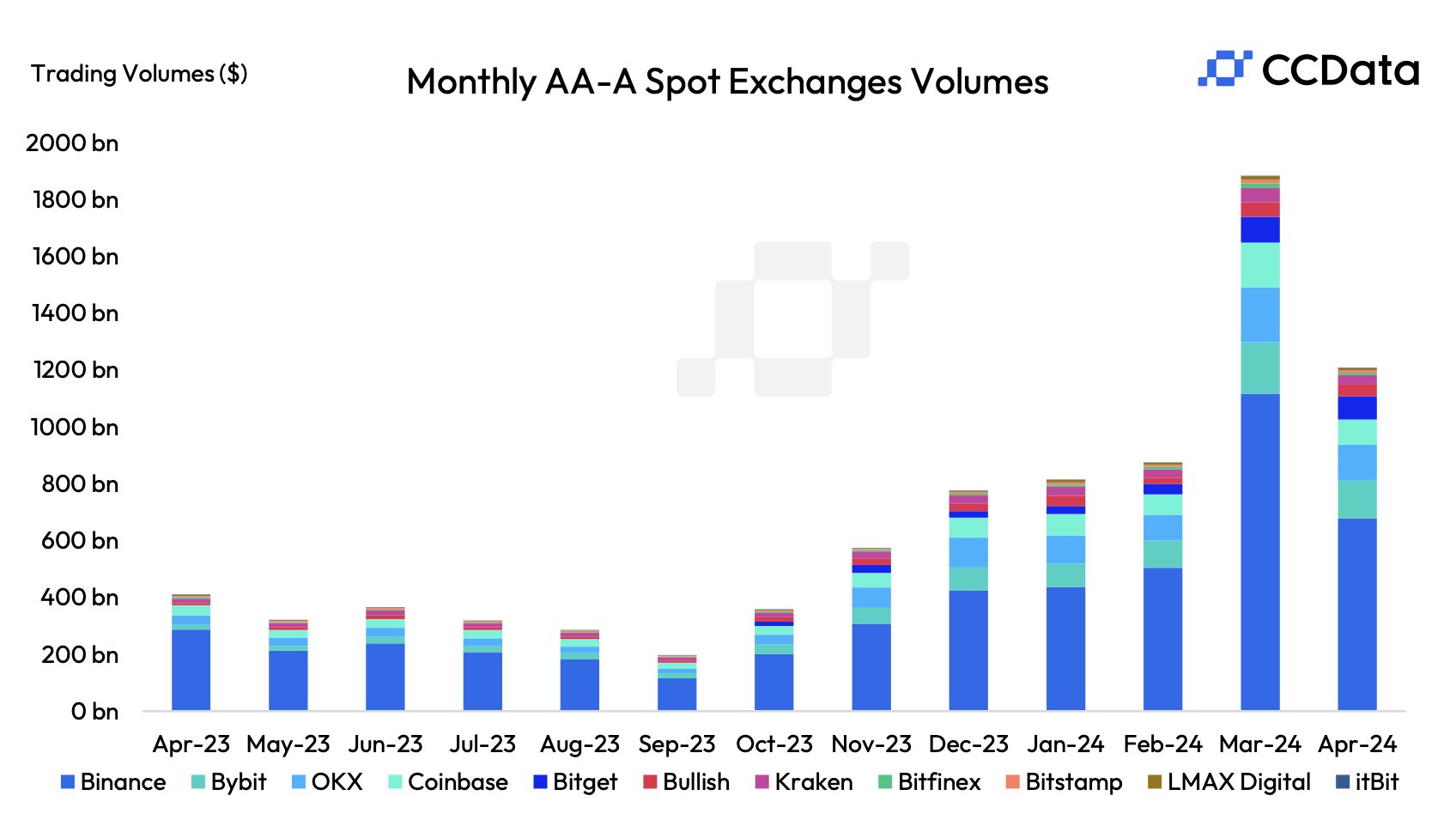
The contraction was not uniform, but it hit the industry’s largest players with the most force. CCData’s analysis identifies Binance, Bybit, and OKX as the primary entities bearing the brunt of the market slowdown.
- Binance: As the world’s largest cryptocurrency exchange by volume, Binance saw its spot trading volume fall by 39.2%, landing at approximately $679 billion.
- Bybit: Ranking among the top-tier exchanges, Bybit experienced a 26.9% decrease, with its monthly volume totaling $133 billion.
- OKX: Similarly, the exchange reported a 34.8% drop, finishing the month with $126 billion in volume.
These figures underscore a broader trend: as market liquidity tightens and volatility stabilizes, retail and institutional interest appears to be retreating from the frantic pace of the first quarter.

Chronology of the 2024 Market Surge and Retreat
To understand the current state of the market, it is essential to trace the trajectory that led to this point.
Q1 2024: The Era of Exuberance
The beginning of 2024 was defined by the anticipation and subsequent approval of spot Bitcoin ETFs in the United States, followed by the heightened speculation surrounding the Bitcoin halving event in April. From January through March, capital flooded into the ecosystem. February saw volumes rise to approximately $8 trillion, and the momentum peaked in March with an unprecedented $11 trillion in combined trading volume. This period was characterized by "fear of missing out" (FOMO) and aggressive price discovery for major assets like Bitcoin and Ethereum.
April: The Pivot
As April commenced, the market entered a period of consolidation. Several macroeconomic factors, including persistent inflationary concerns in the U.S. and shifting interest rate expectations from the Federal Reserve, began to dampen the appetite for risk-on assets. By mid-April, as the Bitcoin halving event passed—an event often dubbed a "sell the news" scenario—traders began to take profits and reduce exposure, leading directly to the volume drop highlighted by CCData.
Supporting Data: The Sector-Specific Divergence
While centralized trading volume took a hit, the broader ecosystem showed signs of internal rotation. CCData’s performance reports reveal that while broad trading activity slowed, specific niche sectors within the crypto market actually posted positive returns as of mid-May, indicating that liquidity did not vanish entirely but rather shifted focus.
Performance by Niche (Month-to-Date as of May 10th)
- Metaverse/Gaming: Leading the pack, this sector saw a 32.4% climb in returns. This suggests that despite the lack of broad market volume, specific projects with utility or community-driven narratives continue to attract speculative capital.
- Artificial Intelligence (AI): Benefiting from the broader tech-sector AI boom, crypto projects focused on AI infrastructure saw a 17.4% increase.
- Meme Tokens: Despite their inherent volatility, meme coins maintained resilience, posting a 16.2% return.
- Infrastructure and DeFi: These foundational sectors saw modest gains of 1.6% and 6.7%, respectively.
- Layer-2 Solutions: Interestingly, the scaling solutions that were highly touted in early 2024 fell into negative territory, with a -4.2% return, reflecting a potential saturation or a cooling of interest in the L2 narrative for the immediate term.
This divergence is critical. It suggests that while the "CEX volume" metric is down, the market is not experiencing a uniform collapse. Instead, it is undergoing a structural rebalancing where investors are moving away from speculative day-trading of major assets toward thematic plays in AI and gaming.
Implications for the Broader Crypto Economy
The 43.8% drop in trading volume carries several implications for the future of the crypto industry.
1. The "Post-Halving" Reality Check
Historically, Bitcoin halving events are followed by a period of volatility and volume stabilization. The current data aligns with historical patterns, suggesting that the industry is moving into a "post-hype" phase. Exchanges that relied on the frenetic activity of the first quarter may need to adjust their operational strategies if this lower volume environment persists.
2. The Shift Toward Decentralization?
While CCData focused on centralized exchanges, the drop in volume often prompts discussions regarding Decentralized Exchanges (DEXs). When centralized platforms become less active, it is worth monitoring whether traders are moving their capital into non-custodial environments or simply exiting the market entirely. If users are moving to DEXs, it could signal a long-term shift in the market’s preference for self-custody and trustless trading.
3. Regulatory Pressures
The heightened scrutiny of major centralized exchanges by global regulators—particularly in the United States—cannot be ignored as a contributing factor. As exchanges implement more rigorous KYC (Know Your Customer) and AML (Anti-Money Laundering) requirements, the friction for retail traders increases, which can naturally lead to lower transaction frequencies compared to the unregulated environments of the past.
4. Institutional Sentiment
Institutional investors often use periods of lower volume to accumulate positions at lower prices. The reduction in overall trading volume may indicate that "smart money" is currently in a wait-and-see mode, waiting for clearer macroeconomic signals from the central banks before committing significant new capital to the market.
Conclusion: A Temporary Lull or a New Normal?
The significant decline in centralized exchange trading volume in April is a clear indicator that the frantic, record-breaking pace of the first quarter has subsided. However, the data should be viewed as a market normalization rather than a systemic failure. With volumes still hovering well above 2023 levels, the interest in digital assets remains historically high.
For market participants, the message is clear: the era of easy, broad-based gains fueled by massive inflows is currently on pause. As the market pivots toward sector-specific growth in AI, gaming, and other niche technologies, investors must become more selective. The coming months will be a test of whether the broader market can find a new floor for trading activity or if further contraction is required before the next major bull cycle can take hold.
Disclaimer: The information provided in this article is for educational and informational purposes only and does not constitute financial, investment, or legal advice. Cryptocurrency investments are inherently volatile and carry a high risk of loss. Always conduct your own due diligence and consult with a qualified financial advisor before making any investment decisions.