
Crypto Market Cool-Down: Trading Volumes Plunge as Sector Shifts Focus
The meteoric rise of the cryptocurrency market, which captivated investors throughout the first quarter of 2024, faced a significant reality check in April. According to the latest data from blockchain analytics firm CCData, the trading landscape on centralized cryptocurrency exchanges (CEXs) experienced a sharp contraction, breaking a six-month streak of consecutive growth. This cooling period serves as a critical juncture for the industry, as market participants grapple with shifting macroeconomic conditions and evolving investor sentiment.
Main Facts: A Staggering 43.8% Decline
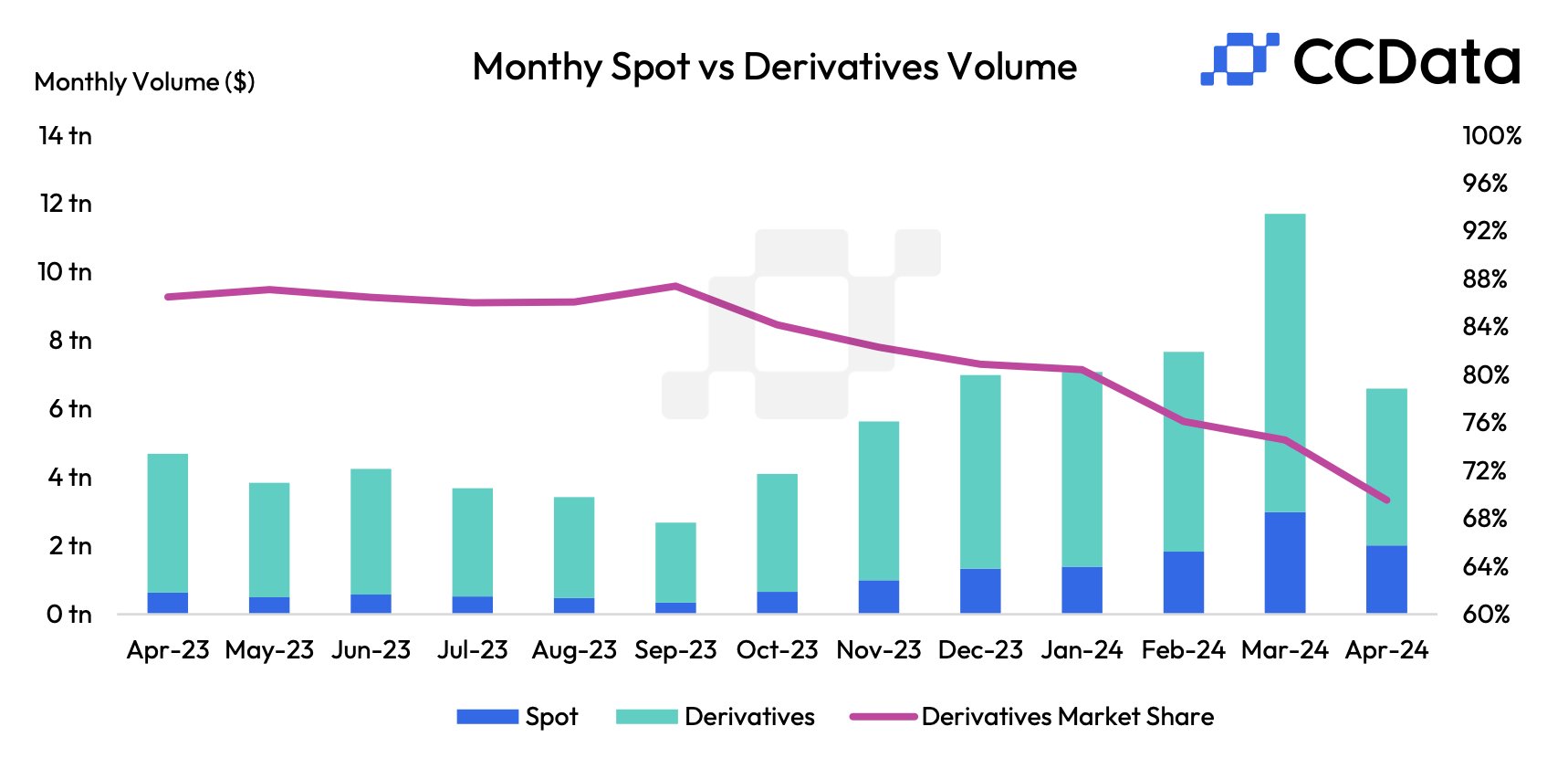
The headline figures released by CCData are stark: the combined volume of spot and derivatives trading across centralized exchanges plummeted by 43.8% in April, totaling $6.58 trillion. This figure stands in sharp contrast to the records set in the preceding months. In March, the industry reached a frenzy of activity with approximately $11 trillion in trading volume, following a robust February that saw roughly $8 trillion in activity.
While a 43.8% drop might appear alarming, context is essential. Despite the contraction, April’s $6.58 trillion total remains higher than any monthly performance recorded throughout the entirety of 2023, with the notable exception of December. This suggests that while the "fever pitch" of early 2024 has subsided, the fundamental liquidity and institutional interest in the sector remain significantly elevated compared to the bear market conditions that defined the previous year.
Chronology: The Rise and Retrenchment
To understand the current state of the market, one must look at the trajectory of the past half-year. Since late 2023, the crypto market was fueled by the anticipation and subsequent approval of spot Bitcoin ETFs in the United States, as well as the build-up to the Bitcoin halving event in April.
- Q4 2023: The market began a steady climb as institutional interest solidified. By December, trading volumes had reached a local peak, reflecting a "bullish" shift in sentiment.
- January–February 2024: Momentum accelerated. February saw volumes climb to $8 trillion, bolstered by increased capital inflows into the digital asset ecosystem.
- March 2024: The "peak" of the cycle to date. With Bitcoin hitting fresh all-time highs, speculative trading reached a crescendo, pushing volumes to an impressive $11 trillion.
- April 2024: The turning point. As the market hit a period of consolidation following the halving, volatility decreased, and speculative fervor cooled, leading to the substantial volume contraction reported by CCData.
Supporting Data: Examining the Heavy Hitters
The decline in trading volume was not distributed evenly across the ecosystem. Major industry players, who typically capture the lion’s share of retail and institutional volume, faced the steepest declines. CCData’s analysis highlights the performance of the sector’s top-tier exchanges:

The Binance Landscape
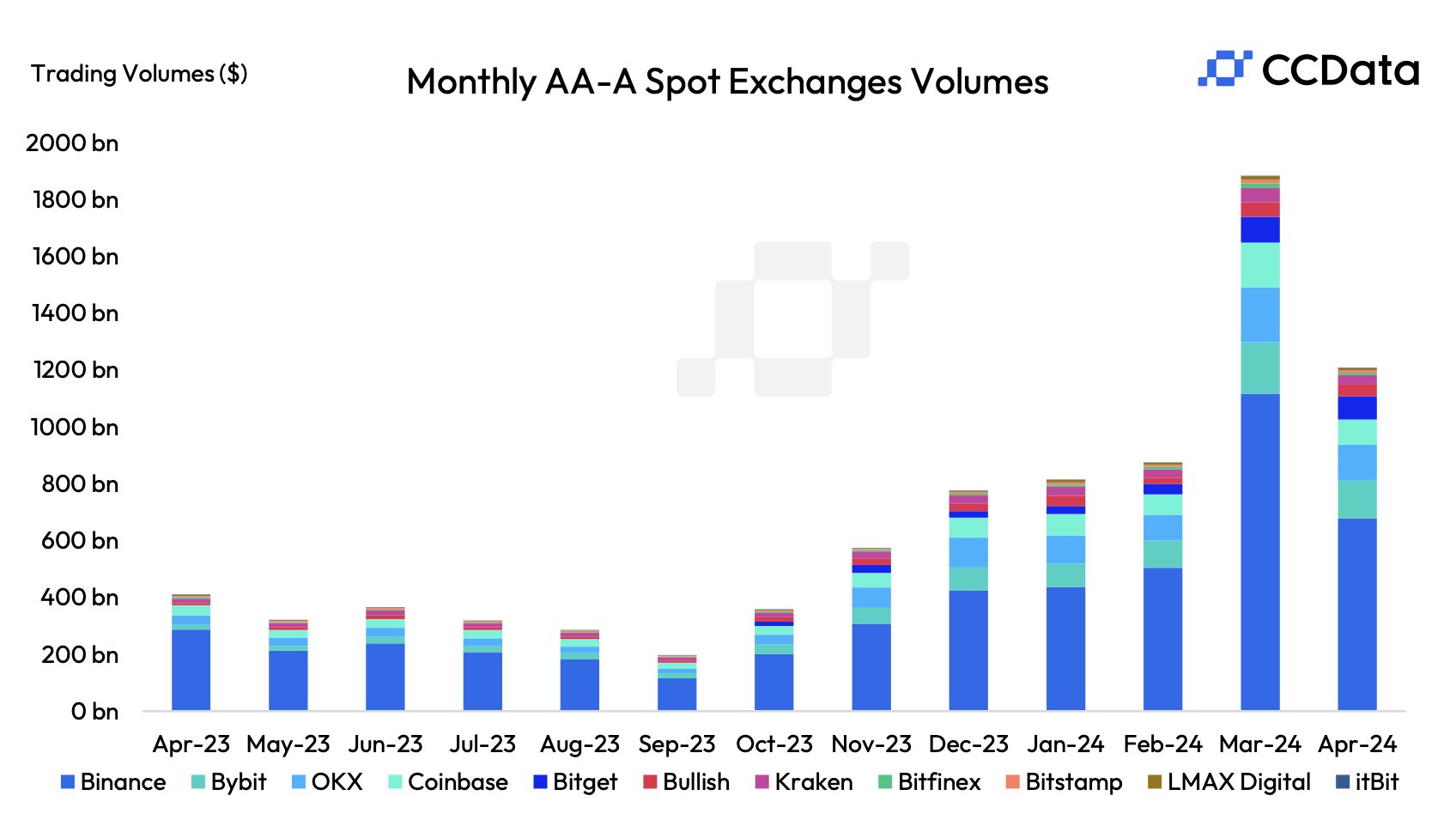
As the world’s largest exchange by volume, Binance continues to set the benchmark for the industry. In April, the exchange saw its spot trading volume hit $679 billion—a 39.2% decrease from the previous month. While this decline is substantial, it mirrors the broader market trend of reduced participation from retail traders who had been highly active during the Q1 price rallies.
The Challenges for Bybit and OKX
Bybit and OKX, two of the most significant competitors in the derivatives and spot markets, also faced sharp declines. Bybit recorded $133 billion in volume, representing a 26.9% drop, while OKX saw its figures fall by 34.8% to $126 billion. These figures demonstrate that even the most robust platforms are subject to the cyclical nature of crypto markets, where volume is often inextricably linked to price action and market volatility.
Sector Performance: Where Capital is Moving
While centralized exchange volume indicates a broader move toward the sidelines, capital within the crypto ecosystem has not vanished; rather, it has rotated. CCData’s performance breakdown for the month-to-date (as of May 10th) reveals a fascinating divergence in investor interest.
The Rise of Metaverse, AI, and Meme Coins
Investors appear to be pivoting away from "blue-chip" trading toward higher-beta, high-reward sectors. The Metaverse and gaming sector led the pack with a 32.4% gain, suggesting a renewed interest in blockchain-based entertainment. Following close behind, Artificial Intelligence (AI) tokens saw a 17.4% return, and the ever-volatile meme coin sector managed a 16.2% gain. This indicates that while the "masses" may have paused their heavy trading, niche communities are still driving significant capital flows into speculative assets.
The Lagging Sectors
Conversely, more "foundational" sectors experienced stagnation or decline. Layer-2 scaling solutions, which are critical for the long-term scalability of networks like Ethereum, saw a 4.2% decline in returns. This cooling in Layer-2 activity may suggest that the current market phase is favoring short-term speculative narratives over long-term infrastructure plays.
Implications: What Does This Mean for the Market?
The contraction in April has several profound implications for the crypto industry as it enters the middle of 2024.
1. Market Consolidation and Sustainability
The drop in volume can be viewed as a healthy consolidation phase. After a parabolic run in Q1, the market needed to stabilize. High trading volumes are often associated with extreme volatility, which can deter long-term institutional investors. A period of lower, more stable volume can provide the foundation for a more sustainable price discovery process.
2. The Shift in Retail Sentiment
The decline in volumes on platforms like Binance and OKX suggests that retail participants, who are often the primary drivers of massive volume spikes, have taken a "wait and see" approach. Many are likely waiting for a clearer signal from the Federal Reserve regarding interest rates or for a fresh catalyst to drive Bitcoin and Ethereum prices higher.
3. Increased Focus on Utility
The outperformance of AI and Metaverse tokens suggests that investors are increasingly looking for "the next big thing" beyond simple store-of-value assets. As the market matures, the focus is shifting from simple speculative trading to the identification of sectors that offer genuine utility or technological disruption.
4. Regulatory and Operational Pressure
For centralized exchanges, the drop in volume is a double-edged sword. While it reduces the pressure on platform infrastructure, it also represents a direct hit to revenue models based on trading fees. This may force exchanges to diversify their service offerings—moving further into staking, lending, and institutional custody services—to ensure they are not solely reliant on high-frequency trading volume.
Conclusion: A New Phase of Maturity
The April data from CCData serves as a reminder that the cryptocurrency market remains highly cyclical. A 43.8% decline in trading volume after a period of intense growth is not necessarily a sign of failure; rather, it is an indicator that the market is recalibrating.
As we look toward the remainder of the year, the industry is transitioning from the explosive, news-driven excitement of the Bitcoin ETF launch into a more calculated phase of growth. For traders and investors, the current environment demands a deeper focus on fundamental sector performance rather than relying on broad market momentum. Whether this cooling period acts as a precursor to another explosive run or a longer period of horizontal price movement remains to be seen, but one thing is clear: the underlying infrastructure of the crypto economy is larger and more resilient than it has ever been.
Investors are advised to remain diligent, keep a close watch on macroeconomic indicators, and maintain a diversified strategy as the market continues to evolve. As always, the digital asset space remains inherently high-risk, and participants should exercise caution in their trading and investment decisions.