
Crypto on Track to Reach 4 Billion Users by 2030, Outpacing Early Internet Adoption, Says Raoul Pal
Global Digital Asset Ecosystem Surpasses 500 Million Users, Defying Historical Tech Growth Curves
Main Facts
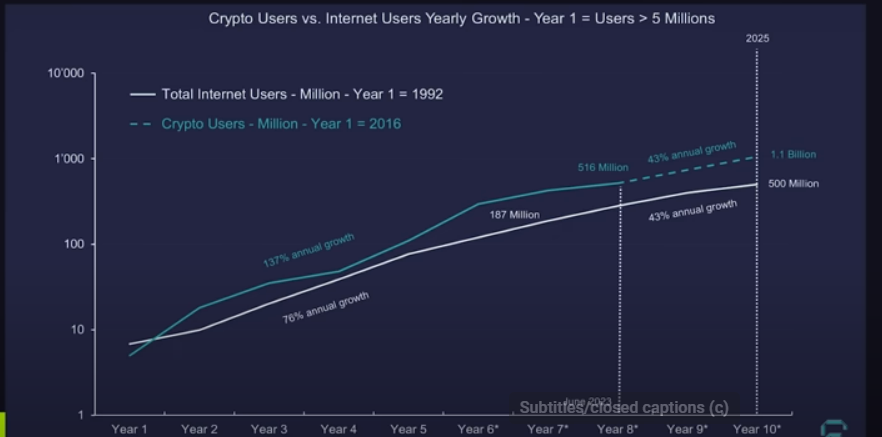
Cryptocurrency adoption is advancing at a historical pace, outstripping the early growth trajectory of the internet. According to macro strategist and Real Vision CEO Raoul Pal, empirical data from a widely tracked five-year adoption model indicates that the digital asset ecosystem is firmly on schedule to reach a staggering four billion users by 2030.
Pal, a former Goldman Sachs executive and prominent macroeconomic analyst, shared these projections in a recent market update. His thesis centers on a comparative growth analysis between the nascent internet of the 1990s and the expansion of Bitcoin (BTC) and the broader cryptocurrency market since 2016.
Key takeaways from Pal’s latest analysis include:
- Current User Base: The global cryptocurrency user count has climbed to approximately 516 million individuals.
- Near-Term Milestone: The digital asset sector is projected to surpass one billion users by the end of 2025.
- Long-Term Projection: Assuming crypto adoption trends eventually mirror the maturation rate of the internet, approximately half of the global population (4 billion people) will use crypto by 2030.
- Growth Velocity: While the internet previously held the record for the fastest technology adoption curve in human history—growing at roughly 76% annually during its initial phases—cryptocurrency has eclipsed that benchmark with a compound annual growth rate (CAGR) of 137%.
Chronology: The Evolution of Digital Asset Growth
To understand the weight of Pal’s projections, it is essential to trace the timeline of technology adoption and how the cryptocurrency asset class has matured over the past decade.
2016: The Baseline Inflection Point
In 2016, the global cryptocurrency market officially crossed the threshold of one million users. While this figure represented a passionate, highly technical community of early adopters, cypherpunks, and hobbyist miners, it was statistically negligible on a global scale. However, 2016 served as the foundational baseline for modern cryptographic adoption curves, coinciding with the maturation of accessible exchange infrastructure and the post-2012 Bitcoin halving economic cycle.
2017–2021: The Retail Boom and Institutional Awakening
During the late 2010s, cryptocurrency experienced exponential surges in public awareness. The 2017 bull market brought decentralized assets into the mainstream consciousness, while the 2020–2021 market cycle introduced institutional capital, corporate balance-sheet allocations, and decentralized finance (DeFi) protocols. Throughout this five-year window, user growth routinely defied traditional technological adoption models, expanding at an unprecedented average rate of 137% per year.
2022–2024: Resiliency Amid Bear Markets
Despite severe macroeconomic headwinds, rising interest rates, and high-profile industry collapses throughout 2022 and 2023, the global crypto user base continued to expand. By mid-2024, cumulative global adoption had broken past the half-billion mark, reaching 516 million users. To put this in perspective, at the exact same relative stage of its lifecycle (measured from its equivalent technological infancy), the internet had only amassed 187 million users.
2025 and Beyond: The Path to One Billion
According to Pal’s models, the crypto ecosystem is rapidly approaching its next major psychological and structural milestone. Factoring in a natural deceleration of growth—aligning crypto’s trajectory with the historical slowdown experienced by the internet after its eighth year—the industry is projected to hit 1.1 billion users by the close of 2025.

Supporting Data: Comparing Internet vs. Crypto Adoption Curves
Pal’s bullish outlook is not based on speculative hype, but rather on quantitative comparative analysis. By overlaying the historical growth metrics of the internet onto the expansion of the digital asset economy, analysts can model future adoption paths with reasonable statistical confidence.
The Internet’s Historical Trajectory
During the dawn of the commercial internet in the mid-to-late 1990s, humanity witnessed the fastest technological adoption curve in recorded history up to that point.
- Early Growth Phase: The internet expanded at an astonishing rate of 76% per year.
- Maturation Phase: After year eight, as global penetration deepened and infrastructure challenges shifted, the annual growth rate naturally moderated to 43% per year.
Crypto’s Outperformance
Cryptocurrency has systematically outperformed those historical benchmarks.
- Current Growth Rate: Digital assets have maintained an average growth rate of 137% per year over the past five years.
- Scale Comparison: At its current stage, crypto boasts 516 million users, dwarfing the 187 million internet users recorded at the equivalent milestone in the internet’s lifecycle.
[Technology Adoption Comparison]
---------------------------------------------------------
Metric                  Internet (Early)    Crypto (Current)
---------------------------------------------------------
Annual Growth Rate      76% (slowed to 43%)  137%
Users at Milestone      187 Million         516 Million
Projected 2025 Users    --                  1.1 Billion
Projected 2030 Users    --                  4.0 Billion (50% of globe)
---------------------------------------------------------
Modeling the 2030 Horizon
When projecting forward, Pal utilizes a conservative assumption: that crypto’s hyper-growth phase will inevitably cool down to match the exact percentage growth rate of the internet’s historical maturation curve.
Even with this aggressive dampening of growth velocity factored into the math, the sheer compounding effect yields extraordinary results. By 2030, the model projects that four billion people—roughly half of the projected global population—will interact with blockchain technology, digital wallets, and decentralized protocols.
“If we look out further using the internet adoption growth and we slow down the trend rate of growth of crypto to the same as the internet going forward, we get to four billion users by 2030. That’s half the world’s population,” Pal noted in his video update. “Now will this be perfect? It’s been pretty perfect so far… Either way, these numbers are simply staggering.”
Official Responses and Industry Perspectives
Raoul Pal’s macro projections have sparked widespread discussion across the fintech, traditional finance, and blockchain sectors. While established institutional players and prominent analysts generally agree that blockchain technology is tracing a massive secular adoption curve, industry leaders emphasize that user growth will be driven by specific technological catalysts.
The Role of Infrastructure and User Experience (UX)
Many fintech executives point out that early crypto adoption was hindered by complex user interfaces, the friction of private key management, and regulatory ambiguity. However, the anticipated push toward one billion users by 2025 is largely expected to be driven by abstraction layers—such as account abstraction, institutional-grade custody solutions, and seamless Web3 integration inside traditional mobile applications.
“The next wave of digital asset users won’t necessarily care that they are interacting with a blockchain,” noted one prominent decentralized finance developer. “Just as billions of people use the internet today without understanding TCP/IP protocols, future users will adopt crypto because it provides faster, cheaper, and more efficient global financial services under the hood.”
Regulatory Clarity as a Catalyst
Institutional analysts also highlight the role of global regulation. As major jurisdictions—including the United States, the European Union, and parts of Asia—implement clearer regulatory frameworks for digital assets, traditional financial institutions (TradFi) are finding it easier to onboard retail and institutional clients into crypto-linked products, exchange-traded funds (ETFs), and tokenized assets. This institutional bridge is widely viewed as the highway that will funnel billions of traditional banking customers into the digital asset fold over the remainder of the decade.
Implications for Global Finance, Technology, and Society
The realization of Pal’s forecast—scaling from roughly 500 million users today to four billion users by 2030—carries profound implications for the global economy, monetary policy, cybersecurity, and technological development.
1. The Financialization of the Global South
A significant portion of the next billion crypto users is expected to emerge from emerging markets and developing economies. In regions plagued by hyperinflation, volatile local fiat currencies, and limited access to traditional banking infrastructure, cryptocurrencies and stablecoins serve as vital economic lifelines. Peer-to-peer digital cash networks and decentralized lending protocols offer unbanked populations direct access to a global, dollar-denominated or decentralized financial system without the need for legacy banking intermediaries.
2. Transformation of Traditional Banking and Payments
As half of the world adopts blockchain-enabled value transfer, legacy financial institutions will be forced to accelerate their technological transformations. Cross-border remittances, which currently incur exorbitant fees and multi-day settlement delays through SWIFT and traditional wire services, are increasingly being disrupted by stablecoins and layer-1 blockchain networks. Commercial banks must either integrate decentralized rails or risk obsolescence.
3. Regulatory and Sovereignty Challenges
A four-billion-user crypto economy presents unprecedented regulatory hurdles for nation-states. Governments will face mounting pressure to balance consumer protection and anti-money laundering (AML) compliance with the decentralized, censorship-resistant nature of public blockchains. The rise of Central Bank Digital Currencies (CBDCs) will likely run parallel to this growth, creating a dynamic multi-currency landscape where citizens choose between state-issued digital fiat and decentralized cryptocurrencies like Bitcoin.
4. Scalability and Infrastructure Demands
Finally, an active user base of four billion individuals will test the absolute limits of current blockchain infrastructure. Layer-1 networks, zero-knowledge (ZK) rollups, optimistic rollups, and modular blockchain architectures will need to handle millions of transactions per second (TPS) globally while maintaining decentralization and security. The engineering challenges solved over the next five years will determine whether blockchain technology can truly support half the human race smoothly.
Disclaimer: Opinions expressed in market updates and analyses do not constitute financial advice. Investors and market participants should conduct thorough due diligence before making high-risk investments in Bitcoin, cryptocurrencies, or digital assets. All trading and financial transfers carry inherent risks of loss.