
Ethereum’s Great Disconnect: Record Network Activity Meets Bearish Price Pressure
Despite the prevailing bearish sentiment currently dragging the cryptocurrency market downward, Ethereum (ETH) is exhibiting a curious and unprecedented phenomenon: a massive, historic disconnect between its price action and its fundamental utility. While market analysts warn that the price could retest the $1,500 support level—and some even point to deeper lows—the Ethereum network is operating at its highest level of intensity since its inception.
This paradox suggests that while speculators are retreating, the underlying ecosystem is experiencing a period of explosive growth. This report explores the divergence between Ethereum’s market valuation and its internal metrics, the shifting behavior of long-term holders, and what the experts say this means for the future of the leading smart contract platform.
Main Facts: The Divergence Phenomenon
The current market cycle has presented a unique anomaly. Typically, network activity correlates positively with price; when the price drops, user activity often wanes. However, Ethereum is currently defying this trend.
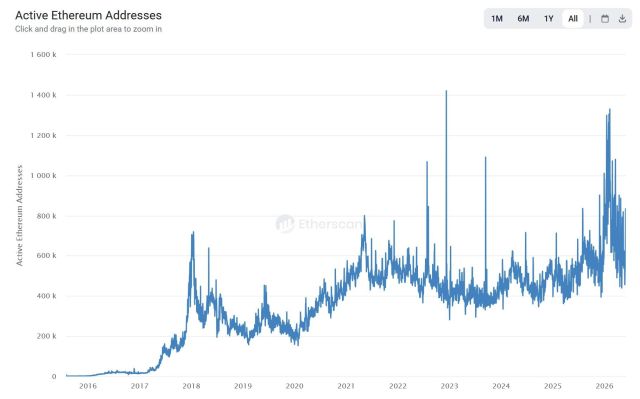
The core fact driving the current conversation is that daily active addresses on the Ethereum blockchain have surged to over 1.3 million, shattering previous records. For context, in the 2018 bull market, active addresses peaked at approximately 720,000, and during the euphoria of the 2021 bull run, that number reached 800,000.
This current surge is not merely a transient spike; it represents a fundamental shift in how the Ethereum network is utilized. From decentralized finance (DeFi) protocols and institutional tokenization to the burgeoning field of blockchain-based applications, Ethereum has cemented itself as the primary settlement layer for the digital economy. The disconnect remains: even as the price faces technical pressure, the "real-world" demand for block space has never been higher.

Chronology of Network Evolution
To understand the magnitude of this growth, one must look at the historical trajectory of Ethereum’s user base.
- 2018 (The Growth Phase): Ethereum saw significant interest as the first major smart contract platform. Active addresses peaked at 720,000, setting a benchmark for what a functional decentralized network looked like.
- 2021 (The Institutional Arrival): As the DeFi summer and NFT boom took hold, Ethereum hit a new ceiling of 800,000 daily active users. This period solidified ETH as a legitimate asset class for institutional investors.
- 2025–2026 (The Maturity Era): The current cycle has witnessed a seismic shift. Daily active addresses have consistently pushed past the 1 million mark, with recent peaks exceeding 1.3 million.
This chronology illustrates that despite a stagnating price, the "adoption curve" is moving in a diametrically opposite direction to the price chart. While speculators might see a "dead" asset, the data suggests a network that is fundamentally healthier than at any point in its history.
Supporting Data: Liquidity and Exchange Dynamics
The most compelling evidence for the "smart money" perspective on Ethereum comes from exchange outflow data. According to market analyst Leon Waidmann, the supply of ETH held on cryptocurrency exchanges has plummeted to historic lows.
As of the latest reports, only 14.5 million ETH remain on centralized exchanges. This is a staggering decline from October 2023, when exchange balances were hovering around 21 million ETH. Over the course of approximately 30 months, more than 6 million ETH have been withdrawn from trading platforms into private, cold, or institutional custody.
The "Buy-and-Hold" Sentiment
This massive exodus from exchanges indicates a strong conviction among market participants. In typical bearish scenarios, investors flee to stablecoins or cash, leading to exchange inflows. The current trend shows the exact opposite: "Whoever is buying here isn’t selling back," noted Waidmann. This behavior is characteristic of long-term accumulation, where sophisticated entities are taking advantage of price volatility to pull supply off the market, effectively tightening the circulating supply (the "float") available for potential future demand.

Expert Analysis: Identifying the Price Bottom
While the network metrics are bullish, the technical picture remains cautious. Professional analysts have turned to specific metrics to gauge where the "floor" for Ethereum might reside.
The Delta Price Metric
Ali Charts, a prominent analyst, has highlighted the importance of the Ethereum Delta Price. This metric represents the difference between the average cost basis of investors and the cost of production for miners. Historically, this metric has been highly effective in identifying the absolute bottom of market cycles, as it delineates a "maximum pain" zone where selling pressure eventually exhausts itself.
According to this analysis, Ethereum’s theoretical bottom lies near the $700 level. While this is significantly lower than current price points, the analysis suggests that should the broader macroeconomic environment force a capitulation event, $700 would represent the final accumulation zone before a sustained, long-term upward trend begins.
Implications: A Network for the Long Term
The current situation poses several critical implications for the broader cryptocurrency landscape:
1. Decoupling of Utility and Speculation
The most profound implication is the potential decoupling of ETH’s price from its utility. For years, the market viewed ETH solely as a speculative asset. The current data suggests that Ethereum is becoming a "utility-first" network, where the volume of transactions is driven by real-world usage—tokenization of real-world assets (RWAs), stablecoin settlements, and enterprise blockchain integration—rather than pure retail speculation.
2. The Supply Squeeze
With 6 million ETH pulled off exchanges, the market is becoming increasingly illiquid. In economic theory, when supply is constrained and demand (in this case, network activity) is rising, price appreciation is the inevitable long-term outcome. The current price action may be a temporary hurdle that masks a brewing supply-side squeeze.
3. Institutional Maturation
The shift in user addresses and the withdrawal of ETH into cold storage are hallmarks of institutional-grade participation. Institutions do not typically trade on short-term sentiment; they invest in infrastructure. The current activity suggests that the "smart money" is positioning itself for a multi-year horizon, viewing the current market dip as an entry point for a foundational asset.
Conclusion: A Tale of Two Ethereums
The narrative surrounding Ethereum is currently split into two distinct realities. On the surface, the price chart reflects a struggling asset, prone to bearish sentiment and technical retests. However, underneath the surface, the network is witnessing a period of unprecedented expansion.
Investors are faced with a choice: focus on the short-term price volatility or the long-term fundamentals. With daily active addresses hitting record highs and exchange supplies reaching historic lows, the data points to a network that is far from "dead." Instead, it is a project undergoing a quiet but powerful transformation, preparing for its next phase of growth. As the market eventually stabilizes, the disconnect between the current price and the underlying activity is likely to be reconciled, potentially in favor of those who recognized the network’s resilience during these uncertain times.
As always, while network metrics provide a strong indicator of health, investors should remain cognizant of the broader macroeconomic climate and the inherent risks of the digital asset space. The path to the next bull cycle may be paved with volatility, but the data suggests that Ethereum’s foundation has never been more solid.