
Ethereum’s Historic RSI Reset: Analyzing the 2026 Downtrend and Potential for a Cycle Reversal
The cryptocurrency landscape is currently gripped by a wave of bearish sentiment, and at the epicenter of this turbulence is Ethereum (ETH), the world’s leading smart-contract platform. In a development that has sent shockwaves through the digital asset community, Ethereum has breached the critical $1,800 support level, plummeting to lows not seen since the beginning of 2026. This downward trajectory, characterized by persistent sell-side pressure and shifting macroeconomic conditions, has culminated in a technical anomaly that has caught the attention of veteran traders and institutional analysts alike: the monthly Relative Strength Index (RSI) has hit its lowest level in the history of the asset.
Main Facts: A Technical Breakdown of the Current Sell-Off
Ethereum’s price action throughout the first half of 2026 has been defined by a relentless erosion of value. Following a peak of $4,946 in August 2025, the asset has spent nine months in a corrective phase that has tested the resolve of even the most dedicated "HODLers."
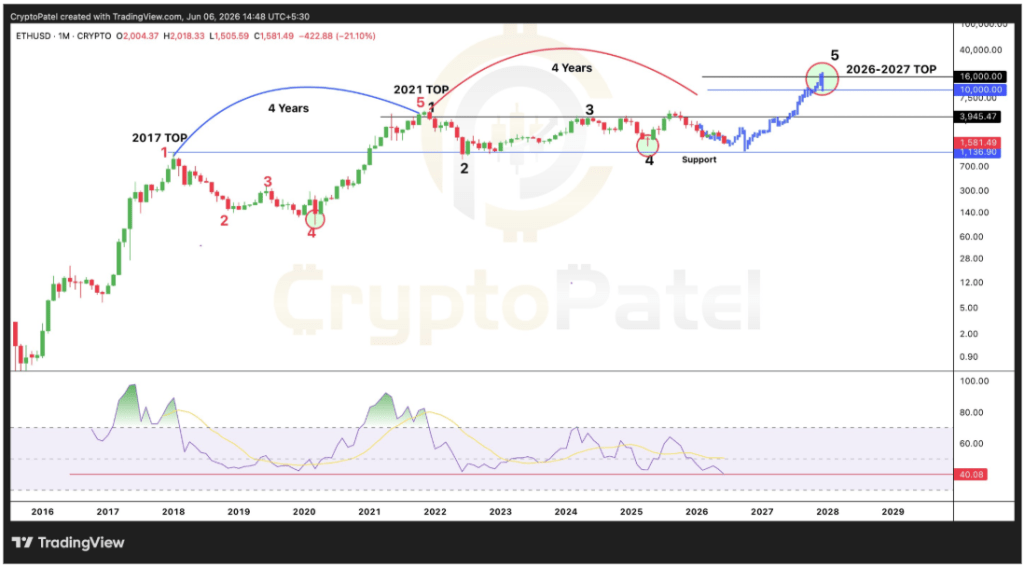
The most alarming development in this current cycle is the collapse of the monthly RSI. For the uninitiated, the RSI is a momentum oscillator that measures the speed and change of price movements on a scale of 0 to 100. Traditionally, an RSI below 30 is considered "oversold," suggesting that the asset may be undervalued and due for a reversal. However, Ethereum has now pushed to an RSI reading of approximately 40 on the monthly timeframe—a level so low that it has no historical precedent since the network’s inception in 2015.
This is not merely a statistical curiosity; it is a signal of extreme exhaustion among sellers. When a blue-chip asset like Ethereum reaches such a depressed momentum state, it indicates that the current downtrend may be approaching an asymptotic limit where the cost of selling outweighs the potential for further profit-taking.
Chronology of the Downtrend
To understand where Ethereum stands today, one must look at the timeline of its recent struggles. The asset’s journey through 2026 has been marked by a series of failed support tests:
- August 2025: Ethereum reaches its cycle peak of $4,946, buoyed by high institutional interest and bullish sentiment.
- Q4 2025 – Q1 2026: The market enters a cooling-off period, with Ethereum gradually losing its gains as macroeconomic headwinds—including inflationary pressures and high interest rates—begin to dampen appetite for risk-on assets.
- May 2026: The $2,000 support level, long considered the "line in the sand" for Ethereum bulls, begins to show significant cracks.
- June 2026: The dam breaks. Ethereum falls decisively below $1,800. In the last 24 hours of the reporting period, the price touched a nadir of $1,536, marking the lowest price point in the current calendar year.
- Current Standing: Trading near the $1,612 mark, the market is currently in a state of high volatility, with bulls desperately attempting to defend the $1,600 psychological support zone.
Supporting Data: Historical Precedents and RSI Dynamics
The current market setup invites comparisons to previous cycle lows, specifically the market bottoms of 2020 and 2022. In both instances, the monthly RSI provided a contrarian signal that preceded massive capital inflows and price appreciation.

The 2020 Recovery
In 2020, as the global economy reeled from pandemic-induced uncertainty, Ethereum’s RSI dropped into a "depressed" zone. Following that reset, the asset embarked on an explosive rally, climbing from the $88 level to a 2021 peak of over $4,800. The correlation between the RSI low and the subsequent 5,000% gain remains a focal point for long-term investors.
The 2022 Reset
Similarly, in 2022, Ethereum saw a deep RSI reset before the asset bottomed out near $880. That accumulation phase served as the launchpad for the historic bull run that eventually pushed ETH to its all-time high in late 2025.
Why 2026 is Different
The defining characteristic of the current 2026 reading is its extremity. While the 2020 and 2022 resets were significant, the current RSI level is the lowest in the history of the Ethereum blockchain. Some analysts argue that this represents a "washout" phase—a final capitulation where weak hands are forced out of the market. If historical patterns hold, the current oversold conditions suggest that Ethereum is closer to a cyclical bottom than a continuation of the current bear trend.
Institutional Perspectives: The Role of ETFs
The institutional landscape adds another layer of complexity to the current price action. Spot Ethereum ETFs have become a primary barometer for investor sentiment. Throughout June 2026, these products experienced a tumultuous period.
On June 4, a 17-day streak of consecutive outflows was finally broken, with a net inflow of $19 million. For a brief moment, it appeared that institutional capital was beginning to "buy the dip." However, this relief was ephemeral. By Friday, June 5, the trend reversed once again, with $5.97 million in net outflows. This flip-flopping highlights the uncertainty among institutional players, who appear hesitant to commit significant capital until a clear floor is established in the $1,500–$1,600 range.
Implications and Future Outlook
What does this mean for the average investor? The technical indicators suggest that Ethereum is currently navigating the most critical phase of its four-year cycle.
The $10,000 Projection
Despite the gloom, many long-term technical analysts remain optimistic about the broader multi-year trajectory. By mapping the 2017 peak to the 2021 peak, analysts have identified a consistent rhythm in Ethereum’s growth. Some projections suggest that the current market consolidation is the prelude to a new expansion phase, with potential price targets reaching as high as $10,000 by 2026-2027. This "Golden Triangle" of market movement relies on the assumption that Ethereum will maintain its dominance as the foundational layer for decentralized finance (DeFi) and enterprise blockchain solutions.
Risks and Caveats
It is essential to note that past performance is never a guarantee of future results. The crypto market is currently facing regulatory pressures, shifting monetary policies, and intense competition from Layer-1 alternatives. Furthermore, if Ethereum fails to hold the $1,600 support level, the next area of technical interest is significantly lower, which could trigger a secondary wave of liquidations.
Strategy for Investors
For those monitoring the charts, the immediate focus remains on the $1,600 level. Stronger inflows—particularly from institutional channels—are required to invalidate the current bearish momentum. Investors are advised to watch the RSI closely; if the index begins to tick upward while the price remains stable, it could indicate that selling pressure is finally exhausting itself, creating the ideal conditions for a reversal.
Conclusion
Ethereum stands at a precarious, yet potentially historic, juncture. The combination of a record-low monthly RSI and a sustained, grueling downtrend has brought the asset to a valuation that many long-term believers view as a generational entry point. While the immediate outlook is marred by volatility and shifting institutional inflows, the structural integrity of the Ethereum network remains intact.
Whether this period of extreme overselling acts as the foundation for a move toward a $10,000 valuation or a deeper test of market liquidity, one thing is certain: the eyes of the financial world are firmly fixed on the $1,600 threshold. In the volatile theater of cryptocurrency, Ethereum is once again playing the role of the ultimate stress test for market sentiment. The weeks ahead will likely determine whether the current RSI reset serves as the catalyst for the next great bull cycle or a warning sign of further turbulence ahead.