Institutional Capital Returns: Ethereum, XRP, and Solana Lead 2026 Market Resurgence
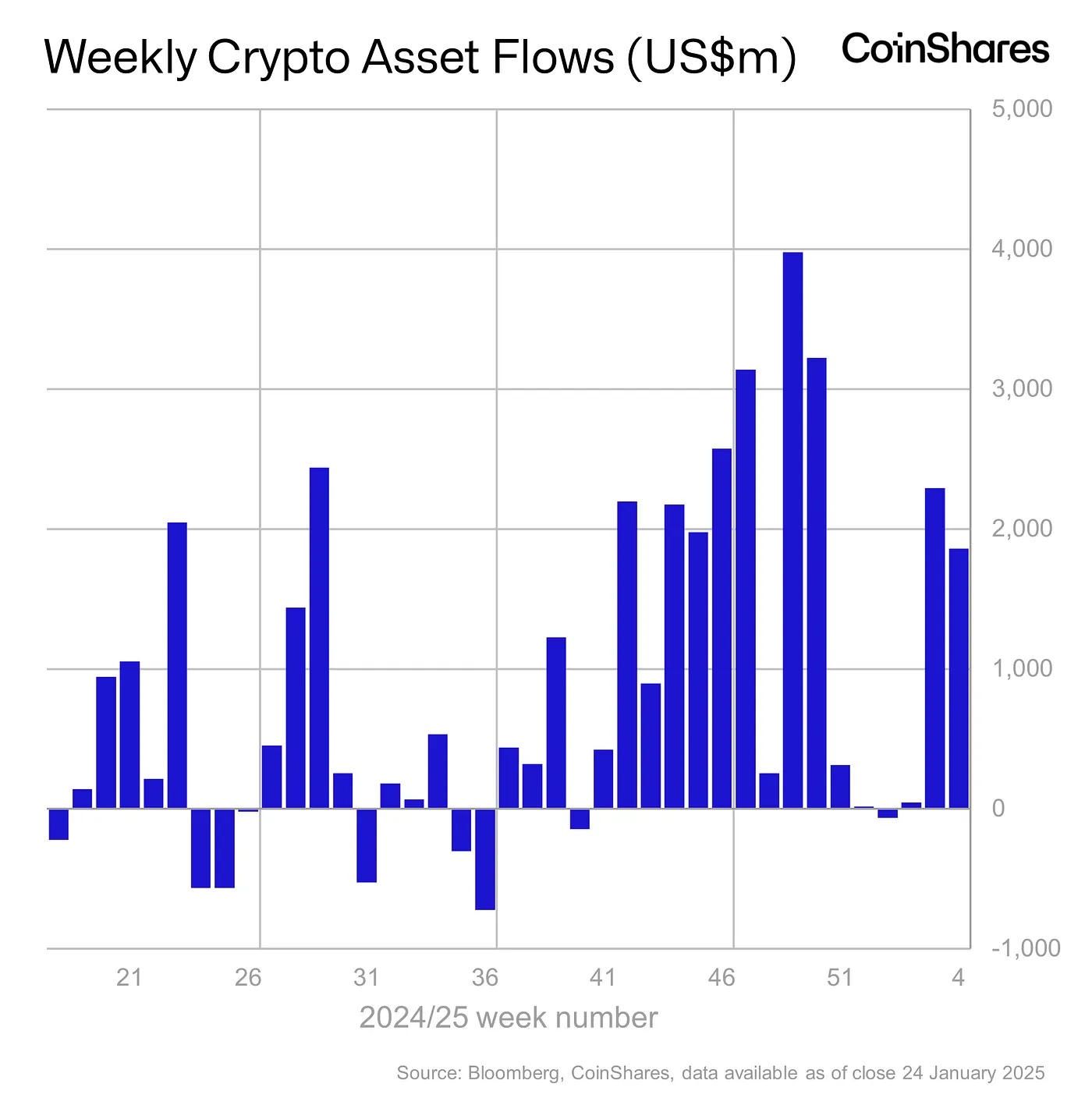
The digital asset landscape has kicked off 2026 with a decisive show of institutional confidence. Following a year of record-shattering capital allocations and shifting macroeconomic winds, institutional investors are signaling a bullish outlook for the new year. According to the latest data from CoinShares, digital asset investment products have successfully shaken off early-week volatility to post a robust $582 million in net inflows.
This momentum represents more than a mere statistical fluctuation; it is a clear indicator that the "smart money" continues to view cryptocurrencies as a core component of modern diversified portfolios. As the dust settles from a high-stakes 2025, the focus has shifted toward the scalability of Ethereum, the utility of XRP, and the resilience of the broader altcoin ecosystem.
The Main Facts: A Strong Start to the Fiscal Year
The first week of 2026 has provided a snapshot of institutional sentiment that many analysts believe will set the tone for the coming months. Despite experiencing initial outflows—likely attributed to end-of-year profit-taking and portfolio rebalancing—the market saw a dramatic recovery toward the end of the week.
The surge was headlined by a staggering $671 million influx on a single Friday, which effectively wiped out earlier losses and resulted in a net weekly inflow of $582 million. This rapid rebound suggests that institutional entities are not merely holding their positions but are actively "buying the dip" when market sentiment softens.
Key Asset Performance Breakdown:
- Bitcoin (BTC): Remains the primary beneficiary, attracting $512 million in fresh capital.
- Ethereum (ETH): Solidifying its position as the premier institutional altcoin, pulling in $119 million.
- XRP: Continues to gain favor with $10.7 million in new investments.
- Solana (SOL): Experienced a temporary setback with $30 million in outflows, likely as investors cycle capital into other high-growth assets.
Chronology: From the Record-Breaking 2025 to the 2026 Kickoff
To understand the current institutional appetite, one must look at the trajectory of 2025. Last year was a historic period for digital asset investment products, which saw a total of $47.2 billion in global inflows. While this figure fell just shy of the 2024 record of $48.7 billion, the internal composition of these inflows revealed a massive shift in investor preference.
The 2025 Landscape:
- Q1–Q2: The US market established itself as the dominant force, with US-based products accounting for $44.5 billion of the total inflow, even as overall US investment volume saw a 12% year-over-year decline compared to 2024.
- Q3: European markets began to show signs of life. Germany, in particular, engineered a remarkable turnaround, moving from net outflows in 2024 to an impressive $2.5 billion in inflows in 2025.
- Q4: Canada and Switzerland solidified their roles as critical hubs, adding $1.1 billion and $775 million, respectively, cementing a global diversification of institutional crypto-exposure.
As we entered January 2026, the initial price volatility was met with a swift influx of capital, demonstrating that the institutional appetite is no longer driven by short-term speculation, but by long-term strategic positioning.
Supporting Data: Analyzing the Institutional Shift
The data provided by CoinShares offers a granular look at the changing preferences of institutional asset managers. While Bitcoin remains the "digital gold" standard with $26.9 billion in total inflows for 2025, the growth in altcoin adoption is where the most significant structural changes are occurring.
Growth Comparison (Year-Over-Year):
- Ethereum: $12.7 billion in inflows, marking a 138% increase from the previous year.
- XRP: $3.7 billion, a staggering 500% surge.
- Solana: $3.6 billion, representing a massive 1,000% increase in interest compared to its 2024 standing.
The data also reveals a cooling sentiment for niche altcoins, which saw a 30% decline in inflows. This suggests that institutional investors are moving away from speculative "long-tail" assets and concentrating their capital in large-cap, high-utility protocols that offer robust ecosystem development and clear regulatory pathways.
Furthermore, the "Short-Bitcoin" market—products designed to bet against the price of BTC—attracted $105 million. While this is a notable figure, it remains a peripheral segment of the total market, indicating that the vast majority of institutional capital is betting on long-term appreciation rather than hedging against downside risk.
Official Responses and Expert Outlooks
While official institutional statements are rarely public, the reports issued by market analysts at firms like CoinShares act as a de facto voice for the sector. The general consensus among these analysts is that the market is entering a "maturation phase."
Market observers point out that the shift from simple BTC exposure to a balanced portfolio (including ETH, XRP, and SOL) reflects a deeper understanding of blockchain technology. Institutions are no longer just buying "crypto"; they are buying "infrastructure."
"The 2025 performance was a testament to the resilience of digital assets in a high-interest-rate environment," says a senior market analyst at a leading digital asset firm. "Entering 2026, the inflow data confirms that institutions are utilizing the volatility to adjust their cost basis. The $582 million inflow isn’t just noise—it’s a commitment to the thesis that digital assets have become a permanent fixture in the global financial system."
Implications: What This Means for the Future
The current influx of capital carries profound implications for both the crypto-native community and the traditional financial sector.
1. Market Decoupling
As institutional inflows stabilize the price of major assets like Ethereum and XRP, these assets may begin to exhibit lower volatility compared to the broader, more speculative altcoin market. This decoupling is essential for institutional adoption, as it allows for better risk management and volatility-adjusted returns.
2. Regulatory Clarity
The consistent flow of capital into regulated investment products (ETFs, ETPs, and trusts) provides a strong argument for further regulatory clarity. Regulators are increasingly forced to acknowledge that these assets are no longer just "retail crazes" but are integral to the balance sheets of global financial institutions.
3. The "Institutionalization" of Altcoins
The massive percentage gains in XRP and Solana inflows suggest that the market is actively looking for high-performance alternatives to Bitcoin. Investors are betting on the long-term utility of these chains for smart contracts, cross-border payments, and decentralized finance (DeFi). This institutional backing provides a "safety net" for these protocols, potentially leading to more consistent development funding and community growth.
4. Global Competition
The turnaround in Germany and the steady inflows from Canada and Switzerland signal that the US no longer holds a monopoly on digital asset innovation. If the US regulatory environment remains fragmented, institutional capital will continue to flow to jurisdictions that offer more stable legal frameworks, potentially shifting the center of the global digital asset economy.
Conclusion
As 2026 unfolds, the data is unequivocal: institutional investors are doubling down on digital assets. The $582 million inflow recorded in the first week of the year serves as a powerful testament to the staying power of the sector.
While Bitcoin remains the anchor of this institutional strategy, the aggressive accumulation of Ethereum, XRP, and Solana indicates a sophisticated strategy aimed at capturing growth across different segments of the blockchain ecosystem. For investors, this institutional trend is a critical indicator that the market is transitioning from its experimental roots into a mature, essential asset class.
Disclaimer: The information provided in this article is for informational purposes only and does not constitute financial, investment, or legal advice. Digital assets, including Bitcoin, Ethereum, XRP, and Solana, are subject to extreme volatility and high risk. Always conduct your own thorough due diligence and consult with a professional financial advisor before making any investment decisions. The Daily Hodl does not recommend the purchase or sale of any specific assets, and any losses incurred are the sole responsibility of the investor.