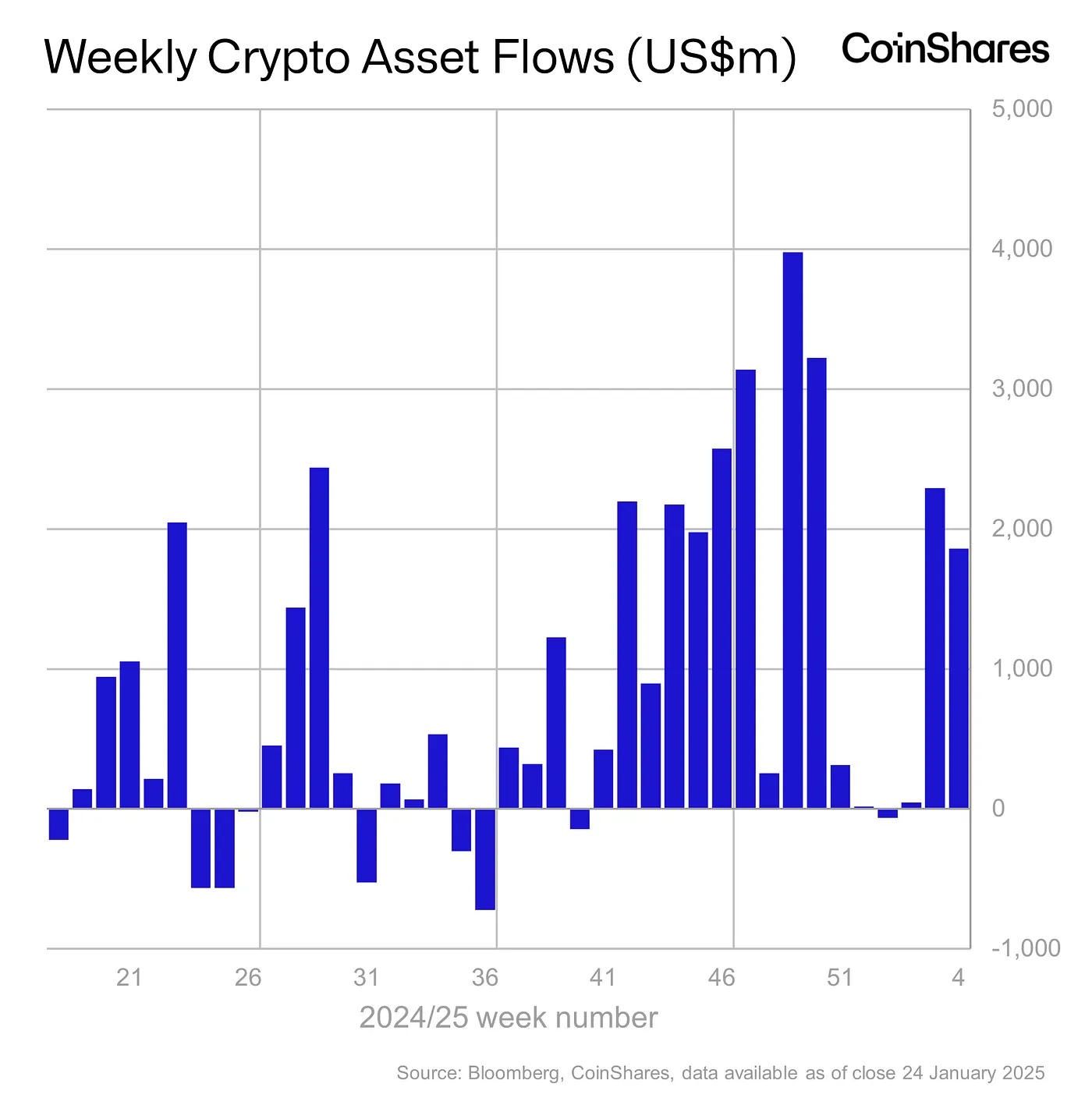

Institutional Capital Surge: Crypto Investment Products Approach Historic Annual Inflows
The digital asset landscape is currently experiencing a profound shift in institutional sentiment. According to the latest "Digital Asset Fund Flows Weekly" report published by CoinShares, the global appetite for regulated crypto investment products has reached a fever pitch. With nearly $1 billion in capital pouring into exchange-traded products (ETPs) in a single week, the industry is witnessing a resurgence that mirrors—and in some respects, surpasses—the fervor seen during the peak of the last cycle.
As of the most recent reporting period, year-to-date (YTD) inflows have climbed to an impressive $6.7 billion. This momentum places the market on a collision course with the record $7.3 billion peak established in early February of this year, signaling that institutional investors are aggressively positioning themselves for a potential year-end rally.
The Core Data: A Global Surge in Institutional Interest
The data provided by CoinShares paints a clear picture of geographic polarization and concentrated demand. While the global market is trending upward, the lion’s share of activity is undeniably centered within the United States.
Regional Breakdown of Capital Flows
The United States remains the undisputed engine of the current crypto rally, capturing $840 million in net inflows last week alone. This dominance underscores the profound impact of the spot Bitcoin ETF ecosystem, which has transformed how institutional portfolios interact with digital assets.
In contrast, other major jurisdictions have seen mixed results. Germany and Australia posted respectable inflows of $44.5 million and $10.2 million, respectively. However, the picture is not universally bullish; Canada and Hong Kong experienced minor outflows of $8 million and $4.3 million, respectively. Analysts suggest that these localized outflows are likely the result of profit-taking or portfolio rebalancing rather than a fundamental shift in regional outlook.
Bitcoin: The Undisputed King of Assets
Bitcoin (BTC) continues to command the overwhelming majority of institutional attention. Last week, Bitcoin investment products attracted $867 million in global inflows. Beyond the weekly snapshot, Bitcoin has achieved a critical milestone: U.S.-listed ETFs have now recorded cumulative net inflows of $62.9 billion since their inception in January 2024. This figure officially surpasses the previous high-water mark of $61.6 billion set in early February, confirming that the current "bull run" is supported by substantial, sustained capital commitments rather than speculative retail trading alone.
Chronology of the Rally: Tracking the Momentum
To understand the current state of the market, one must look at the progression of the last four weeks. The crypto sector has entered a sustained period of capital accumulation that suggests a departure from the mid-year volatility that plagued the market.
- Mid-October: The market began to stabilize, with institutional investors shifting from a "wait-and-see" approach to proactive accumulation.
- Late October: The trend accelerated, marking the beginning of a four-week streak of consecutive inflows. This period saw a significant rotation of capital out of traditional equity funds and into crypto-exposed products.
- Early November: The accumulation reached a crescendo, with the $882 million weekly inflow figure reported by CoinShares serving as the highlight.
- Current Standing: The market is now within striking distance of the annual YTD record, a target analysts believe will be breached before the end of Q4 if current macroeconomic tailwinds persist.
Macroeconomic Catalysts: Why the Money is Moving
The surge in digital asset inflows is not occurring in a vacuum. CoinShares’ research team highlights three specific macroeconomic drivers that are compelling institutional players to treat Bitcoin as a strategic necessity rather than a speculative asset.
1. The Global M2 Money Supply Expansion
The M2 money supply—a measure of the total volume of currency held by the public and in liquid bank accounts—is once again on the rise globally. Historically, an expanding money supply leads to currency debasement. Institutional investors, fearful of the long-term erosion of purchasing power, are increasingly turning to Bitcoin as a "digital hedge" against fiat inflation, viewing it as a store of value analogous to "digital gold."
2. The Specter of Stagflation
The United States is currently navigating a complex economic environment characterized by persistent inflation coupled with sluggish growth, a combination known as stagflation. In such an environment, traditional asset classes like bonds often struggle to provide real returns. Bitcoin’s performance is increasingly being viewed as decorrelated from traditional equities, making it an attractive component for diversified institutional portfolios looking to mitigate the risks associated with a stagnant economy.
3. State-Level Strategic Reserves
Perhaps the most significant development of the year is the legislative shift within the United States. Several states have begun drafting and introducing initiatives to recognize Bitcoin as a strategic reserve asset. This institutionalization at the state level provides a "regulatory floor" for crypto prices, giving large-scale institutional investors the confidence to allocate capital without fear of imminent, hostile regulatory intervention.
Supporting Data: Altcoins and Market Diversity
While Bitcoin dominates the narrative, the inflow data reveals interesting trends among alternative assets.
- SUI: The SUI network has emerged as a dark horse in the institutional race, capturing $11.7 million in inflows last week. This indicates that institutional interest is beginning to broaden beyond the "Big Two" (Bitcoin and Ethereum), with investors seeking exposure to high-performance Layer-1 ecosystems.
- Ethereum (ETH): Ethereum saw a more modest performance, with $1.5 million in inflows. While this is positive, it reflects the ongoing struggle for Ethereum to recapture the market excitement it enjoyed prior to the launch of spot ETFs, where supply-side pressures and staking yield uncertainty have kept some institutional investors on the sidelines.
Implications for the Future of Finance
The transition of digital assets into the mainstream financial plumbing has profound implications for the future of investment management.
The Institutionalization of Custody
The scale of these inflows necessitates a robust infrastructure for custody and settlement. As more capital flows into ETPs, we are seeing the rise of "institutional-grade" custodial solutions that are fundamentally changing the risk profile of holding digital assets. This creates a virtuous cycle: as custody becomes safer, more capital flows in, which in turn leads to further technological innovation.
The End of the "Wild West" Era
The record-breaking inflows into regulated products signal the definitive end of the "Wild West" era for cryptocurrency. Institutional investors are demanding compliance, transparency, and liquidity—all of which are provided by the current ETP structure. This shift forces issuers to adhere to strict SEC and global regulatory standards, effectively sanitizing the asset class for pension funds, sovereign wealth funds, and large-scale asset managers who previously avoided the space.
Market Volatility and Price Discovery
With billions of dollars flowing through regulated vehicles, the nature of Bitcoin’s price discovery is changing. The market is becoming increasingly influenced by macro-triggers rather than isolated crypto-native events. This "financialization" of Bitcoin suggests that, while volatility will remain, it will be driven more by interest rate decisions and fiscal policy than by social media sentiment or retail FOMO.
Conclusion: A Turning Point for Digital Assets
The latest report from CoinShares is more than just a summary of weekly numbers; it is a ledger of a tectonic shift in global finance. By approaching the $7.3 billion annual inflow peak, the digital asset sector has demonstrated that it has successfully transitioned from a niche asset class to a staple of modern portfolio construction.
The confluence of M2 expansion, stagflationary pressures, and the emergence of strategic state-level reserves has created a "perfect storm" for institutional adoption. As the year draws to a close, all eyes will be on whether this capital surge continues, potentially propelling Bitcoin and its associated investment vehicles into a new era of record-breaking valuation.
Disclaimer: The information provided in this article is for educational and informational purposes only and does not constitute financial, investment, or legal advice. Digital assets, including Bitcoin and other cryptocurrencies, are subject to extreme market volatility and high risk. Investors should conduct their own thorough due diligence and consult with a certified financial advisor before making any investment decisions. The Daily Hodl does not endorse or recommend the buying or selling of any specific assets and participates in affiliate marketing.