
Macro Guru Raoul Pal Predicts Crypto Will Skyrocket to 4 Billion Users by 2030, Surpassing Early Internet Growth
Main Facts
Cryptocurrency adoption is currently tracking on a historic trajectory that could see the asset class scale to unprecedented heights over the remainder of the decade. According to Raoul Pal, a former Goldman Sachs executive and the current CEO of macroeconomic and financial video platform Real Vision, proprietary adoption models indicate that Bitcoin (BTC) and the broader digital asset ecosystem are firmly on schedule to reach a staggering four billion users by the year 2030.
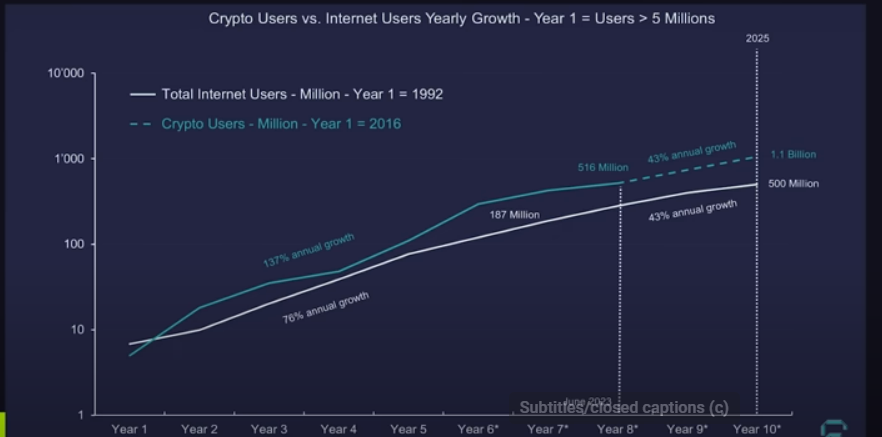
In a comprehensive market update shared via his video channel, Pal broke down the metrics driving his long-term bullish thesis. His core argument centers on a comparative growth model that measures the user acquisition rates of the nascent internet during the 1990s against the ongoing adoption curve of cryptocurrency since 2016.
Based on this historical framework, Pal projects that the cryptocurrency industry will eclipse the milestone of one billion global users by the close of 2025. This rapid expansion outpaces the velocity of the internet’s formative years, suggesting that blockchain technology and digital currencies represent the fastest-growing adoption curve of any major technological innovation in human history.
Key highlights of Pal’s projection include:
- The 2025 Milestone: Crypto is projected to surpass 1.1 billion users by the end of 2025.
- The 2030 Horizon: Half of the world’s population—roughly four billion people—is expected to interact with or utilize cryptocurrency assets and decentralized networks by 2030.
- Current Standing: The cryptocurrency market currently boasts approximately 516 million users globally, drastically outperforming the 187 million internet users recorded at a corresponding historical equivalent stage of development.
Chronology
To understand the weight of Pal’s modern projections, it is essential to examine the timeline of technological adoption that forms the foundation of his analytical model.
The Internet Era (1990s–2000s)
During the mid-to-late 1990s, the commercial internet transformed from a specialized academic and military network into a consumer-facing phenomenon. According to historical technological data cited by analysts, the internet grew at an astonishing rate of roughly 76% per year during its initial phase. As the technology matured past its eighth year of widespread commercial availability, this exponential growth naturally began to decelerate, stabilizing at a still-impressive annual growth rate of approximately 43%. At the time, this was heralded as the fastest technological adoption rate the world had ever witnessed, fundamentally altering global communication, commerce, and culture.
The Crypto Genesis and 2016 Baseline
Cryptocurrency’s modern chronology effectively began with the introduction of Bitcoin in 2009 by the pseudonymous Satoshi Nakamoto. However, systematic user tracking on a global scale began to take definitive shape around 2016, a milestone year when the asset class crossed its first major threshold of one million distinct users. Since that inflection point, the cryptocurrency market has experienced hyper-growth, significantly outpacing the early trajectory set by the internet.
The 2019–2024 Track Record
For the past five years, Pal has publicly shared and updated his comparative adoption chart across various media appearances and investor updates. Throughout market cycles, regulatory headwinds, severe bear markets, and euphoric bull runs, this specific comparative model has tracked with notable accuracy. By 2024, the global crypto user base swelled to an estimated 516 million individuals—a figure that dwarfs the 187 million users the internet claimed at a comparable stage in its lifespan.

Supporting Data
The core of Pal’s thesis rests upon empirical data contrasting the growth velocities of two paradigm-shifting technologies: the internet and cryptocurrency.
When evaluating the data points provided in Pal’s recent market assessment, several stark contrasts emerge:
-
Annual Growth Rates:
- Early Internet: Grew at a compound annual growth rate (CAGR) of 76% during its initial rapid-expansion phase, later slowing to 43% per year.
- Cryptocurrency: Has maintained an aggressive growth rate of approximately 137% per year since its 2016 tracking baseline.
-
Comparative User Milestones:
- At an identical developmental phase in their respective timelines, the internet had accrued roughly 187 million users.
- In contrast, the cryptocurrency ecosystem has already amassed an estimated 516 million users at the same relative structural milestone.
-
Conservative Modeling for 2025:
- Rather than assuming crypto will maintain its blistering 137% annual growth rate indefinitely, Pal’s predictive model builds in a sharp deceleration. By assuming crypto slows down its growth to match the historical deceleration curve of the internet, the model still arrives at a projection of 1.1 billion users by the end of 2025.
-
The Half-Population Projection for 2030:
- Projecting the trend further out to the end of the decade, even when factoring in an expected cooling of growth rates as market saturation increases, the model points directly to four billion users by 2030—representing roughly 50% of the total projected global population.
Official Responses and Industry Perspectives
While Raoul Pal’s macro perspective is widely followed within the digital asset community, his ambitious projections invite broader discussions regarding the feasibility of onboarding half the planet onto decentralized networks within the next six years.
Industry analysts, macroeconomic strategists, and fintech leaders have offered varied perspectives on the mechanics of such rapid mass adoption. Proponents of Pal’s thesis point to several structural catalysts currently driving global crypto integration:
- Institutional Inflows: The introduction and maturation of spot Bitcoin and Ethereum exchange-traded funds (ETFs) in major financial markets—such as the United States—have lowered the barrier to entry for traditional retail and institutional investors alike. Financial advisors and pension funds are increasingly viewing digital assets as a legitimate macro-allocative asset class.
- Layer-2 Scaling and User Experience (UX): Critics of early-generation blockchains often cite high transaction fees and network congestion as barriers to mass adoption. However, the rapid development of Layer-2 scaling solutions on networks like Ethereum, alongside significant improvements in wallet interfaces and self-custody applications, are making blockchain interactions as seamless as traditional web applications.
- Emerging Markets and Economic Instability: A significant driver of organic crypto adoption continues to emanate from developing economies experiencing hyperinflation, severe currency devaluation, and restrictive capital controls. In regions across Latin America, Africa, and Southeast Asia, stablecoins and Bitcoin are increasingly adopted not merely as speculative investments, but as essential tools for daily commerce, wealth preservation, and cross-border remittances.
Conversely, cautious market observers note that regulatory uncertainty, compliance hurdles, and persistent cybersecurity risks remain formidable obstacles that could temper the velocity of future onboarding. However, even accounting for potential regulatory friction and macroeconomic volatility, proponents argue that the underlying network effects of blockchain technology mirror the inexorable spread of telecommunications and internet infrastructure in the late 20th century.
Implications
If Raoul Pal’s predictive model holds true and the cryptocurrency ecosystem successfully scales to four billion users by 2030, the implications for global finance, technology, and society at large will be profound and far-reaching.
1. The Redefinition of Global Financial Infrastructure
Onboarding half of the world’s population onto blockchain-enabled networks implies a fundamental restructuring of traditional banking and payment systems. Legacy financial intermediaries—such as correspondent banks, traditional clearinghouses, and high-fee remittance operators—will face existential pressure to integrate decentralized rails or risk obsolescence. Cross-border payments, which currently take days and incur steep fees, could become instantaneous and frictionless on a global scale.
2. Macroeconomic Shifts and Sovereign Currencies
As digital assets gain broader utility and mainstream acceptance, central banks will continue to grapple with the implications for monetary sovereignty. The rise of stablecoins and decentralized cryptocurrencies acts as an alternative financial system, particularly in countries with fragile domestic fiat currencies. This dynamic could force central banks to accelerate the deployment of their own Central Bank Digital Currencies (CBDCs) or adopt more disciplined monetary policies to retain public trust.
3. Maturation of the Digital Asset Class
Reaching four billion users transforms cryptocurrency from a speculative niche asset class into foundational global infrastructure. This degree of mainstream integration would likely precipitate immense institutional capital inflows, driving market valuations significantly higher while simultaneously reducing volatility as liquidity deepens. Regulatory frameworks worldwide would shift from tentative exploration to permanent, standardized codification, cementing digital assets as a permanent pillar of the modern global economy.
Disclaimer: The opinions and projections discussed in this article are for informational purposes only and do not constitute financial or investment advice. Investors should conduct thorough due diligence before committing capital to high-risk digital assets, cryptocurrencies, or Bitcoin.