
Macro Strategist Raoul Pal Predicts Crypto Will Reach 4 Billion Users by 2030, Surpassing Early Internet Adoption Curves
By Financial Markets Desk
Published: April 2024
Main Facts
Cryptocurrency adoption is tracking at a historic pace, outperforming the foundational growth phase of the internet, according to macroeconomic strategist and Real Vision CEO Raoul Pal. In a comprehensive market update, the former Goldman Sachs executive revealed that a predictive adoption model—one that he has successfully utilized and tracked over the last five years—indicates that Bitcoin (BTC) and the broader digital asset ecosystem are firmly on schedule to achieve a staggering four billion users by the turn of the decade.
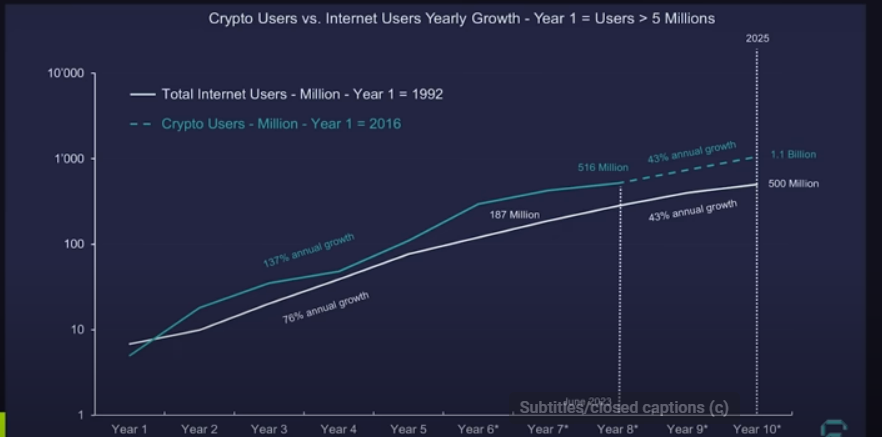
Pal’s bullish thesis hinges on a comparative analysis between the proliferation of the internet during the 1990s and 2000s and the expansion of the cryptocurrency user base since 2016. According to the data presented in his latest video briefing, crypto is currently expanding at an annualized compound rate of 137%. This velocity has propelled the total global crypto-using population to approximately 516 million people. By comparison, at an equivalent developmental milestone in its lifecycle, the internet boasted a user base of roughly 187 million.
Even when accounting for an inevitable deceleration in growth as the market matures—matching the exact slowdown curve experienced by the internet—Pal forecasts that the global digital asset space will breach the milestone of 1.1 billion users by the end of 2025. Looking further down the horizon to 2030, the model projects that approximately half of the world’s population—roughly four billion individuals—will be integrated into the cryptocurrency network.
While Pal acknowledges that macroeconomic headwinds, regulatory interventions, and market volatility could create deviations from the projected curve, he emphasizes that the underlying trajectory remains remarkably consistent, pointing toward an inevitable paradigm shift in global finance.
Chronology: The Evolution of Digital Asset Growth
To understand the weight of Pal’s projections, it is necessary to examine the chronological timeline of how digital assets evolved from an obscure cryptographic experiment into a macroeconomic asset class.
- 2008–2015 (The Genesis and Inception Phase): Following the publication of the Bitcoin whitepaper by the pseudonymous Satoshi Nakamoto in the wake of the 2008 global financial crisis, cryptocurrencies operated largely within a niche enclave of cryptographers, libertarians, and early-stage technologists. During this period, user acquisition was slow, fragmented, and largely restricted to peer-to-peer computer hobbyists running mining software on home hardware.
- 2016 (The One Million User Inflection Point): By 2016, the foundational infrastructure of the cryptocurrency market had stabilized sufficiently to establish reliable metrics. This year marked the baseline for Pal’s comparative tracking model, registering the first institutional-grade metrics for global crypto adoption at approximately one million active participants.
- 2017–2020 (Retail Discovery and Institutional Curiosity): The 2017 bull market introduced cryptocurrencies to the mainstream consciousness, driven by the initial coin offering (ICO) boom and retail participation. Despite subsequent cyclical bear markets, institutional infrastructure began to take shape, highlighted by the entrance of regulated custodians, futures markets, and corporate treasury adoption led by firms like MicroStrategy.
- 2021–2023 (Macro Integration and Regulatory Scrutiny): Driven by pandemic-era monetary stimulus, decentralized finance (DeFi), and non-fungible tokens (NFTs), crypto users surged past hundreds of millions. Despite high-profile industry failures and stringent regulatory crackdowns, the user base continued to expand across developing economies seeking hedges against hyperinflation and currency devaluation.
- 2024–Present (The ETF Era and Institutional Mainstreaming): The approval and launch of spot Bitcoin Exchange-Traded Funds (ETFs) in major financial markets marked a watershed moment, bridging traditional capital markets with decentralized digital assets. This institutional endorsement laid the groundwork for the accelerated user growth paths currently forecasted for 2025 and beyond.
Supporting Data and Comparative Analysis
The core of Raoul Pal’s argument rests on empirical data comparing the internet’s historical adoption metrics with contemporary cryptocurrency metrics. The analysis breaks down into several key statistical observations:
1. Growth Velocity: Internet vs. Crypto
During its formative years, the internet was widely recognized as the fastest technological adoption cycle in human history.

- The Internet’s Pace: In its initial growth phase, the internet expanded at an annualized rate of 76%. As the user base scaled and matured past its eighth year, that growth rate moderated to 43% annually.
- Crypto’s Pace: In contrast, cryptocurrency has maintained an aggressive compound growth rate of 137% per year since 2016.
2. Milestone Comparisons
When comparing absolute numbers at parallel points in time, digital assets have significantly outpaced the early internet:
- At an identical stage of network maturation, the internet had accumulated roughly 187 million users.
- At the present stage of its cycle, cryptocurrency has already surpassed 516 million users globally.
3. The 2025 and 2030 Projections
Pal’s model applies the internet’s historical deceleration rate to future crypto projections to establish a conservative baseline:
- End of 2025: By factoring in a cooling of crypto’s growth rate to match the internet’s historical slowdown, the model points to a global adoption milestone of 1.1 billion users.
- Year 2030: Projecting the trend outward to the end of the decade yields an estimated four billion users, which accounts for approximately 50% of the projected global population at that time.
Official Responses and Industry Context
Pal’s projection has sparked widespread discussion across the fintech, traditional banking, and blockchain sectors. Industry analysts have weighed in on both the structural tailwinds supporting this growth and the potential friction points that could alter the trajectory.
The Institutional Perspective
Traditional financial institutions, once skeptical of cryptocurrencies, have increasingly integrated digital asset frameworks into their long-term strategies. Major global custodians, payment processors such as Visa and Mastercard, and asset management giants like BlackRock and Fidelity have signaled that blockchain technology is no longer an isolated asset class, but rather the next iteration of global financial settlement infrastructure.
Executives from these institutions frequently point out that mobile-first internet penetration in developing regions—particularly across Latin America, Southeast Asia, and Sub-Saharan Africa—acts as an immediate on-ramp for decentralized financial applications. In regions plagued by unbanked populations and unstable fiat currencies, stablecoins and self-custodied digital assets are serving as functional economic lifelines, bypassing legacy banking systems entirely.
Regulatory Challenges and Compliance
Conversely, regulatory bodies worldwide maintain a cautious—and often adversarial—stance toward the rapid expansion of digital assets. Central banks and securities regulators have repeatedly warned retail investors about the risks associated with market volatility, fraud, and the lack of consumer protections in decentralized ecosystems.
Proponents of Pal’s thesis argue that while stringent regulatory frameworks may cause short-term friction or geographic shifts in crypto activity, they ultimately provide the legal clarity required for risk-averse institutional capital and mainstream corporate entities to onboard billions of new users securely.
Implications of Reaching Four Billion Users
If Raoul Pal’s econometric model proves accurate and the cryptocurrency ecosystem successfully scales to four billion users by 2030, the socioeconomic, technological, and geopolitical implications will be profound.
1. Transformation of the Global Financial Architecture
Achieving a user base equivalent to half the world’s population would fundamentally challenge the dominance of legacy fiat monetary systems. Cross-border remittances, international trade settlements, and retail transactions would increasingly migrate to decentralized rails. This transition could drastically reduce transaction fees, eliminate settlement delays, and diminish the geopolitical leverage historically wielded by central banking hegemones through traditional SWIFT-based banking networks.
2. The Rise of Sovereign Individuals and Self-Sovereignty
A network utilized by four billion people necessitates robust digital identity and self-custody solutions. The proliferation of crypto adoption implies a massive shift toward financial self-sovereignty, where individuals retain absolute control over their wealth without intermediary permission. This structural change aligns with the growing global demand for privacy, digital ownership, and protection against domestic monetary debasement.
3. Integration with Emerging Technologies (AI and IoT)
As blockchain networks scale to accommodate billions of human users, they will increasingly serve as the native settlement layer for machine-to-machine transactions. Artificial intelligence agents, automated Internet of Things (IoT) devices, and autonomous micro-economy systems require permissionless, programmatic money to function. Consequently, the user metrics cited by Pal may ultimately understate total network utilization once non-human entities begin interacting with blockchain rails at scale.
4. Macroeconomic Volatility and Market Maturity
Scaling to four billion users would fundamentally alter the micro-market dynamics of cryptocurrencies. While early-stage adoption has been characterized by extreme boom-and-bust cycles driven by speculation and macroeconomic liquidity shocks, a mature network of half the global population would inherently exhibit greater liquidity, deeper order books, and potentially reduced volatility. As the asset class transitions from a speculative vehicle to an entrenched utility layer, its correlation with traditional macroeconomic indicators will continue to evolve.
Conclusion
Raoul Pal’s forward-looking analysis underscores a central reality of the modern digital economy: technological adoption curves are accelerating exponentially with each successive generation of innovation. While market participants must continuously navigate regulatory hurdles, cyclical drawdowns, and macroeconomic uncertainties, the comparative data suggests that blockchain technology is tracking well ahead of the historical benchmarks set by the internet.
Whether the cryptocurrency ecosystem hits the milestone of 1.1 billion users by 2025 or scales to four billion participants by 2030, the underlying metrics signal that digital assets are transitioning irrevocably from the fringes of finance into the foundational infrastructure of global human commerce.
Disclaimer: The information provided in this article is for informational and educational purposes only and does not constitute financial, investment, or legal advice. Readers should perform their own thorough due diligence and consult with a qualified professional before engaging in high-risk investments involving digital assets, cryptocurrencies, or Bitcoin.