MEXC Reports Record August 2026 TradFi Growth: Stock Futures Surge 130% Amid Semiconductor and AI Boom
Mutsamudu, Comoros — September 11, 2026 — MEXC, a recognized pioneer in zero-fee digital asset and cross-market trading, has released its financial and operational performance data for August 2026. The figures reveal a massive acceleration in traditional finance (TradFi) product adoption on the platform, punctuated by a 130% month-on-month increase in aggregate trading volume across stock, index, and ETF futures.
The exchange’s expanding ecosystem continues to bridge the gap between traditional equities and digital assets. In August, the total number of available contracts expanded by 35%, pushing past the milestone of 400 distinct listings. Simultaneously, tokenized stocks and ETF spot trading volumes experienced a robust 30% month-on-month growth trajectory, with positive performance metrics recorded across virtually all active listings.
This latest data underscores a profound shift in retail trading behavior: investors are increasingly utilizing crypto-native infrastructure to access global equities around the clock, bypassing traditional geographic and operational barriers.
Main Facts and Key Performance Indicators
The August 2026 report highlights several monumental shifts in asset class preferences, regional market participation, and structural product utilization on MEXC:
- Massive Futures Expansion: Total trading volume for stock, index, and ETF futures skyrocketed by 130% compared to July figures.
- Contract Diversity: The total pool of available contracts grew by 35%, scaling to over 400 options.
- Spot Market Vigor: Tokenized stocks and ETF spot trading volume grew by 30%, with an overwhelming 99% of existing listings registering positive volume gains.
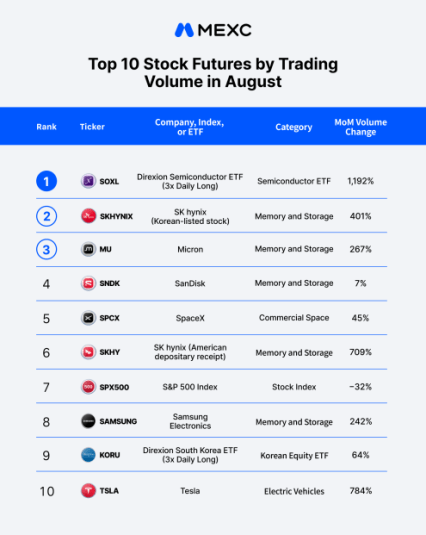
- Semiconductor Dominance: Memory chip and semiconductor equities commanded the spotlight, capturing five of the top ten spots for stock futures trading volume.
- Korean Market Surge: Combined trading volume for stock futures tracking Korean enterprises—such as SK hynix and Samsung—soared by approximately 348%, expanding their market share of total stock futures from 14% to 27%.
- Cost Savings for Traders: The platform’s promotional MEXC 0808: Stock Season zero-fee event successfully attracted over 86,000 active participants, saving traders an aggregate of more than $1 million in transaction fees.
Chronology of August’s Market Shifts
The month of August was characterized by rapid, sector-specific capital rotations on the MEXC platform.
At the start of the month, trading activity maintained a broad distribution across general indices, though early signals pointed toward a concentration in high-growth technology equities. By mid-August, the narrative shifted dramatically toward memory and storage hardware suppliers, driven by global supply chain developments and escalating institutional interest in artificial intelligence infrastructure.
As the month progressed into its final ten days, weekend trading activity accounted for roughly 11% of total monthly futures volume. This unusual concentration of off-hours trading highlighted a core utility of MEXC’s infrastructure: enabling investors to execute positions during weekend windows when traditional Wall Street and Asian equities exchanges remain shuttered. The month culminated in record-breaking engagement metrics driven by the platform’s zero-fee initiatives, cementing August as a watershed period for tokenized TradFi adoption.
Supporting Data: Deep Dive into Asset Performance
A granular review of MEXC’s August data reveals fascinating trends regarding where capital flowed and how traders diversified their portfolios.
Memory, Semiconductors, and Regional Shifts
Stock futures trading broadened significantly away from single-asset dominance toward a diversified basket of U.S. and Korean memory and hardware manufacturers.
- SKHYNIX (SK hynix): Claimed the second overall spot and ranked first among individual stock futures, registering an astronomical 401% month-on-month volume increase.
- MU (Micron Technology): Secured the third position overall, enjoying a 267% surge in trading volume.
- Korean Equities Basket: Collective volumes for SKHYNIX, SKHY, SAMSUNG, and the KORU ETF leaped by 348%, lifting their combined share of stock futures volume to 27%.
- SNDK (SanDisk): Continued to post absolute volume growth, though its relative market share adjusted from 25% down to 11% as capital dispersed into broader memory plays.
Leveraged ETFs and Sector Rotation
Traders aggressively favored high-beta, sector-specific instruments over broad-market indices.
- SOXL: Futures tracking a semiconductor ETF offering 3x daily long exposure rocketed to the number one spot. Trading volume surged by an astounding 1,192%, driving its share of total stock futures from under 4% in July to 20% in August.
- SOXS: Conversely, the inverse 3x leveraged semiconductor ETF futures saw a 436% volume expansion, utilized by hedgers navigating short-term volatility.
- SPX500: In stark contrast to tech-heavy rallies, trading volume for S&P 500 Index futures contracted by approximately 32%, demonstrating a clear portfolio rotation away from broad-market exposure into high-octane sector plays.
- Outliers: SpaceX (SPCX) and Tesla (TSLA) stock futures recorded robust volume increases of 45% and 784% respectively, rounding out the top ten and signaling sustained retail appetite for commercial space and electric vehicle narratives.
Tokenized Spot Stocks and AI Infrastructure
In the spot markets, tokenized stocks and ETFs expanded their footprint, accounting for 73% of total TradFi spot trading volume up from 63% in July.
- Broad-Based Participation: The top 10 tokens accounted for a mere 12% of the segment’s volume, proving that growth was systemic across nearly all 99% of active listings rather than isolated to a few speculative assets.
- Crypto-Adjacent Equities: Circle (CRCL) led the spot rankings with a 69% volume jump. Coinbase (COIN) and Robinhood (HOOD) also joined the top ten, with their combined volumes climbing 47%.
- AI Computing: Nebius (NBIS)—an AI cloud infrastructure provider—recorded the highest growth rate among the top ten, with trading volume soaring 188% to capture third place. NVIDIA (NVDA) followed closely with a 54% volume increase.
Official Responses and Strategic Vision
The rapid convergence of digital asset trading mechanics with traditional equity markets has validated MEXC’s long-term product roadmap. By allowing users to trade products linked to U.S., Korean, and Hong Kong equities using USDT via a single, unified account, the platform has successfully removed historic friction points for international retail investors.
Vugar Usi, Chief Executive Officer of MEXC, emphasized the structural significance of these metrics in a public statement:
"The sustained growth in stock-related trading across multiple asset classes and markets underscores the accelerating global demand for accessible, diversified market exposure. We remain committed to expanding our equity-linked offerings and simplifying access for users worldwide, consolidating trading into a single account and delivering on our core proposition: trading Wall Street, without walls."
Usi’s remarks highlight the exchange’s core philosophy: breaking down geographic and institutional barriers that have traditionally kept retail traders locked out of global multi-asset opportunities.
Implications for the Future of Multi-Asset Trading
The August 2026 data release from MEXC points toward several broader implications for the future of global finance:
- The Blurring Lines of TradFi and Crypto: Platforms offering tokenized representations of equities, commodities, and fiat-backed assets are no longer peripheral novelties. They are becoming primary liquidity hubs where retail investors execute complex cross-market strategies using stablecoins.
- Demand for 24/7 Financial Infrastructure: The heavy utilization of stock futures during weekends demonstrates an overwhelming consumer preference for continuous, uninterrupted market access. Traditional market hours are increasingly viewed by digital-native generations as an inefficient legacy constraint.
- The Rise of Borderless Retail Participation: By permitting seamless exposure to foreign markets—such as Korean memory chip giants and U.S. technology leaders—from a single account in regions spanning over 170 markets, platforms like MEXC are democratizing capital allocation on a global scale.
As MEXC continues to scale its zero-fee architecture, deep liquidity pools, and expansive asset listings, the traditional financial sector faces mounting pressure to adapt to a borderless, 24/7 trading paradigm.