The Digital Frontier: Why Crypto Adoption is Primed to Reach Half the Global Population by 2030
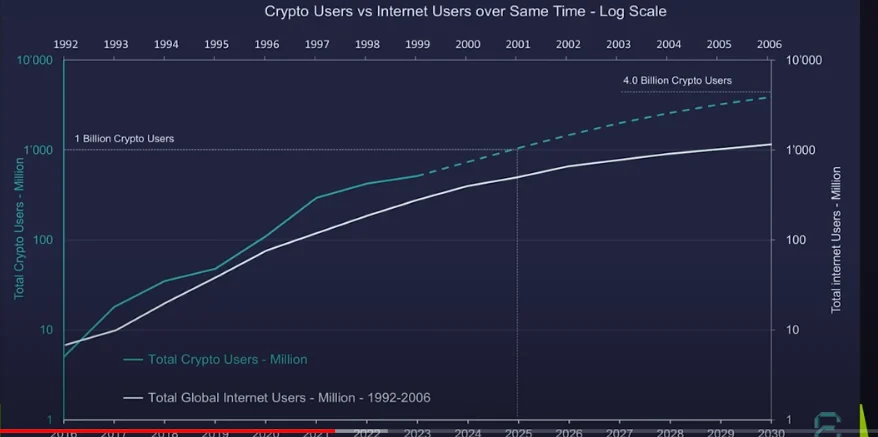
As the digital asset landscape continues to evolve from a niche technological curiosity into a cornerstone of the modern global financial infrastructure, institutional observers are increasingly looking toward historical data models to forecast the future. Among the most prominent voices in this analysis is Raoul Pal, a former Goldman Sachs executive and the CEO of Real Vision. In a recent detailed breakdown, Pal leveraged a long-standing growth model to argue that the cryptocurrency ecosystem is currently tracking toward an unprecedented milestone: the adoption of digital assets by four billion people—roughly half of the global population—by the year 2030.
The Core Thesis: A Historical Mirror
The foundation of Pal’s optimistic outlook rests on a comparative analysis between the nascent stages of the internet and the current trajectory of the cryptocurrency market. By overlaying the user adoption curves of the early internet against the growth of crypto wallets and active addresses since 2016, Pal has identified a pattern that suggests the crypto revolution is not only sustainable but significantly outperforming the most transformative technology of the 20th century.
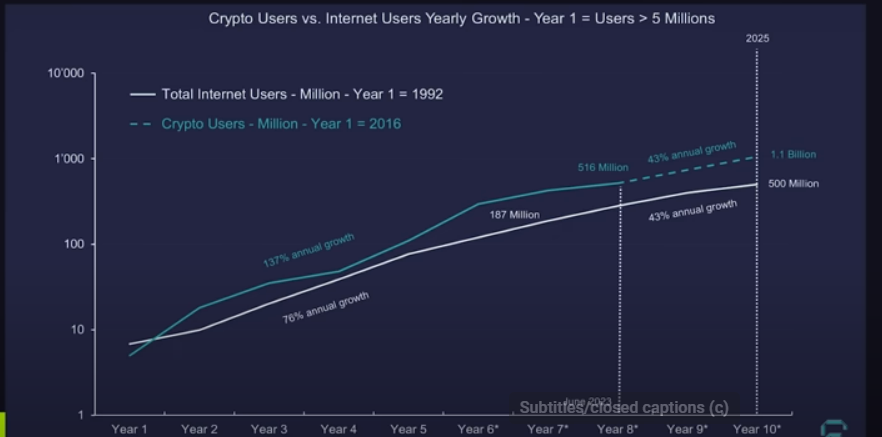
According to Pal, the internet—historically considered the fastest-growing technology in human history—expanded at an average rate of 76% per year during its initial surge, before moderating to 43% after its eighth year of mainstream accessibility. In stark contrast, the cryptocurrency space has maintained a blistering growth rate of approximately 137% per year.
"The internet was the fastest adoption of technology the world had ever seen," Pal noted in his recent presentation. "Crypto has been growing at 137% a year. It is now at 516 million users, compared to 187 million for the internet at the same relative stage of its development."
Chronology of Exponential Growth
To understand the magnitude of this shift, one must view the timeline of crypto adoption not as a series of market cycles, but as a compounding technological evolution.
The Early Phase (2016–2020)
In 2016, when the crypto market hit the one-million-user milestone, the technology was largely relegated to enthusiasts, developers, and early-stage investors. This period was marked by high volatility and significant skepticism from traditional financial institutions. However, behind the scenes, the infrastructure—ranging from layer-1 blockchains to early decentralized finance (DeFi) protocols—began laying the groundwork for what would become a global movement.
The Acceleration Phase (2021–2024)
The years following 2020 served as a catalyst for mainstream interest. The entrance of institutional giants, the rise of non-fungible tokens (NFTs), and the mainstreaming of centralized exchanges pushed user counts into the hundreds of millions. Pal’s data points suggest that this period represents the "inflection point," where the network effects of digital assets began to override the friction of regulatory uncertainty and technological complexity.
The Projected Horizon (2025–2030)
Looking forward, Pal’s model makes a conservative assumption: that the growth of the crypto sector will eventually slow down to match the adoption curves of the early internet. Even with this deceleration, the numbers remain staggering. By the end of 2025, the model projects the crypto ecosystem will surpass the one-billion-user threshold. Extending this projection to 2030 brings the total to four billion, effectively digitizing the world’s financial interactions on a massive scale.

Supporting Data: Validating the Model
The strength of Pal’s argument lies in the consistency of the chart he has tracked for five years. He emphasizes that while no model is a perfect predictor of complex, human-driven systems, the predictive power of this particular chart has remained remarkably accurate through various market regimes, including bear markets and "crypto winters."
Comparative Metrics
When comparing the two technologies, the "Total Addressable Market" (TAM) for crypto is theoretically larger than that of the early internet. While the internet required hardware infrastructure (PCs, modems, and broadband) that was often prohibitively expensive in developing nations, the modern crypto ecosystem is built upon the ubiquitous smartphone. With over 6.8 billion smartphone users globally, the barrier to entry for decentralized finance, digital identity, and asset storage is significantly lower than the barrier to entry for the internet in the mid-1990s.
The Role of Decentralized Infrastructure
The growth is also being driven by the expansion of Layer-2 scaling solutions and user-friendly "abstraction" technologies. As decentralized applications (dApps) become easier to use—requiring less knowledge of private keys and complex wallet management—the user experience is approaching the simplicity of traditional web applications. This "frictionless" evolution is what fuels the transition from the "early adopter" phase to the "early majority" phase of the technology adoption lifecycle.
Institutional and Official Perspectives
While Raoul Pal remains a vocal proponent of this bullish trajectory, his views are echoed by a growing chorus of institutional players. Financial behemoths like BlackRock, Fidelity, and Franklin Templeton have begun integrating blockchain technology into their product offerings, signaling a fundamental shift in how the traditional financial sector views digital assets.
These institutions are not merely speculating; they are investing in the infrastructure of tokenization. By bringing real-world assets (RWAs)—such as bonds, real estate, and treasury bills—on-chain, they are creating the "on-ramps" that will facilitate the next billion users.
However, regulatory bodies maintain a cautious, often skeptical, stance. From the U.S. Securities and Exchange Commission (SEC) to the European Union’s Markets in Crypto-Assets (MiCA) regulation, the focus remains on consumer protection, anti-money laundering (AML) compliance, and market integrity. The "official" view is that while blockchain technology holds transformative potential, it must be integrated within a framework that preserves the stability of the global financial system. The tension between this regulatory requirement for control and the decentralized ethos of the technology remains the primary friction point for mass adoption.
Implications of a Four-Billion-User Ecosystem
If Pal’s projection of four billion users by 2030 holds true, the implications for the global economy would be profound.
1. The Democratization of Capital
With half the world participating in a decentralized financial network, the ability to transfer value, access credit, and store wealth would no longer be dependent on local banking infrastructure. For populations in developing nations with unbanked or underbanked citizens, this represents a quantum leap in economic agency.
2. The Erosion of Financial Borders
A global, borderless financial system would challenge the traditional role of national currencies in international trade. As more commerce occurs in digital assets—or stablecoins pegged to fiat currencies—the efficiency of global trade would increase, while the reliance on legacy payment systems (like SWIFT) would likely decrease.
3. Cultural and Societal Shifts
Widespread adoption would normalize digital ownership. From intellectual property rights managed via NFTs to decentralized governance models (DAOs) for digital communities, the societal structure of the internet would shift from a "read-only" or "read-write" model to a "read-write-own" model. This shift in ownership is likely to reshape how individuals interact with digital platforms, moving away from centralized corporate control toward user-owned ecosystems.
Conclusion: A Reality Check
Despite the optimistic projections, it is essential to maintain a balanced perspective. Technology adoption is rarely a straight line; it is subject to economic shocks, geopolitical conflicts, and technological failures. The "crypto winter" of 2022 served as a potent reminder that rapid growth can be followed by sharp corrections, and that the industry is still maturing in its approach to security and risk management.
Raoul Pal himself acknowledges the uncertainty, stating, "Now will this be perfect? It’s been pretty perfect so far… but let’s assume not. Either way, these numbers are simply staggering."
As we move toward the 2030 horizon, the focus for the industry will likely shift from pure user acquisition to value retention and utility. Whether or not the four-billion-user target is met exactly, the momentum behind the digital asset revolution appears to be a structural change in the global landscape, one that is reshaping the intersection of technology, finance, and human society. Investors, regulators, and everyday users alike are advised to approach this digital frontier with both curiosity and the due diligence required of such a high-stakes evolution.
Disclaimer: The information provided in this article is for educational and informational purposes only and does not constitute financial, investment, or legal advice. Cryptocurrency investments carry a high level of risk and may result in the loss of capital. Always conduct your own research or consult with a qualified financial advisor before making any investment decisions.