The Exponential Horizon: Raoul Pal Projects Global Crypto Adoption to Reach Four Billion Users by 2030
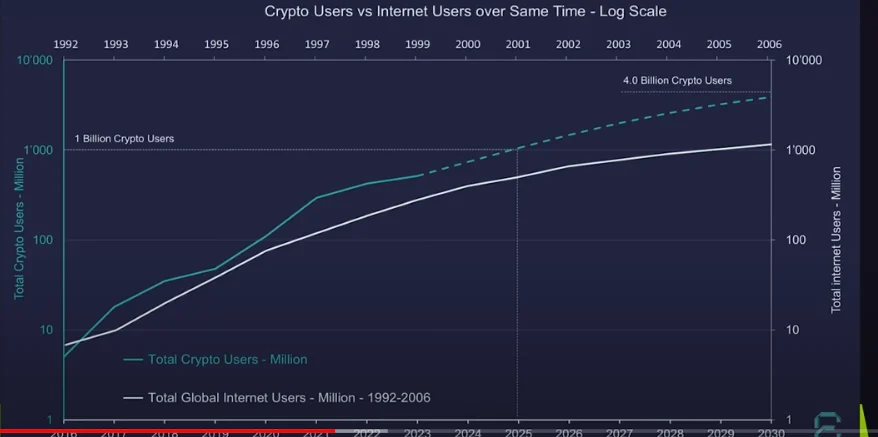
In the rapidly evolving landscape of digital finance, the question is no longer whether cryptocurrency will achieve mainstream status, but rather how quickly it will integrate into the fabric of global society. Raoul Pal, a former Goldman Sachs executive and the current CEO of Real Vision, has recently reignited the debate surrounding digital asset adoption. Utilizing a long-term data model that has consistently tracked the trajectory of Bitcoin (BTC) and the broader crypto market for half a decade, Pal posits that the industry is currently on an unstoppable trajectory toward four billion users by the turn of the decade.
The Core Thesis: A Historical Mirror
At the heart of Pal’s analysis lies a compelling comparison between the adoption of the internet in the 1990s and the growth rate of the cryptocurrency ecosystem since 2016. Pal argues that digital assets are not merely mimicking the internet’s success—they are actively outpacing it.
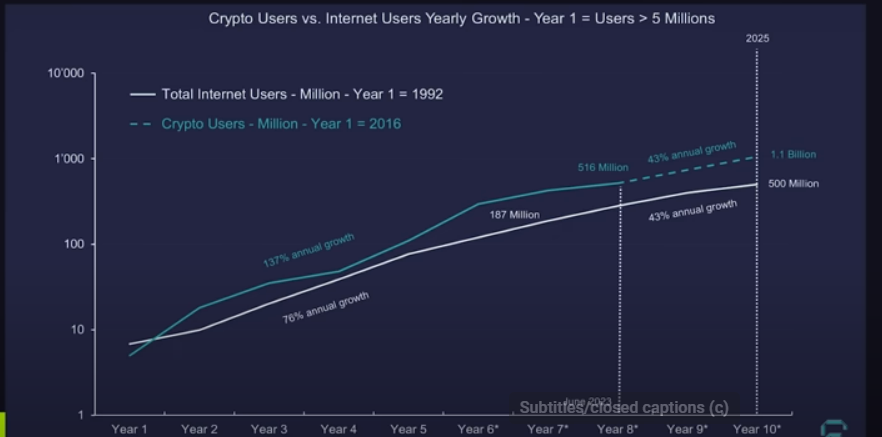
According to his data, when crypto first reached the milestone of one million users in 2016, it began a compounding growth cycle that has far exceeded the historical velocity of the World Wide Web. While the internet, widely regarded as the fastest-growing technology in human history, grew at a rate of 76% per year during its infancy before decelerating to 43% after its eighth year, cryptocurrency has maintained a blistering growth rate of 137% annually.
As of his most recent analysis, the crypto ecosystem boasts approximately 516 million users. When contrasted with the 187 million users the internet commanded at a comparable stage of its development, the implication is clear: the adoption curve of blockchain technology is significantly steeper and more aggressive than that of its predecessor.
Chronology of Adoption: From Niche to Necessity
To understand the gravity of Pal’s projections, one must look at the timeline of digital adoption. The "Crypto Revolution," while often characterized by volatile price action, has shown a remarkably consistent user growth pattern.
- 2016 (The Starting Line): The industry hits the one-million-user threshold. This is the baseline for Pal’s model, marking the transition from a cypherpunk curiosity to an investable asset class.
- 2016–2023 (The Growth Phase): Over the past seven years, the ecosystem has ballooned from one million to over 500 million participants. This period saw the maturation of decentralized finance (DeFi), the emergence of non-fungible tokens (NFTs), and the institutionalization of Bitcoin via spot ETFs and corporate balance sheet allocations.
- 2024–2025 (The Billion-User Milestone): Pal projects that even if the growth rate were to normalize to match the internet’s historical trajectory, the crypto space is on track to surpass one billion users by the end of 2025.
- 2026–2030 (The Mass Adoption Era): Looking toward the end of the decade, the model suggests a compounding effect that could bring the total user base to four billion. This would represent roughly half of the current global population, cementing digital assets as a foundational layer of the global financial infrastructure.
Supporting Data and Model Methodology
Pal’s methodology relies on a "Law of Adoption" framework, which suggests that all revolutionary technologies follow an S-curve. In the early stages, adoption is slow and localized; it then hits a "tipping point" of exponential growth before eventually plateauing as it approaches market saturation.
Pal’s model is conservative in its assumptions. He explicitly notes that he expects growth rates to decelerate as the user base expands. However, even with this projected cooling of growth, the sheer momentum behind blockchain-based technologies—driven by decentralized applications, stablecoins, and the infrastructure of Web3—creates a "staggering" statistical outcome.

The data suggests that the utility of these networks is increasing alongside the number of participants. Unlike the early internet, which was largely informational, the crypto ecosystem is transactional. The integration of stablecoins, which facilitate near-instant global remittances, has provided a "killer app" for emerging markets, significantly accelerating adoption in regions where traditional banking systems are either inaccessible or hyper-inflationary.
Industry and Institutional Perspectives
The perspective offered by Raoul Pal aligns with a growing sentiment among institutional analysts and venture capital firms. While many traditional financial institutions remained skeptical of crypto throughout the 2010s, the current decade has seen a pivot toward "Blockchain as a Service" (BaaS).
Institutional Integration
Major players such as BlackRock and Fidelity have moved from passive observers to active participants, providing the necessary institutional rails for the next wave of users. These entities argue that the "four billion" figure is not an abstraction, but a logical endpoint for a global financial system that is increasingly digitized.
The Regulatory Tailwind
While global regulation remains a fragmented landscape, many experts agree with Pal’s assessment that the regulatory clarity arriving in jurisdictions like the European Union (through the MiCA framework) and the United States (via legislative efforts) acts as a catalyst for adoption. As the legal status of digital assets becomes codified, the "friction" that currently prevents retail users from entering the market is expected to diminish significantly.
Implications for the Global Economy
If Pal’s projections hold true, the implications for the global economy would be profound. A world with four billion crypto users would fundamentally alter the balance of power in international finance.
1. The Disintermediation of Finance
The primary implication is the shift away from centralized intermediaries. With billions of users interacting directly with smart contracts and decentralized protocols, the need for traditional clearinghouses, correspondent banks, and legacy payment rails would be drastically reduced. This could lead to a more efficient, 24/7 global economy characterized by lower transaction costs and greater financial inclusivity.
2. Sovereignty and Asset Ownership
As crypto reaches 50% of the global population, the concept of "sovereign wealth" shifts from the state to the individual. The ability to custody one’s own assets—free from the risk of bank failure or geopolitical interference—becomes a default rather than a niche preference. This transition would likely force governments to compete more aggressively in providing value to their citizens, as capital becomes increasingly mobile and borderless.
3. The End of "Traditional" Banking
The banking sector is already witnessing the beginning of this transition. Banks that fail to integrate blockchain technology or offer "crypto-friendly" services are increasingly finding themselves obsolete. A four-billion-user crypto market implies that banking services will likely become a backend utility provided by blockchain protocols, with the user interface being handled by a new generation of fintech companies.
Challenges and Counter-Arguments
Despite the optimism, critics of this model point to significant hurdles that could derail the path to four billion users. The most notable concerns include:
- User Experience (UX): Despite improvements, interacting with self-custody wallets and managing private keys remains a significant barrier for the average consumer. Without significant improvements in account abstraction and security, the "mass market" may remain hesitant.
- Infrastructure Sustainability: As the network scales, the demand on underlying infrastructure will increase. The ability of blockchain networks to process transactions at a global scale without compromising on decentralization remains a subject of intense technical debate.
- Geopolitical Pushback: The rise of Central Bank Digital Currencies (CBDCs) represents a potential challenge to the decentralized ethos. Governments may attempt to incentivize the use of state-controlled digital tokens, which could either compete with or coexist alongside public blockchains.
Conclusion: A Paradigm Shift
Raoul Pal’s analysis serves as a stark reminder of the velocity at which technology can transform the human experience. Whether the specific target of four billion users is reached by 2030 or a few years thereafter is perhaps less important than the broader trend itself: the world is migrating toward a digital-first financial system.
The "staggering" nature of these numbers, as Pal describes them, highlights that we are living through a generational shift. As digital assets continue to weave themselves into the daily habits of billions—from remittances in the Global South to institutional portfolios in the West—the legacy financial system is finding itself in a race to adapt.
For investors and observers alike, the path forward is increasingly clear. The data suggests that the foundations are being laid for a future where digital asset ownership is as common as owning a smartphone. While the road ahead will undoubtedly be marked by volatility, technological hurdles, and regulatory debates, the trajectory described by Pal offers a compelling vision of a future defined by decentralized, borderless, and inclusive finance.
Disclaimer: The information provided in this article is for educational and informational purposes only and does not constitute financial, investment, or legal advice. Cryptocurrency investments are inherently volatile and carry a high degree of risk. Readers are encouraged to conduct their own research and consult with a professional financial advisor before making any investment decisions.