The Gaming Frontier: How a16z Views Web3 as the Catalyst for Mass Crypto Adoption
In the rapidly evolving landscape of digital assets, the question of "mass adoption" remains the industry’s North Star. While decentralized finance (DeFi) and non-fungible tokens (NFTs) have dominated the headlines for years, venture capital titan Andreessen Horowitz (a16z) suggests that the next monumental wave of users will not come from traditional banking disruption, but from the immersive world of Web3 gaming.
In its comprehensive 2023 "State of Crypto" report, a16z’s specialized crypto arm, a16zcrypto, positions gaming as the primary bridge between casual internet users and the complex ecosystem of blockchain technology. By leveraging the engagement models of traditional gaming, the firm argues that Web3 is poised to transition from a niche financial playground to a mainstream consumer utility.
The Convergence of Gaming and Blockchain
For decades, the gaming industry has perfected the art of digital asset ownership—albeit within "walled gardens." Players purchase skins, items, and currency, yet they rarely truly own them, and they almost never have the ability to move these assets outside of the specific game environment.
Web3 gaming changes this paradigm fundamentally. By integrating blockchain technology, these games allow for true digital property rights, interoperability across platforms, and the ability to monetize time spent in-game. a16z’s report underscores a critical sentiment: "Web3 games are a huge opportunity to welcome new users to crypto."
Unlike DeFi, which requires a steep learning curve regarding liquidity pools, collateralization, and yield farming, gaming provides an "in-game" incentive. Players are often drawn to the mechanics of the game first and the blockchain backend second. This "fun-first" approach is seen by industry analysts as the key to lowering the barriers to entry that have historically hindered broader crypto adoption.
Chronology of Adoption: From Niche to Necessity
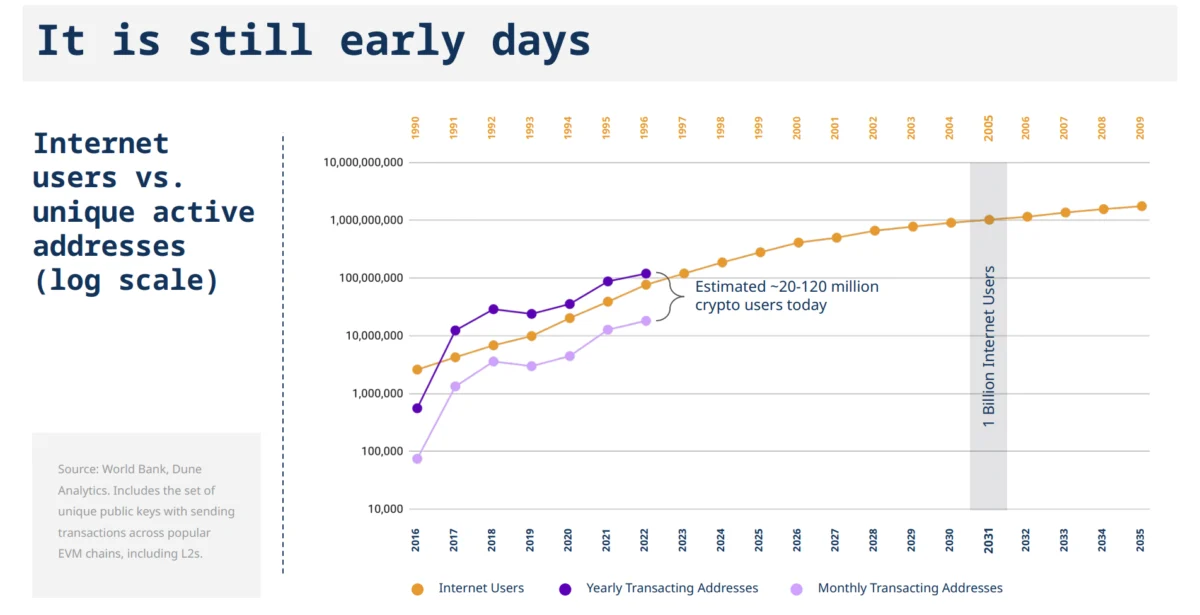
To understand the current trajectory of the crypto industry, a16z draws a historical parallel to the birth of the commercial internet. The firm maps the growth of the internet starting in 1990 against the expansion of the crypto ecosystem beginning in 2016.
The 1990s vs. The 2020s
In the early 1990s, the internet was a text-heavy, fragmented network used primarily by academics and hobbyists. It took several years of infrastructure building—modems, browsers, and eventually social platforms—before the internet became the backbone of global commerce.

Crypto is currently traversing a similar "infrastructure phase." According to the data provided by a16z, 2022 saw an estimated 20 million monthly transacting crypto addresses, with 120 million yearly transacting addresses. When compared to the 1996 milestone of nearly 100 million internet users, the report suggests that crypto is currently in its "Netscape moment." We are moving past the era of early-adopter experimentation and into a phase of functional, consumer-facing application.
The Surge of Web3 Gaming
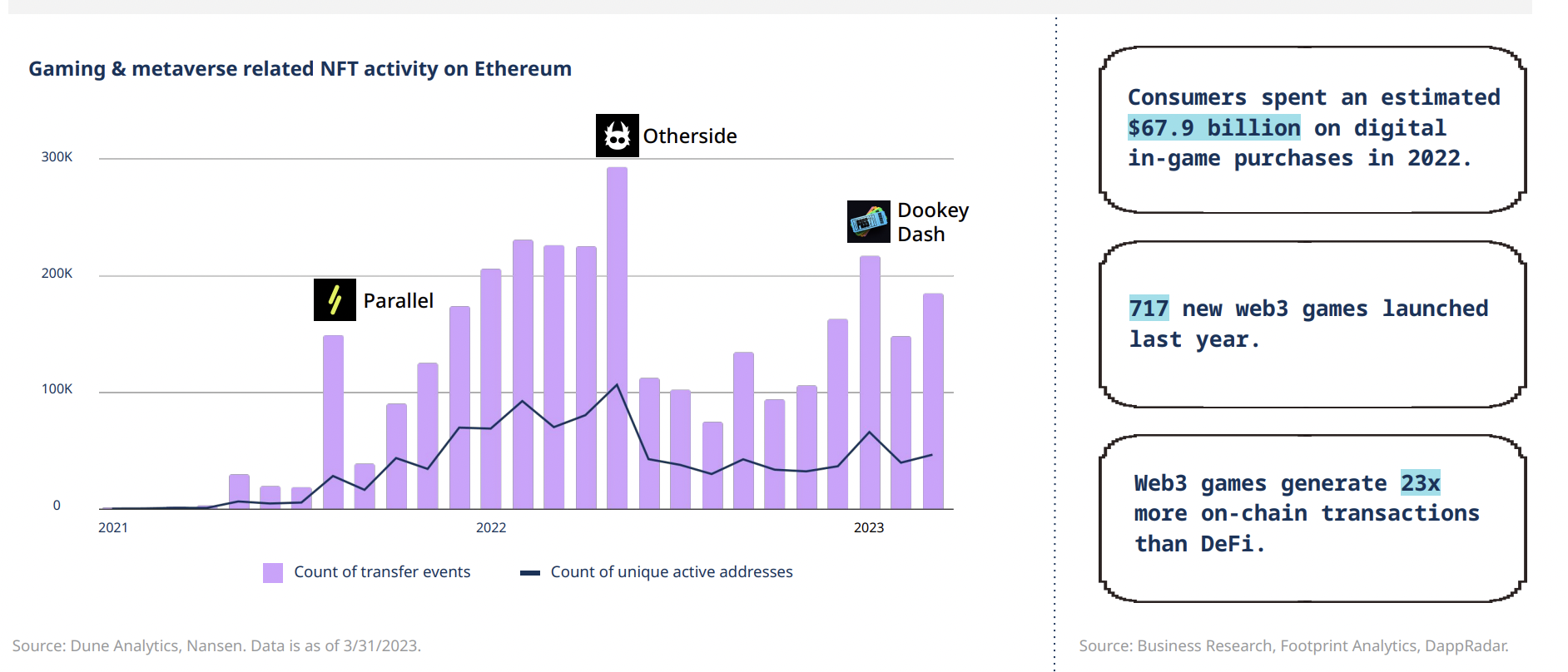
The last 24 months have witnessed a Cambrian explosion in Web3 game development. According to the report, 717 new Web3 games launched in the past year alone. This is not merely an increase in quantity; it represents a shift in developer talent, as engineers and designers from AAA gaming studios move into the blockchain space, seeking to build more sophisticated, high-fidelity experiences that go beyond the "click-to-earn" models that characterized early blockchain games.
Supporting Data: Why Gaming Dominates On-Chain Activity
Critics of crypto often point to the lack of "real-world use cases." a16z counters this narrative with stark data regarding on-chain volume.
Currently, Web3 games are generating 23 times more on-chain transactions than traditional decentralized finance applications. This statistic is pivotal. While DeFi protocols hold significant value (TVL), gaming protocols generate consistent, high-frequency activity. Every sword swing, quest completion, or inventory trade in a blockchain-enabled game constitutes an on-chain transaction. This volume provides the "network effect" necessary to stress-test blockchain scalability, lower transaction costs, and prove the viability of high-throughput networks like Solana, Immutable X, and Polygon.
Furthermore, the scale of the traditional gaming market provides a massive TAM (Total Addressable Market). The report notes that consumers spent an estimated $67.9 billion on digital in-game purchases in 2022 alone. Even capturing a single-digit percentage of this market—shifting it from centralized platforms to decentralized ledgers—represents a multi-billion dollar opportunity for the crypto sector.
Official Perspectives and Industry Implications
The investment thesis from a16z is not just an observation; it is a roadmap for their capital allocation. The firm’s "State of Crypto" report serves as a manifesto for the builders they fund.
The Shift in Narrative
Industry experts argue that the shift toward gaming helps solve the "crypto PR problem." By focusing on entertainment and ownership rather than speculation, Web3 gaming could help wash away the stigma associated with the 2022 market crashes and the proliferation of low-utility memecoins. When users are interacting with a game, the volatility of the underlying asset becomes secondary to the value of the experience.
The Infrastructure Challenge
However, the path to mass adoption is not without hurdles. The report acknowledges that while interest is high, the "State of Crypto" is still hindered by user experience (UX) friction. Wallets are still too complex for the average gamer, and the onboarding process—involving fiat-to-crypto off-ramps and complex gas fees—remains a significant barrier.
a16z emphasizes that 2023 and beyond must be defined by:
- Abstraction of Complexity: Building "invisible" wallets that function like traditional gaming accounts.
- Regulatory Clarity: Navigating the legalities of digital assets within entertainment software.
- Scalability: Ensuring that thousands of simultaneous players do not clog the network or inflate gas fees.
Broader Implications for the Digital Economy
The implications of a16z’s findings extend far beyond the gaming industry. If gaming succeeds as the "Trojan Horse" for crypto adoption, it will fundamentally change how digital economies function.
- The Creator Economy: Web3 gaming empowers modders, skin-creators, and digital artists by allowing them to earn royalties on secondary sales through smart contracts, effectively creating a "middle-class" of digital laborers within virtual worlds.
- Interoperability: As games become more interconnected, we may see the rise of a "Metaverse" where assets can be ported between titles, creating a unified digital identity that is not owned by a single corporation.
- Decentralized Governance: Many of these games are governed by DAOs (Decentralized Autonomous Organizations), giving players a literal vote in the development and economic policies of the games they frequent.
Conclusion: The Path Forward
The "State of Crypto" report from Andreessen Horowitz paints a picture of an industry maturing. By identifying gaming as the primary engine for growth, a16z is betting on a future where crypto is integrated into the daily lives of millions, not as a speculative financial instrument, but as a core layer of the digital experience.
While the "early days" of crypto were defined by code, cryptography, and whitepapers, the next phase will be defined by user interface, gameplay, and community. If the current trends in development and on-chain activity hold, the gaming industry is poised to move blockchain technology from the fringes of finance into the center of global culture.
Investors and enthusiasts alike are watching closely. If the analogy of the 1990s internet holds true, we are not witnessing the end of the crypto cycle; rather, we are seeing the beginning of the infrastructure that will power the next generation of the internet—one where digital ownership is not just a feature, but the standard.
Disclaimer: Opinions expressed in this report are based on public documentation and industry analysis. This content does not constitute investment advice. Investors should conduct their own due diligence before making any high-risk investments in Bitcoin, cryptocurrency, or digital assets. Your trades are at your own risk, and losses are the responsibility of the individual investor. The Daily Hodl does not recommend the buying or selling of any assets.