
The Great Crypto Cooling: Centralized Exchanges Experience Sharp Volume Contraction in April
After a blistering six-month rally that saw trading activity across the digital asset landscape reach dizzying heights, the cryptocurrency market experienced a significant deceleration in April. New data provided by the blockchain analytics firm CCData indicates that the feverish pace of trading on centralized exchanges (CEXs) has cooled, marking a notable departure from the bullish momentum that defined the first quarter of 2024.
The Core Data: A Multi-Trillion Dollar Contraction
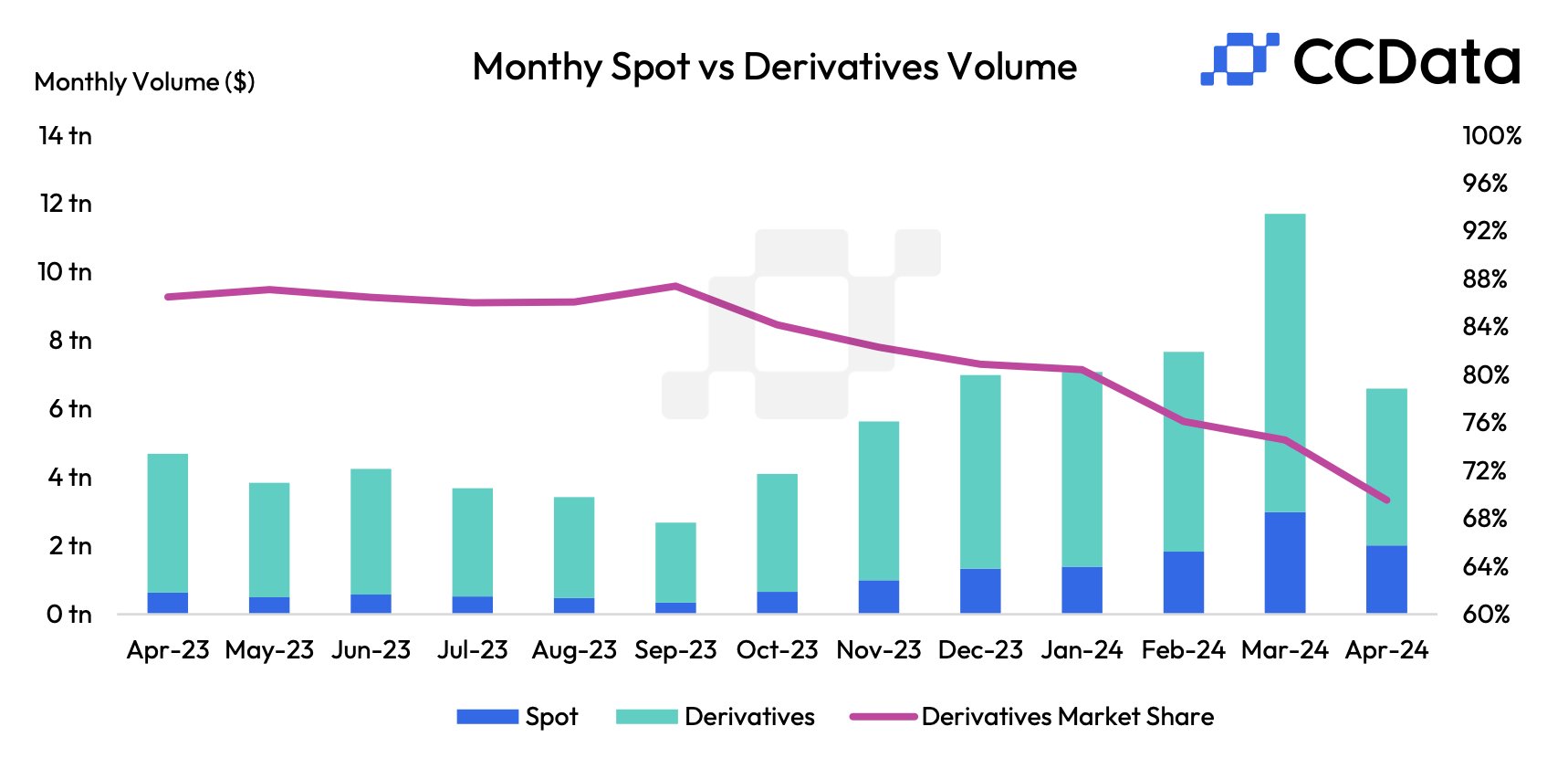
The latest report from CCData highlights a staggering 43.8% decline in the combined volume of spot and derivatives trading on centralized exchange platforms. In absolute terms, the total trading volume plummeted to $6.58 trillion, a stark reversal from the record-breaking levels witnessed in the preceding months.
To contextualize the scale of this contraction, one must look at the recent trajectory of the market. In March, the combined volume across these platforms sat at approximately $11 trillion, following a February performance of roughly $8 trillion. The rapid ascent to these figures had been fueled by a combination of macroeconomic optimism, the successful launch of spot Bitcoin ETFs in the United States, and the anticipation surrounding the Bitcoin halving event.
However, the April data serves as a sobering reminder of the cyclical and volatile nature of the crypto markets. Despite the significant percentage drop, analysts note that the $6.58 trillion figure remains historically robust. When viewed against the backdrop of 2023, the April 2024 performance still eclipses any single month of the previous year, with the notable exception of December. This suggests that while the "froth" may be coming off the market, the structural foundation of liquidity remains significantly stronger than it was during the "crypto winter" of 2023.
A Chronological Perspective: From Peak Mania to Market Calibration
The first quarter of 2024 was defined by a relentless upward trajectory. As January transitioned into February and March, investor sentiment turned overwhelmingly bullish. The influx of institutional capital, coupled with retail "fear of missing out" (FOMO), pushed trading volumes to levels not seen since the peak of the 2021 bull cycle.

- Q1 2024 (January – March): This period represented a sustained "green wave." As Bitcoin breached its all-time high, centralized exchanges were overwhelmed by transaction requests. High volatility and price discovery created a playground for traders, driving massive volume in both spot markets and derivatives.
- Late March/Early April: Market participants began to express caution. With the Bitcoin halving approaching, many investors adopted a "sell the news" strategy, leading to a period of consolidation.
- April 2024: The month of the halving itself proved to be a period of consolidation rather than a catalyst for a sustained parabolic move. Trading volumes retracted as investors reassessed the macroeconomic environment, including persistent inflation concerns in the U.S. and the shifting expectations regarding Federal Reserve interest rate cuts.
The Impact on Industry Titans
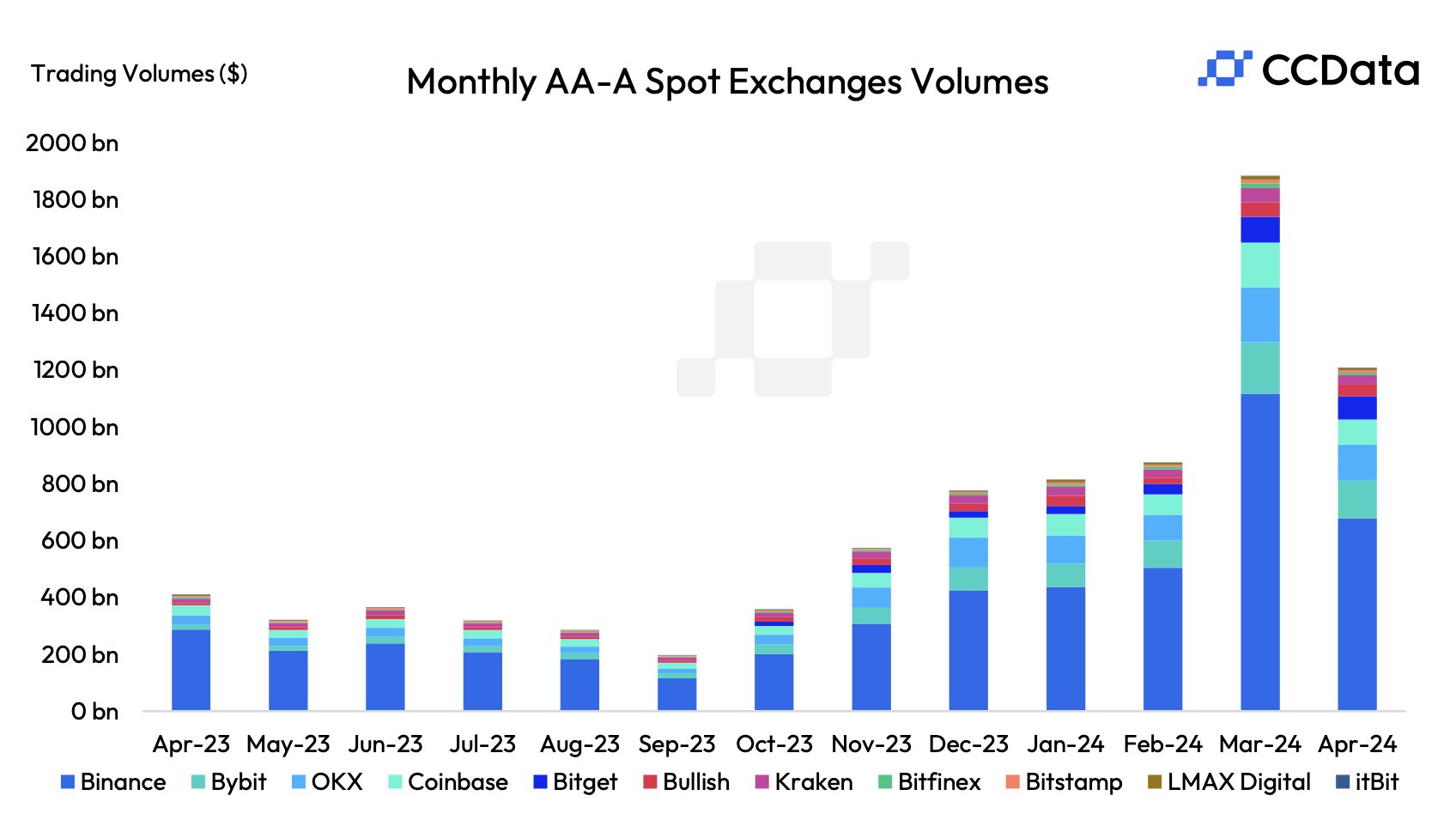
The contraction in volume was not evenly distributed; rather, it hit the industry’s most prominent players with varying degrees of severity. Binance, the world’s largest exchange by volume, faced a substantial decline. CCData’s analysis reveals that Binance’s spot volume in April sat at approximately $679 billion, representing a 39.2% decrease from the previous month.
Other major players were similarly affected. Bybit, a platform that has seen meteoric growth over the past year, recorded $133 billion in volume—a 26.9% decline. OKX, another top-tier exchange, saw its volume drop by 34.8% to $126 billion.
These figures underscore a universal trend: when volatility decreases or becomes erratic, and when the broader market enters a consolidation phase, the volume on centralized exchanges is the first metric to retreat. These exchanges serve as the primary conduits for retail and institutional flow, and their health is directly correlated with the prevailing risk appetite of the global investor base.
Sector Performance: Divergence Beneath the Surface
While centralized trading volume took a hit, the underlying crypto ecosystem showed signs of deep sector-specific divergence. CCData’s analysis of basket performance returns through May 10th reveals that while the broader market cooled, certain "narrative-driven" sectors continued to exhibit strength.
The standout performer was the Metaverse and Gaming sector, which posted a 32.4% gain in month-to-date returns. This suggests that even as speculative trading in majors like Bitcoin and Ethereum slowed, capital continued to flow into high-beta, long-term development sectors.
Similarly, Artificial Intelligence (AI) tokens and Meme coins remained resilient, with returns of 17.4% and 16.2%, respectively. This highlights a persistent retail preference for high-reward tokens that capitalize on current cultural and technological zeitgeists.
Conversely, Layer-2 scaling solutions—which have been the darlings of the Ethereum ecosystem—recorded a decline of 4.2%. This performance indicates a potential "fatigue" among investors regarding the proliferation of L2 networks, or perhaps a shift in capital allocation toward more speculative, high-alpha assets like meme tokens.
The Implications: What Does This Mean for the Market?
The sharp decline in trading volume carries several implications for the future of the crypto landscape:
- Normalization vs. Stagnation: The drop from $11 trillion to $6.58 trillion should be viewed as a cooling-off period rather than a collapse. Markets that rise too quickly often require periods of lower liquidity to establish new support levels. This "basing" process is often healthy for long-term sustainability.
- Increased Scrutiny on Exchange Revenue: For centralized exchanges, the revenue model is heavily dependent on trading fees. A 40%+ drop in volume directly impacts the bottom line of these companies. This may force exchanges to diversify their revenue streams, moving further into institutional custody services, lending, and proprietary product development.
- The Shift in Retail Behavior: The outperformance of meme coins and AI tokens versus Layer-2 infrastructure suggests that the market is currently driven by short-term narrative momentum rather than fundamental utility. This trend creates significant volatility, as these assets are prone to sudden liquidity crunches when the broader market sentiment turns negative.
- Macroeconomic Sensitivity: The April volume drop is inextricably linked to the broader macroeconomic environment. As global liquidity tightens, speculative assets are the first to see their liquidity evaporate. Investors are waiting for clearer signals from central banks before committing significant new capital to the market.
Expert Outlook and Future Considerations
Market analysts remain divided on whether this contraction marks the beginning of a deeper correction or merely a "mid-cycle" pause. The resilience of the sector-specific baskets—particularly in AI and gaming—indicates that there is still significant "dry powder" sitting on the sidelines, waiting for a catalyst to re-enter the market.
For the centralized exchanges, the focus in the coming months will likely be on operational efficiency and regulatory compliance. As volume fluctuates, exchanges that can maintain market share while providing a secure and compliant environment will likely emerge as the ultimate victors of the current cycle.
Investors are advised to exercise caution. The data from April serves as a stark reminder that while the long-term thesis for digital assets remains strong, the path forward is rarely a straight line. Market participants should monitor upcoming macroeconomic data releases and developments in the regulatory sphere, as these will likely dictate the next phase of volume growth or contraction.
Disclaimer: The analysis provided herein is for informational purposes only and does not constitute financial, investment, or legal advice. Cryptocurrency investments involve significant risk, including the potential for a total loss of capital. Investors should conduct their own thorough due diligence and consult with a qualified financial advisor before making any investment decisions. The entities mentioned in this report are subject to market forces and regulatory environments that can change rapidly.