
The Great Onboarding: Raoul Pal Predicts Global Crypto Adoption Will Hit 4 Billion Users by 2030
In the rapidly evolving landscape of digital finance, the question of "if" cryptocurrency will reach mass adoption has long been replaced by the question of "when." According to Raoul Pal, former Goldman Sachs executive and the current CEO of Real Vision, the answer is arriving faster than most market observers dared to imagine. Drawing upon historical parallels with the dawn of the internet age, Pal suggests that the crypto ecosystem is currently tracking toward a milestone of four billion users by the year 2030—a figure that represents roughly half of the current global population.
The Core Thesis: Crypto’s Exponential Trajectory
The crux of Pal’s argument lies in a data-driven model that benchmarks the growth of the cryptocurrency market against the most successful technological adoption curve in human history: the internet.
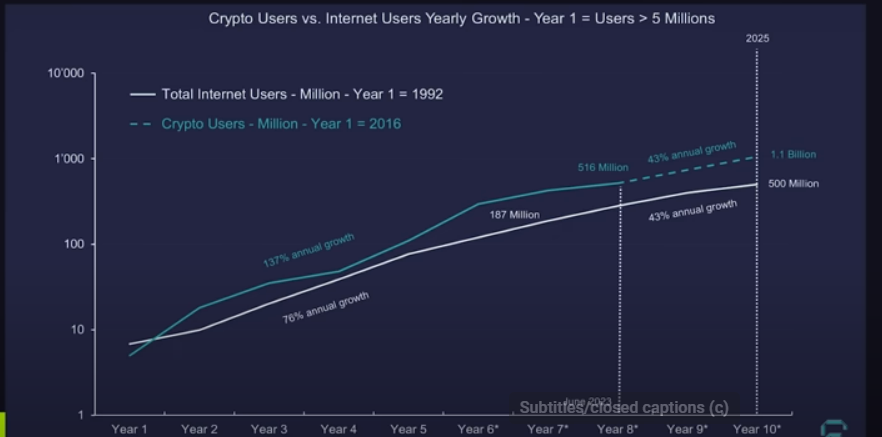
Pal points out that while the internet was historically lauded as the fastest-growing technology of its time, its growth trajectory—while impressive—is being eclipsed by the crypto industry. The internet grew at an average rate of 76% per year during its early expansion phase, eventually tapering off to roughly 43% annually after its eighth year. In stark contrast, cryptocurrency adoption has maintained a blistering average growth rate of 137% per year.
As of current metrics, the crypto market is estimated to have approximately 516 million users. When compared to the internet at a similar stage in its development—which boasted only 187 million users—the disparity is clear. The crypto industry is not merely keeping pace; it is fundamentally outperforming the digital infrastructure that redefined the 20th century.
Chronology of Adoption: From Niche to Necessity
To understand the significance of Pal’s prediction, it is essential to view the timeline of crypto adoption through a wider lens.
The Foundation (2016)
The year 2016 serves as the baseline for Pal’s model. At this point, the global user base for cryptocurrency reached one million. This was the "proof of concept" phase, where Bitcoin and the nascent Ethereum ecosystem began to transition from a fringe interest of cypherpunks and computer scientists into a legitimate financial asset class.
The Growth Phase (2017–2024)
Over the last eight years, the market has endured multiple "crypto winters" and extreme volatility. Despite the boom-and-bust cycles, the underlying trend—the number of wallet addresses, active participants, and institutional integration—has remained consistently upward. The industry has survived regulatory scrutiny, the collapse of major exchanges, and global macroeconomic instability, proving that the demand for decentralized finance is resilient.
The Near-Term Outlook (2025)
Pal projects that by the end of 2025, the total number of crypto users will cross the one-billion threshold. Even if one were to conservatively estimate that crypto adoption growth will eventually mirror the "slowing" trend seen in the internet’s history, the momentum is already too significant to stall. Pal asserts that reaching one billion users is not a matter of speculation but a statistical probability based on current user acquisition rates.

The Decade Milestone (2030)
Looking toward the turn of the decade, the model predicts that if crypto growth continues at a trajectory comparable to the internet’s historical path, it will reach four billion users by 2030. This would effectively move cryptocurrency from a speculative investment vehicle to a foundational layer of the global economy, utilized by half of the world’s population for payments, savings, and digital identity.
Supporting Data and Comparative Analysis
The strength of Pal’s argument is bolstered by the historical performance of his model, which he notes has been "pretty perfect" over the last five years. While critics often dismiss aggressive adoption predictions as "crypto-optimism," the empirical data regarding blockchain wallet growth, the rise of Layer-2 scaling solutions, and the integration of crypto-assets into traditional financial portfolios provide a tangible foundation for these figures.
The Internet vs. Crypto
The primary differentiator between the two is the nature of the value proposition. The internet primarily revolutionized the flow of information; cryptocurrency is revolutionizing the flow of value. Because money is a more universal utility than digital content, the "friction" of adoption is lower, and the incentive to join the network is higher.
Demographic Shifts
The adoption is being driven by three primary cohorts:
- The Unbanked: In regions with hyperinflation and unstable banking infrastructure, cryptocurrencies serve as a vital hedge and primary tool for financial inclusion.
- Institutional Investors: The approval of Bitcoin ETFs and the involvement of giants like BlackRock and Fidelity have provided a "seal of approval," encouraging retail investors who were previously wary of the sector.
- The Digital-Native Generation: Younger demographics are increasingly viewing digital assets as a natural extension of the digital-first economy they live in, bypassing traditional banking systems in favor of decentralized alternatives.
Official and Industry Responses
The broader financial community remains divided on these projections. While institutions like the IMF and various central banks remain cautious—often highlighting risks related to money laundering, volatility, and lack of consumer protection—the "on-the-ground" data tells a different story.
Major financial institutions are no longer debating whether crypto is a legitimate asset class but rather how to integrate it. The rise of Central Bank Digital Currencies (CBDCs) suggests that governments are keenly aware of the shift toward digital finance, even if they intend to control the infrastructure themselves.
Industry analysts often note that Pal’s projections assume a relatively stable regulatory environment. If governments were to implement draconian bans, the growth curve could flatten. However, most experts agree that the global nature of blockchain technology makes total containment impossible, meaning that even in a restrictive regulatory environment, adoption is likely to continue, albeit potentially in more clandestine or decentralized forms.
Economic and Societal Implications
If the world reaches a threshold of four billion users, the implications for global economics would be profound.
A New Monetary Standard
The normalization of crypto as a payment rail would fundamentally alter the effectiveness of traditional monetary policy. If a significant portion of the global population is operating on a decentralized network, the ability of central banks to manipulate the money supply through quantitative easing or interest rate hikes becomes less effective. This could lead to a more disciplined global fiscal environment, or conversely, a fragmented financial system.
Financial Inclusion
The most significant potential impact is the democratization of finance. For the millions of people currently excluded from the global banking system, decentralized finance (DeFi) represents an opportunity to participate in global markets without needing the permission of a legacy institution. This could lead to a massive increase in global economic activity and wealth distribution.
The End of Traditional Intermediaries
The transition to a four-billion-user crypto economy implies a massive disintermediation of the financial sector. Banks, payment processors, and remittance companies will be forced to evolve or face obsolescence. The role of the "trusted third party" will be replaced by smart contracts and code, shifting the burden of trust from institutions to protocols.
Conclusion: The Path Ahead
Raoul Pal’s vision of four billion users by 2030 is an ambitious forecast, but it is one grounded in the reality of exponential technological adoption. Whether the final count hits exactly four billion or deviates due to unforeseen macroeconomic shocks, the direction of the trend is unmistakable.
As cryptocurrency moves from the periphery of finance to the center of global economic activity, the "Great Onboarding" will likely redefine the relationship between individuals and their money. While the risks remain high and the path is rarely linear, the historical precedent suggests that we are witnessing the early stages of a fundamental shift in how humanity interacts, transacts, and stores value.
Disclaimer: The information provided in this article is for educational and informational purposes only and does not constitute financial, investment, or legal advice. Cryptocurrency investments are subject to high volatility and significant risk. Readers should conduct their own thorough due diligence and consult with a qualified financial advisor before making any investment decisions. The author and publisher are not responsible for any financial losses incurred based on the content of this article.