
The Justin Sun Prize: Redefining Scientific Rewards and AI-Driven Discovery in the Modern Era
GENEVA, SWITZERLAND — In a move that bridges the gap between historical mathematical challenges and cutting-edge artificial intelligence, the Office of Justin Sun announced the formal establishment of the Justin Sun Prize on September 16, 2026. Designed as a zero-trust, decentralized academic bounty mechanism, the initiative pivots away from traditional, slow-moving institutional academic cycles. Instead, it relies on a strict "problem list" where breakthroughs in fundamental disciplines and machine-formal verification serve as the sole criteria for recognition. With individual awards reaching up to US$1 million per solved problem, the prize aims to catalyze fundamental scientific research through synergistic collaboration between human intellect and artificial intelligence.
Concurrently, the initiative published its inaugural list of winners, honoring solutions and formalized proofs across 66 complex mathematical problems. Notably, the marquee US$1 million prize was awarded to the OpenAI research team for achieving a verified solution and formal proof for the Existence and Smoothness of the Three-Dimensional Navier–Stokes Equations. According to documentation released by OpenAI, the foundational proof was generated by its internal model, while the rigorous Lean formalization and verification process was completed by GPT-6 Astra.
Main Facts: A Paradigm Shift in Scientific Bounties
The launch of the Justin Sun Prize establishes a new framework for rewarding scientific breakthroughs, deliberately bypassing traditional bureaucratic gatekeeping.
- The Core Mechanism: The initiative operates on a decentralized, zero-trust model. It discards traditional nomination processes, credential barriers, four-year cycles, and lifetime-achievement metrics.
- The Award Criterion: Prizes are tied directly to specific mathematical problems and machine-verifiable formalized proofs. The first entity—whether human, institutional, or AI-driven—to submit a valid, verified solution claims the reward.
- The Inaugural Winner: The OpenAI team secured the $1 million top prize for resolving the Navier–Stokes existence and smoothness problem, utilizing GPT-6 Astra for Lean formalization.
- Guiding Principles: The initiative is anchored in three core tenets: openness (no restrictions on nationality, institution, or human-versus-AI status), public benefit (funds dedicated exclusively to awards and open initiatives without profit motives), and open-source transparency (proofs and verification materials published via GitHub, with payouts recorded immutably on-chain).
- Payout Flexibility: Winners can elect to receive their prize funds in either USDT on TRON (TRC-20) or USDC on Ethereum (ERC-20).
Chronology: From 19th-Century Fluid Dynamics to AI Verification
To understand the weight of the inaugural award, one must trace the lengthy history of the underlying mathematical challenge and the rapid evolution of the Justin Sun Prize framework.
- 19th Century: French physicist Claude-Louis Navier and Irish-born British mathematician George Gabriel Stokes independently develop the Navier–Stokes equations (N–S equations) to describe fluid motion, laying the groundwork for modern fluid dynamics.
- The Year 2000: The Clay Mathematics Institute designates the Navier–Stokes Existence and Smoothness problem as one of the seven prestigious Millennium Prize Problems, attaching a $1 million reward that remains largely unclaimed until now.
- September 16, 2026: The Office of Justin Sun officially launches the Justin Sun Prize in Geneva, Switzerland, introducing a decentralized problem-list bounty system aimed at becoming the "Nobel Prize of the AI Era."
- September 2026 (Inaugural Announcement): Alongside the launch, the prize committee releases its first wave of recognitions, awarding the $1 million top prize to OpenAI for its historic resolution of the Navier–Stokes problem using advanced AI architecture.
Supporting Data: Mathematics, Philanthropy, and Ecosystem Impact
The scale of the Justin Sun Prize is backed by significant financial commitments and a meticulously curated repository of historical mathematical hurdles.
The Problem List
The initial repository features formal verification challenges for some of mathematics’ most notorious unsolved problems, including:
- The Navier–Stokes Existence and Smoothness Problem (Solved by OpenAI / GPT-6 Astra)
- The Poincaré Conjecture
- The Riemann Hypothesis
- Goldbach’s Conjecture
- A comprehensive catalog of unsolved problems proposed throughout the lifetime of the late mathematician and Wolf Prize laureate Paul Erdős.
Once a problem is added to the repository, it is permanently locked. Problems can only be added, never removed, and awarded funds are non-retractable under any circumstances.
Philanthropic Footprint
According to public disclosures, Justin Sun has previously directed more than US$45 million toward technology, environmental protection, and global disaster relief. The Justin Sun Prize is positioned as the new cornerstone of his philanthropic endeavors, intended to recycle wealth generated within the technology and blockchain sectors back into fundamental scientific inquiry.
Ecosystem Background
The infrastructure supporting the prize leverages leading blockchain ecosystems:
- TRON: As the foundational network for the prize’s stablecoin payouts, TRON processes trillions in volume and serves as a critical pillar for stablecoin adoption across emerging global markets.
- Global Reach: The initiative reflects Sun’s diverse professional background, spanning digital assets, his tenure as Grenada’s Ambassador and Permanent Representative to the WTO, his spaceflight experience aboard Blue Origin’s NS-34 mission, and his ongoing investments in AI and decentralized infrastructure.
Official Responses and Statements
The unveiling of the prize and its unprecedented decision to award a top-tier mathematical bounty to an artificial intelligence system has drawn global attention.
Reflecting on the philosophical underpinnings of the initiative, Justin Sun remarked:
"An award named after a person is the least political thing in the world. More importantly, it gives me an answer to myself—my wealth is rooted in mathematics. It came from mathematics, and it will return to mathematics."
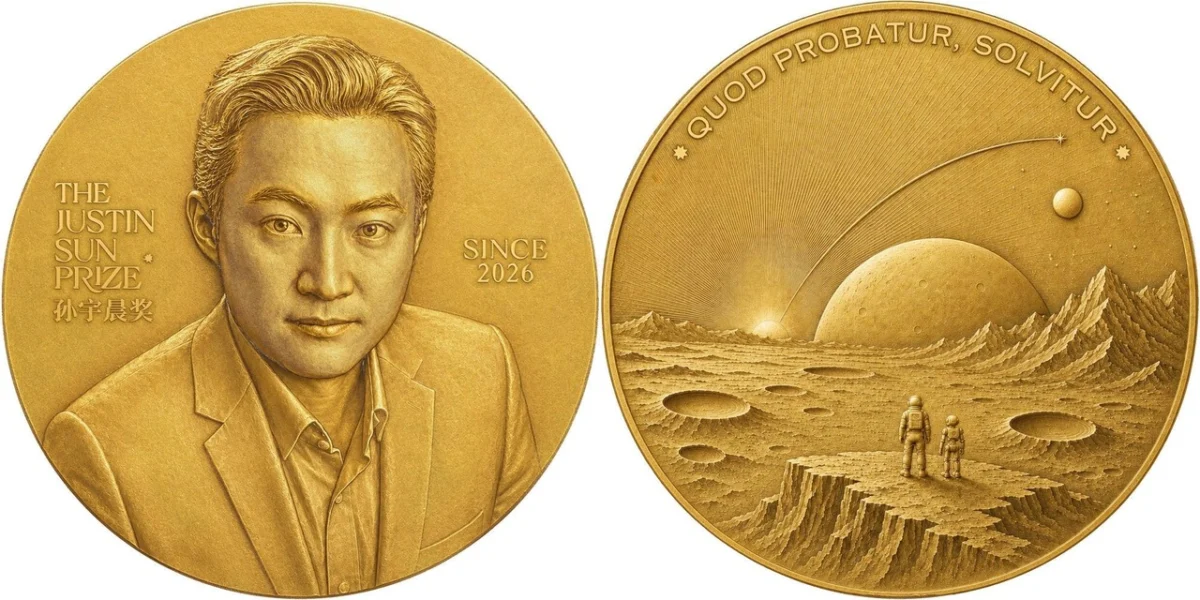
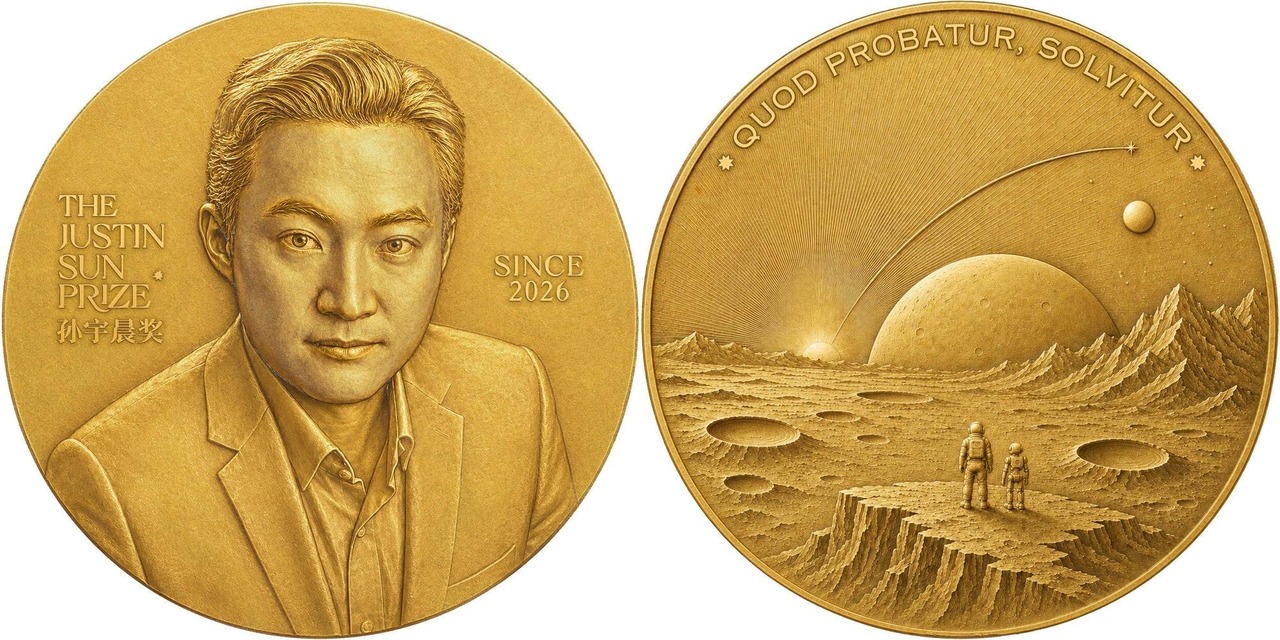
In keeping with classical traditions adapted for the digital age, recipients of the prize receive a formal certificate, a medal inscribed with the Latin phrase "Quod probatur, solvitur" ("Proved, then paid"), and a fully traceable on-chain transaction record.
Implications: The "Nobel Prize of the AI Era" and the Future of Science
The establishment of the Justin Sun Prize carries profound implications for the global scientific community, academic publishing, and the trajectory of artificial intelligence.
1. Redefining Academic Validation
By substituting human peer-review bottlenecks with machine formal verification (such as the Lean theorem prover), the prize eliminates subjectivity from the evaluation process. A proof is either mathematically sound down to its logical axioms or it is not. This "zero-trust" model could force traditional academic journals to reconsider how rapidly they adopt automated verification tools.
2. Accelerating Human-AI Synergy
The award of a $1 million mathematical prize to an OpenAI system assisted by GPT-6 Astra marks a watershed moment. It signals that artificial intelligence has transitioned from a predictive text tool or data analyzer into an active participant capable of solving centuries-old theoretical problems. This sets a precedent for future scientific discovery, where AI tackles the heavy computational and logical lifting of formal proofs, guided by human problem framing.
3. Democratization of Research
Because the Justin Sun Prize imposes zero restrictions regarding nationality, institutional affiliation, or human-versus-AI categorization, it breaks down the geographic and socioeconomic barriers that frequently lock independent researchers out of elite scientific recognition. Anyone anywhere can access the GitHub-hosted problem list, draft a proof, and claim a bounty once verified.
As the repository expands to include the Riemann Hypothesis and other intractable problems, the Justin Sun Prize may well succeed in its vision: establishing a permanent, decentralized engine for human and machine ingenuity that reshapes how scientific progress is incentivized in the twenty-first century.