The Path to Four Billion: Why Raoul Pal Believes Global Crypto Adoption is Just Getting Started
The trajectory of technological adoption has historically followed a predictable, exponential curve. From the early adoption of the telephone to the explosive ubiquity of the World Wide Web, each transformative technology eventually reaches a tipping point where growth shifts from a niche endeavor to a global necessity. According to Raoul Pal, former Goldman Sachs executive and CEO of Real Vision, the cryptocurrency industry is currently navigating this very inflection point.
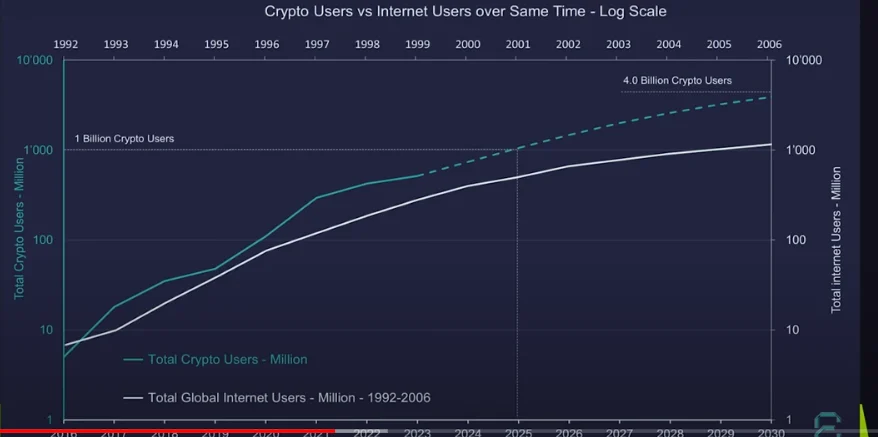
In a recent comprehensive analysis, Pal posits that Bitcoin and the broader digital asset ecosystem are on an unprecedented trajectory, one that could see global crypto adoption reach a staggering four billion users by the year 2030.
The Core Thesis: Crypto vs. The Internet
At the heart of Pal’s projection is a comparative model that measures the adoption rate of digital assets against the growth patterns of the internet during its formative years. Pal, who has tracked these metrics for half a decade, notes that the current rate of crypto adoption has consistently outpaced the initial adoption curve of the internet, suggesting that we are witnessing the fastest integration of a new financial technology in human history.
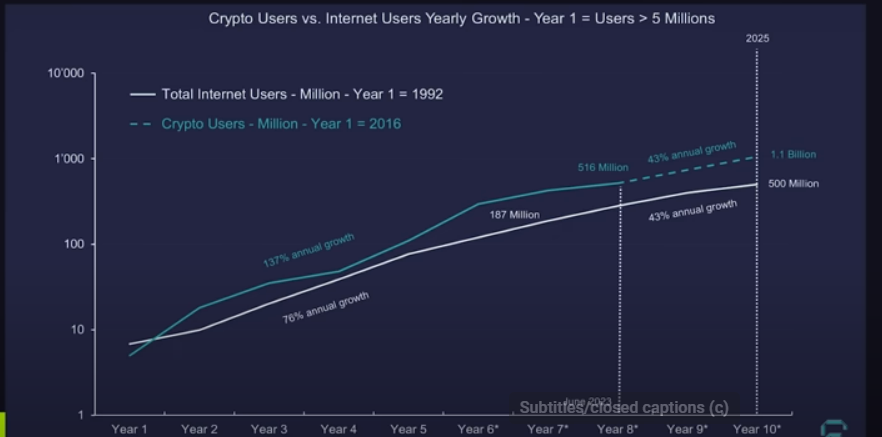
When comparing the two, the data is compelling. The internet, which remains the gold standard for rapid technological penetration, grew at a rate of 76% per year during its infancy. After eight years, that growth rate tempered to a more sustainable 43% annually. In stark contrast, the cryptocurrency sector has maintained a compound annual growth rate of 137% since 2016.
As of the latest industry data, the crypto ecosystem boasts approximately 516 million users. When placed against the 187 million internet users at a similar stage in that technology’s development, the divergence is clear: crypto is not just keeping pace; it is fundamentally disrupting the traditional speed of global adoption.
Chronology of Adoption: From Niche to Necessity
To understand where we are going, it is essential to look at how we arrived here. The chronology of digital asset adoption can be broken down into several distinct phases:
Phase 1: The Incubation Period (2009–2015)
This era was characterized by technical experimentation, Cypherpunk involvement, and the initial development of the blockchain ledger. Adoption was largely limited to developers, libertarians, and early enthusiasts. By 2016, the total user base hit the one-million-user milestone, a figure that serves as the baseline for Pal’s current modeling.

Phase 2: The Acceleration Phase (2016–2021)
This period marked the transition of Bitcoin from an obscure asset to a recognized store of value. The entrance of institutional investors, the rise of DeFi (Decentralized Finance), and the proliferation of accessible exchanges propelled user numbers from the thousands into the hundreds of millions.
Phase 3: The Integration Phase (2022–2025)
We are currently in the midst of this phase, characterized by regulatory frameworks, the introduction of spot ETFs (Exchange Traded Funds), and the integration of blockchain technology into traditional finance (TradFi). Pal’s models suggest that this phase will conclude with a milestone of 1.1 billion users by the end of 2025.
Phase 4: The Ubiquity Phase (2026–2030)
This projected final stage involves the "democratization" of crypto. During this period, the technology is expected to be baked into the infrastructure of daily life—ranging from global remittances and digital identity to programmable money and decentralized governance. This is where Pal envisions the total user base reaching four billion, effectively encompassing half of the world’s population.
Supporting Data and the Mathematical Model
The methodology behind Pal’s prediction relies on a "conservative cooling" assumption. While crypto is currently growing at 137% per year, Pal’s model adjusts for the reality that as any technology reaches a larger base, its growth rate naturally slows.
Even if we assume that crypto’s growth rate will drop significantly to match the 43% growth rate seen in the internet’s more mature years, the absolute numbers remain mathematically overwhelming. By applying this slowing growth factor to current user figures, the math dictates that the ecosystem will hit the one-billion-user mark by 2025. Extending this further, the model points toward the four-billion-user mark by 2030.
"Will this be perfect?" Pal asks rhetorically. "It’s been pretty perfect so far. I’ve been showing this chart for five years, and it has tracked remarkably well. But even if we assume the model is slightly off, the numbers remain staggering. We are talking about half the human population interacting with decentralized, cryptographic ledgers within a decade."
Official Perspectives and Market Context
Raoul Pal’s bullish outlook is shared by a growing cohort of analysts and institutional researchers. Recent reports from companies like Chainalysis and Triple-A have corroborated the surge in global crypto adoption, particularly in emerging markets where fiat currency instability has driven populations toward Bitcoin and stablecoins as a hedge against inflation.
Conversely, some institutional skeptics—including various central bank officials—have urged caution, citing concerns over market volatility and the lack of comprehensive consumer protections. However, the tone of official discourse is shifting. Rather than calling for total prohibition, many international bodies are now focused on "responsible innovation," acknowledging that the sheer scale of adoption makes outright bans impractical, if not impossible.
Implications for the Global Economy
The shift to a four-billion-user crypto economy carries profound implications for the global landscape:
- Financial Inclusion: A significant driver for the projected growth is the unbanked population. In many developing regions, mobile-based crypto wallets are providing the only path to global trade, credit, and savings, bypassing archaic banking systems that have historically excluded them.
- Monetary Sovereignty: As more individuals adopt digital assets, the influence of centralized monetary policy may weaken. This creates a feedback loop where citizens increasingly opt for assets with hard-capped supplies, such as Bitcoin, in response to excessive money printing by sovereign states.
- Institutional Infrastructure: With a user base of four billion, the "crypto industry" ceases to exist as a separate entity. Instead, it becomes the infrastructure upon which the global economy sits. Banking, legal contracts, supply chain tracking, and intellectual property management will all be digitized, creating a massive shift in how value is stored and transferred.
- The Regulatory Tug-of-War: The transition to this level of adoption will inevitably lead to increased friction between decentralized protocols and state actors. The next decade will likely be defined by the attempt to reconcile the borderless nature of crypto with the territorial nature of legal jurisdictions.
Conclusion: The Horizon of Digital Adoption
Raoul Pal’s prediction, while bold, is firmly rooted in the historical performance of transformative technologies. The narrative of "digital assets as a fringe asset class" is rapidly being replaced by the reality of a global financial revolution.
Whether the world hits the four-billion-user mark exactly by 2030 or shortly thereafter is perhaps less important than the underlying trend: the global population is moving toward a system of programmable, decentralized value. As the infrastructure matures and the user experience becomes seamless, the barriers to entry continue to crumble. If the last five years of data are any indication, the digital asset ecosystem is not just growing—it is accelerating toward a future where it is as common as the internet itself.
Disclaimer: The analysis provided here is for informational purposes only and does not constitute financial, investment, or legal advice. Cryptocurrency investments involve significant risk. Readers should conduct their own thorough due diligence and consult with a professional financial advisor before making any investment decisions. The Daily Hodl and its contributors are not responsible for any financial losses incurred.