The Psychology of the Bottom: CZ’s Contrarian Call Amidst Market Turbulence
In the volatile landscape of digital assets, few voices carry as much weight as Changpeng Zhao (CZ), the founder of Binance. As the cryptocurrency market recently navigated one of its most grueling periods of negative sentiment in the current cycle, CZ issued a characteristically blunt reminder to investors: "Unpopular opinion, but it’s better to sell when there is maximum greed, and buy when there is maximum fear."
While the adage is a classic tenet of value investing, its timing was anything but accidental. The statement arrived as the market struggled to find a definitive floor, caught between the echoes of October’s historic highs and the gnawing anxiety of a prolonged correction. For traders currently caught in the crosshairs of volatility, the message serves as both a strategic anchor and a psychological challenge.
A Chronicle of Fear: The Anatomy of the Recent Correction
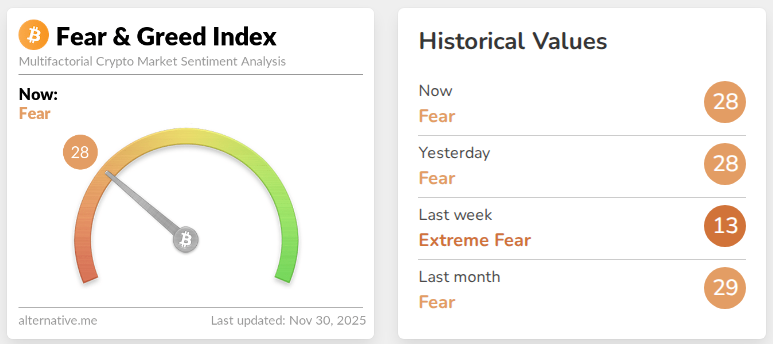
To understand the weight of CZ’s intervention, one must look at the recent historical context of market sentiment. According to the Crypto Fear & Greed Index, the market had been held in a vice-like grip of "Extreme Fear" for an astonishing eighteen consecutive days. On November 22, the index plummeted to a yearly low of 10, a reading that typically signals capitulation among retail participants.
The timeline of this descent was rapid. After reaching an all-time high of $126,000 in October, Bitcoin’s trajectory shifted sharply. The subsequent weeks were defined by a steady erosion of confidence, characterized by a lack of conviction in the bulls and a relentless pressure from institutional liquidations. By the time sentiment climbed to a modest 20—a slight reprieve but still firmly within the "Extreme Fear" category—the market had already been hollowed out by uncertainty.
Market analysts were quick to label the duration and intensity of this cycle as anomalous. Matthew Hyland, a prominent market observer, described this stretch as the "most extreme fear level" of the current cycle, noting that for many seasoned traders, even the index’s dire metrics felt like a conservative assessment of the prevailing dread.
Bitcoin’s Fragile Equilibrium
Bitcoin currently trades in the $91,000 range, a significant distance from its October peak of $126,000. While the digital asset remains substantially higher than its 2024 lows of approximately $40,000, the psychological distance from recent highs has left investors feeling vulnerable.

Data from Santiment, which monitors social sentiment and on-chain activity, suggests that the current discourse is dominated by discussions of systemic risk and institutional outflows rather than the speculative fervor typically seen during bull runs. The Altcoin Season Index, which serves as a barometer for risk appetite, sits at a tepid 22/100, indicating that capital is fleeing to the perceived safety of stablecoins and cash rather than rotating into riskier, high-beta assets.
The fragility of this state cannot be overstated. When Bitcoin struggles to reclaim psychological milestones, the broader ecosystem often enters a period of "dead-cat" consolidation, where the market is neither crashing nor rallying, but simply waiting for a catalyst to break the stalemate.
The Cognitive Gap: Psychology Over Technicals
One of the most compelling aspects of the recent market cycle is the disconnect between technical analysis and investor behavior. When CZ’s comments surfaced, the reaction across social media platforms was instantaneous and revealing.
While many traders intellectually agreed with the "buy the fear" philosophy, the actual execution of such a strategy is notoriously difficult. Behavioral economists have long noted that humans are evolutionarily predisposed to "loss aversion"—the tendency to avoid losses being psychologically more powerful than the joy of gains. Consequently, as prices drop, the "maximum fear" phase is precisely when most retail investors feel the strongest impulse to exit their positions to preserve remaining capital.
This gap between knowledge and action is the bedrock of market cycles. As one market observer noted, "The market moves on human psychology long before the charts confirm the trend." Technical indicators, such as the Relative Strength Index (RSI) or moving averages, are lagging indicators. They measure what has happened, whereas the Fear & Greed Index attempts to measure the emotional state of the participants who cause those movements.
Patterns and Precedents: History as a Guide
While history is not a crystal ball, it remains the most reliable compass in the crypto space. Market analysts have pointed out a recurring pattern over the last five years: whenever the Fear & Greed Index hits extreme lows, a "local bottom" often follows within a matter of weeks.
Nicola Duke, an analyst tracking these cyclical movements, notes that these periods of extreme pessimism have historically served as the definitive "washout" phase, where weak hands are forced out of the market and institutional "smart money" begins to accumulate. However, this time, the narrative is clouded by macroeconomic headwinds.
Bitwise researcher André Dragosch has issued a cautionary note, suggesting that the current market environment is not solely driven by internal crypto dynamics. Instead, it is being heavily influenced by a global growth outlook that reflects a recessionary environment—the most bearish macro setting since the onset of the COVID-19 pandemic and the subsequent 2022 market collapse. This adds a layer of complexity: is this a standard crypto correction, or is it a reflection of a broader, systemic economic shift?
A Sign of Recovery? The Coinbase Premium Shifts
In a potential signal that the tide may be turning, the Bitcoin Coinbase Premium—a metric that tracks the price difference between Bitcoin on the Coinbase exchange versus the global average—has finally flipped into positive territory. After 29 consecutive days of trading in the red, this shift is significant.
On November 30, the premium reached 0.0255%. For nearly a month, the negative premium had been a reliable indicator of persistent selling pressure within the United States, suggesting that domestic investors were leading the liquidation wave. A return to a positive premium suggests that the sentiment among US-based institutional and retail buyers is beginning to shift from net-selling to net-accumulation.
The Coinbase Premium is often viewed as a proxy for institutional confidence and dollar liquidity. When the premium is positive, it implies that demand within the US market is outpacing the global average, a phenomenon typically associated with the influx of capital from ETFs and high-net-worth individuals. While one day of positive premium does not constitute a trend, it is the first "green shoot" to appear in a landscape otherwise dominated by red ink.
Strategic Implications for the Market
What does this mean for the average trader? The intersection of CZ’s commentary, the historic levels of fear, and the recent stabilization of the Coinbase premium points to a market that is currently in a "wait-and-see" phase.
For long-term holders, the current environment offers a classic case study in risk management. Those who subscribe to the "buy the fear" mantra are often those who have already stress-tested their portfolios against a potential move lower. Conversely, for those who trade on momentum, the lack of a clear, sustained trend suggests that caution is warranted until the market clears the overhead resistance levels established during the October peak.
Ultimately, the market is currently testing the resolve of its participants. The "maximum fear" described by the index is not just a number; it is a test of conviction. Whether the recent positive shift in the Coinbase premium is the start of a recovery or merely a brief pause in a longer bear cycle remains to be seen. However, as the industry reflects on CZ’s words, one thing is clear: the market has once again reached that critical juncture where the courage to act against the herd often separates the survivors from the casualties.
As we move into the final stretch of the year, all eyes remain fixed on the charts, but the true battle continues to take place in the minds of the traders who watch them. The market is not just a collection of assets; it is a collective of human emotions, and as history has shown, those emotions are often the most reliable—and the most dangerous—indicators of all.