The Rise of the Machine Economy: How Autonomous AI Agents are Revolutionizing Crypto Micro-Payments
In a quiet, digital revolution that has largely escaped the attention of mainstream financial headlines, autonomous artificial intelligence agents have begun to reshape the landscape of online commerce. According to a landmark report from blockchain intelligence firm Chainalysis, these software-driven entities are now responsible for facilitating a massive volume of cryptocurrency transactions, signaling a fundamental shift in how services are purchased, consumed, and paid for on the internet.
At the heart of this transformation is the x402 protocol, an innovation incubated by Coinbase. Designed to bridge the gap between AI autonomy and financial utility, x402 allows software programs to independently execute payments for online services without requiring human intervention for every transaction. The data suggests that we are witnessing the birth of a genuine "Machine Economy," where AI agents serve as both the consumers and the participants in a high-velocity, automated financial ecosystem.
Main Facts: The x402 Protocol and the Surge in Agentic Commerce
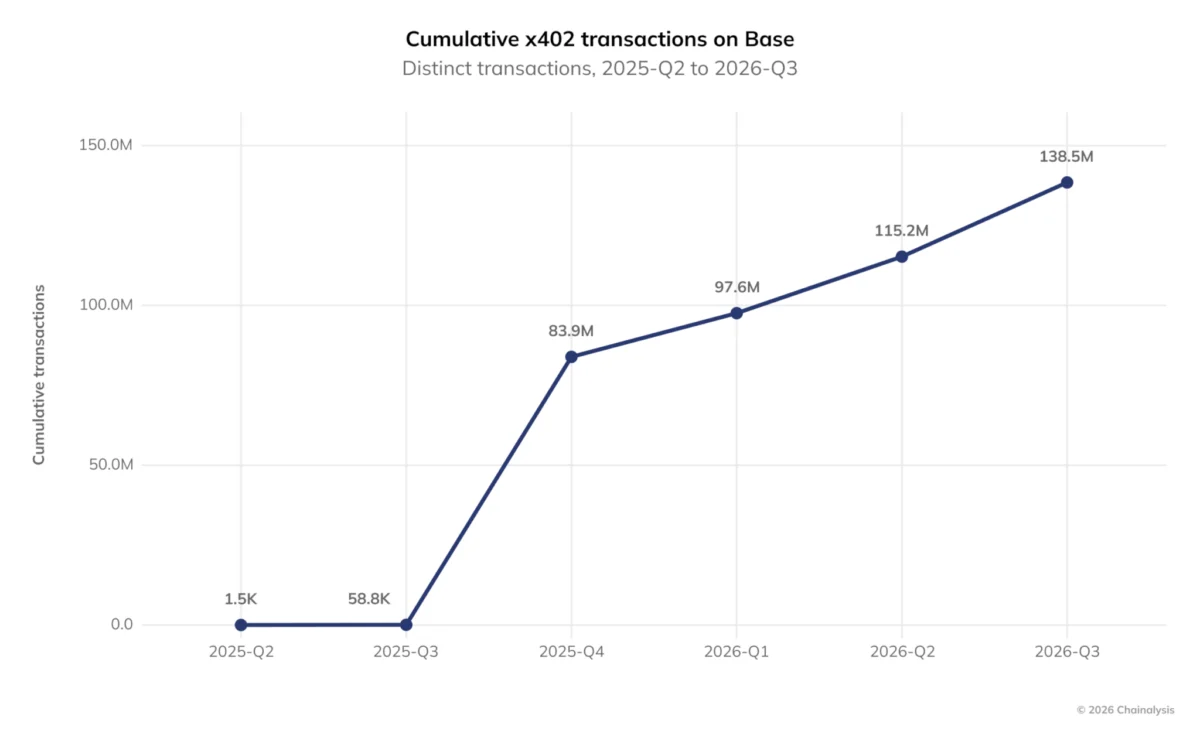
The Chainalysis report reveals that x402 has processed over 138 million cryptocurrency payments in a remarkably short period. This scale of activity underscores the efficiency of blockchain technology in handling automated, high-frequency micro-payments that would be logistically impossible or cost-prohibitive through traditional banking rails.
The nature of these transactions is defining: the vast majority are categorized as "micropayments." For the 16-month period ending in September 2026, over 87% of all x402 payments fell within the range of a hundredth of a cent to ten cents. The most frequent transaction size hovers between one and ten cents. This confirms that the protocol is being utilized primarily to settle tiny, granular costs—such as API calls, data requests, or computing power—that fuel the operations of sophisticated AI systems.
Unlike traditional consumer transactions, which require human authorization, x402 allows AI agents to carry out these payments autonomously. This is the cornerstone of "agentic commerce." By removing the human "middleman" from the payment process, AI agents can engage in millions of rapid-fire transactions to gather the data, processing power, or specialized intelligence they require to complete complex tasks.
Chronology: From Experimental Protocol to Rapid Integration
To understand the trajectory of this technology, one must look at the timeline of its adoption. When the x402 protocol was first introduced, it was treated as a novel, experimental sandbox for developers. However, the data from late 2025 through Q3 2026 paints a picture of rapid, aggressive maturation.
Late 2025: The Nascent Phase
In the initial months following the protocol’s launch, the interaction between AI agents and financial wallets was characterized by long latency periods. Chainalysis data indicates that in late 2025, the median age of a wallet—the time elapsed between its initial funding and its first x402 transaction—was approximately 73 days. This suggests that early adopters were testing the waters, moving slowly, and treating the integration of financial capabilities into AI agents as a secondary, deliberate project.
Early to Mid-2026: The Shift toward Purpose-Built Wallets
As 2026 progressed, the behavior of these wallets shifted dramatically. Developers and companies began "purpose-building" wallets specifically for agentic commerce. Rather than using legacy wallets, developers created new, specialized addresses designed exclusively to interact with the x402 protocol.
Q3 2026: The Era of Instant Utility
By the third quarter of 2026, the latency gap had collapsed to a mere 18 minutes. This radical compression—from over two months to less than twenty minutes—is a testament to the standardization of the technology. It indicates that AI infrastructure is now being deployed with pre-configured, "plug-and-play" payment capabilities. The industry has moved past the experimental phase and into a deployment phase where AI agents are expected to start spending the moment they go live.
Supporting Data: Mapping the AI Economy
The utility of x402 is not limited to a single sector. Chainalysis has categorized the spending patterns of these AI agents, providing a rare window into the specific needs of modern machine intelligence.
Information-Hungry Agents
A significant portion of the millions of transactions analyzed flows into information-intensive services. This includes code review platforms, financial intelligence feeds, and sophisticated data/search APIs. AI agents are inherently "hungry" for high-quality, machine-readable data. Because these agents are constantly iterating and learning, they require continuous access to fresh inputs, making on-chain micropayments an ideal mechanism for access control and billing.
The "Agent-to-Agent" Ecosystem
Perhaps the most fascinating finding is that AI agents are now paying other AI agents. A significant category of x402 transactions is dedicated to "model inference." In this scenario, one agent (a master agent) outsources specific computing tasks or specialized logic to another, more focused model. By paying for this inference through x402, the agents create a decentralized, modular AI network where intelligence can be bought and sold in real-time.

Diversified Use Cases
Beyond data and inference, AI agents are utilizing the protocol to settle costs for:
- Gaming: Automated systems participating in blockchain-based games.
- Token Issuance: Managing the lifecycle of digital assets.
- Gambling Services: High-speed automated betting systems.
- Agent Frameworks: Purchasing the very tools and software libraries required for the agents to function.
Official Responses and Industry Sentiment
While Coinbase and Chainalysis have provided the technical framework and analytical data, the broader industry reaction has been one of calculated optimism. Financial analysts point out that x402 addresses a long-standing "bottleneck" in the AI industry: how to monetize machine-to-machine interactions.
In briefings, proponents of the protocol argue that the legacy financial system is ill-equipped to handle billions of tiny, automated payments. Banks are constrained by transaction fees, clearing times, and regional borders. By contrast, the x402 protocol, leveraging the transparency and speed of the Base blockchain, turns these micro-transactions into a viable business model.
"The transition from human-centric to agent-centric commerce represents the next frontier of the digital economy," noted an analyst familiar with the Coinbase-incubated project. "When software can pay for software, you eliminate the friction that currently prevents AI from achieving its full potential as a decentralized economic actor."
Implications: The Future of the Digital Landscape
The implications of this shift are profound, impacting everything from labor markets to cybersecurity.
1. The Proliferation of "Micro-SaaS"
The ability to charge for access in tiny increments will likely foster a new wave of "Micro-SaaS" (Software as a Service) providers. Developers can now build highly specialized, niche AI tools that generate revenue through millions of micro-transactions, rather than relying on monthly subscription models that may not reflect the actual usage frequency of an AI agent.
2. A New Financial Infrastructure for the Internet
As AI agents become more prevalent, they will increasingly operate outside the scope of traditional consumer protection and KYC (Know Your Customer) frameworks. This presents a regulatory challenge: how does one govern or tax an economy where the primary actors are autonomous software agents? The x402 protocol provides a transparent, on-chain audit trail, which may serve as a blueprint for future regulatory compliance in the machine economy.
3. The Efficiency of Autonomous Resource Allocation
Perhaps the most significant long-term impact is the optimization of resources. AI agents are ruthlessly efficient. By utilizing a protocol that allows them to pay for what they need—and only what they need—they are driving a more efficient allocation of computing power and data. This could lower the barrier to entry for smaller startups, who can now "rent" the intelligence or data they need from larger, more established models without massive upfront investment.
4. Security and Ethical Considerations
With billions of dollars potentially flowing through autonomous agents, the security of these wallets is paramount. As the report indicates, these wallets are being created rapidly and often for ephemeral purposes. Protecting these systems from being hijacked or exploited by malicious agents is the next major challenge for developers. Furthermore, the ethical implications of AI agents participating in gambling or token issuance require rigorous scrutiny as the technology matures.
Conclusion
The data provided by Chainalysis paints an unambiguous picture: the era of the autonomous, self-funding AI agent has arrived. Through the x402 protocol, we are observing a transition toward a decentralized machine economy that operates with a speed and granularity that was unimaginable just a few years ago.
While the individual payments—often just pennies—may seem insignificant on their own, their cumulative impact is massive. As these agents continue to grow in number and sophistication, their ability to exchange value autonomously will likely become the foundational layer of the future internet. The "Machine Economy" is no longer a theoretical concept discussed in academic papers; it is active, it is growing, and it is executing millions of transactions every single day.
Disclaimer: The information provided in this report is for educational and informational purposes only and does not constitute financial, investment, or legal advice. Cryptocurrency and digital asset investments carry high risks. Readers are encouraged to conduct their own due diligence before engaging with new protocols or technologies. The Daily Hodl does not recommend specific assets and is not responsible for any losses incurred through the use of the technologies discussed herein.