Winter Storm Shocks US Bitcoin Mining Fleet: A Stress Test for Grid Stability and Global Hashrate
By Financial Wire Desk
Published: January 2026
Main Facts
A severe winter storm that swept across large swathes of the United States created a dramatic yet temporary disruption in the global cryptocurrency ecosystem. As freezing temperatures, heavy snowfall, and icy winds gripped the country—particularly impacting energy-heavy hubs in Texas and the Southeast—a massive portion of the Bitcoin mining fleet was forced to power down.
The event underscored the unique relationship between industrial-scale cryptocurrency mining and public utility infrastructure. Far from being random shutdowns caused solely by transmission line failures, a substantial percentage of these interruptions were calculated, voluntary measures. Mining operators collaborated directly with regional grid managers, deliberately curtailing their operations to relieve extreme pressure on local power utilities as consumer heating demand spiked.
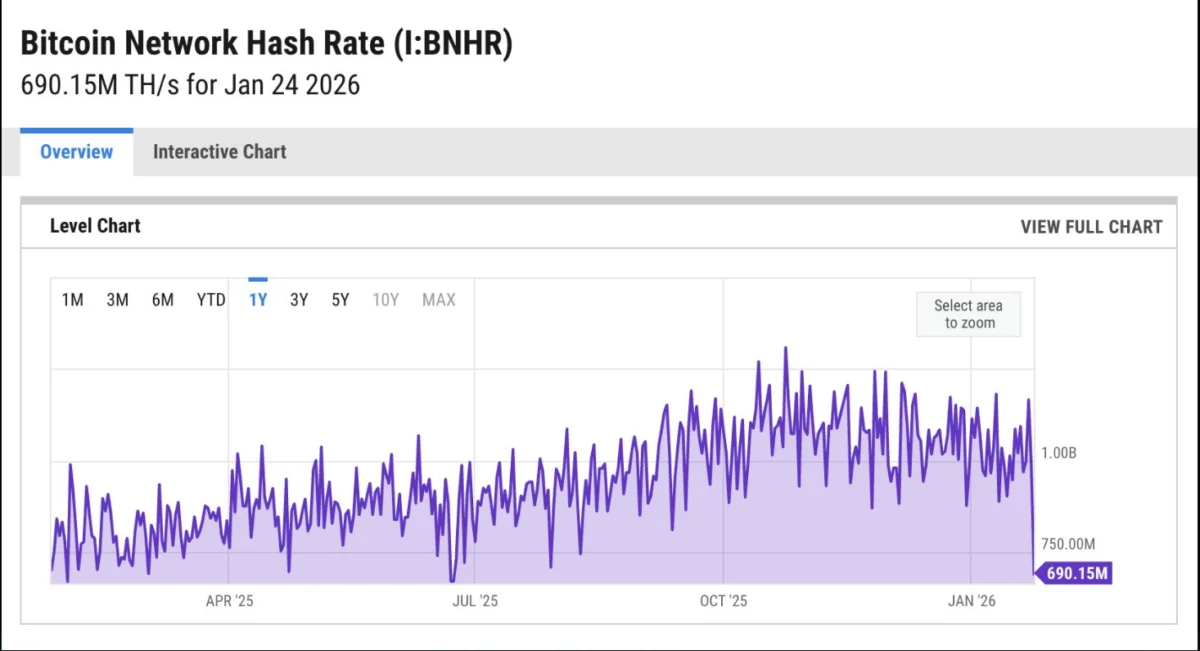
This coordinated and forced withdrawal of computing power resulted in an immediate, sharp drop in the global Bitcoin network hashrate. For a brief window, network security experienced its most pronounced slump in seven months. However, the architecture of Bitcoin mining proved its resilience; as the weather systems passed and grid stability was restored, operators swiftly brought their rigs back online, resulting in a rapid recovery of the network’s hashing power.
Simultaneously, the storm’s effects rippled through the financial statements of publicly traded mining giants. Daily production metrics plummeted across the board before rebounding, while Bitcoin’s spot price navigated a separate crosscurrent of macroeconomic uncertainty and geopolitical tensions, holding relatively steady around the $88,000 threshold.

Chronology of the Event
Friday: The Cold Front Approaches
As meteorological agencies issued severe winter weather warnings across the central and southern United States, early signs of grid strain began to appear. Major mining operators in Texas—which accounts for a massive share of the North American hash rate—received advisories from regional transmission organizations. Anticipating a surge in residential heating loads, industrial power consumers began preparing contingency plans. By late Friday, initial hashrate trackers began registering a downward slope, departing from the stable baselines maintained earlier in the week.
Saturday: Peak Curtailment and the Hashrate Trough
The storm intensified through the weekend, bringing sub-freezing temperatures and crippling ice accumulations. Power grids in the affected regions faced unprecedented demand. In response, crypto mining facilities executed deep curtailment procedures, turning off thousands of application-specific integrated circuit (ASIC) rigs.
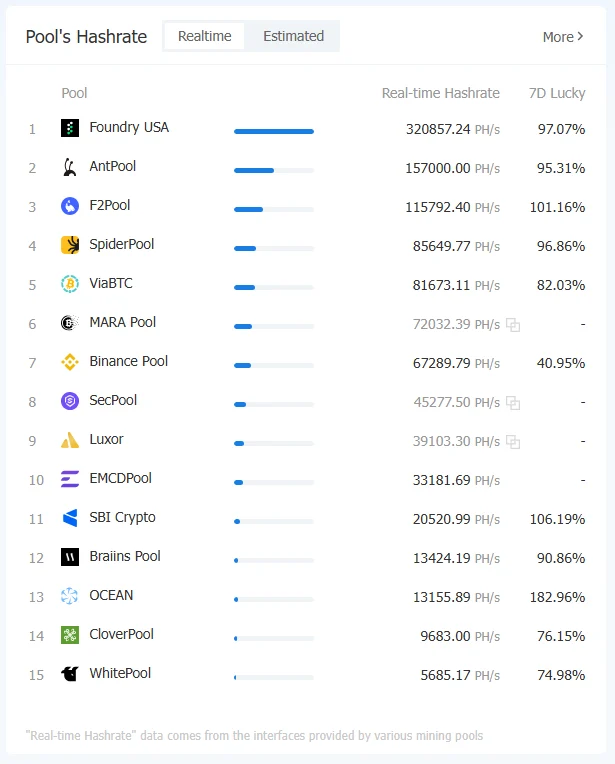
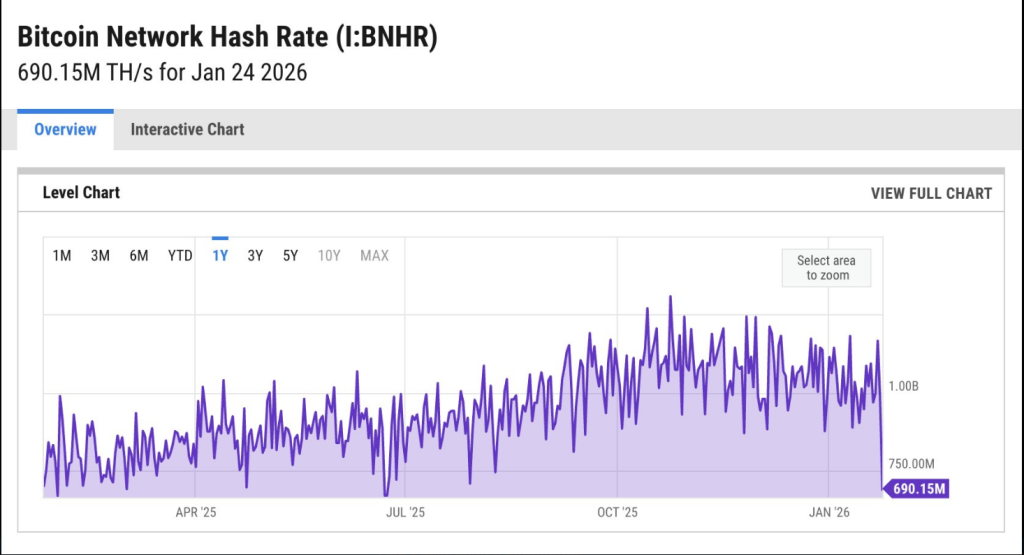
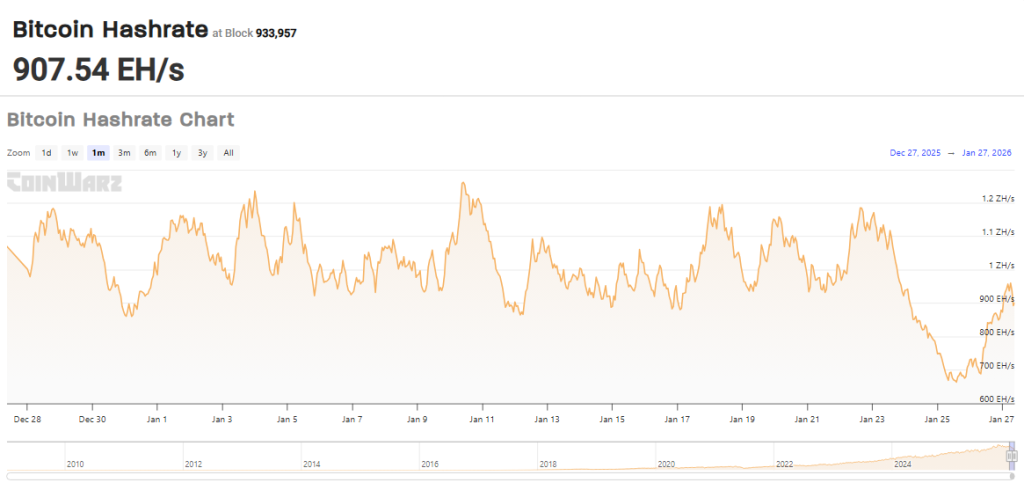
Data compiled by mining pools and analytics platforms revealed that the network hashrate plummeted aggressively. By Sunday, the global hashrate hit a multi-month low, dropping to approximately 663 EH/s (exahashes per second) from pre-storm levels hovering well above 850 EH/s. Industry estimates indicated that roughly 38% of global mining capacity originates in the US, making the localized weather event a globally significant bottleneck. Major corporate miners saw their daily output decimated within a 24-hour window, marking one of the steepest single-day production contractions in recent mining history.
Monday and Beyond: The Swift Rebound
As meteorological forecasts showed the storm systems moving eastward and dissipating over the Atlantic, local utilities began regaining their footing. Utility operators signaled that the immediate threat of rolling blackouts had subsided. Mining infrastructure teams immediately initiated safety checks and systematically brought their hardware back online. The recovery was remarkably swift; within days of hitting the 663 EH/s trough, the network’s total hashrate climbed steadily back toward 854 EH/s, restoring standard processing speeds and block times to the Bitcoin blockchain.
Supporting Data and Production Impact
The quantitative impact of the winter storm on corporate mining balance sheets provides a clear window into how deeply these operations are intertwined with local energy grids. According to data analytics firm CryptoQuant and various market trackers, major publicly listed Bitcoin mining corporations experienced immediate contractions in their daily coin generation.
- Marathon Digital (MARA): Recognized for its volatile, high-capacity output—including periods of solo mining—Marathon’s daily Bitcoin production fell sharply from an average of 45 coins down to just 7 coins at the height of the storm.
- CleanSpark (CLSK): As operations were throttled to preserve grid integrity, CleanSpark’s daily production figures dropped from 22 Bitcoin down to 12 Bitcoin.
- Riot Platforms (RIOT): Heavily concentrated in Texas, Riot saw its output experience a severe contraction, sliding from 16 daily coins down to a mere 3 coins as facilities went dark to protect local power supplies.
- IREN (formerly Iris Energy): Market trackers noted a similar trajectory, with IREN’s daily coin output dropping from 18 down to 6.
On a macro level, the global hashrate chart provided by platforms like CoinWarz and the Hashrate Index detailed the sheer scale of the disruption. The network descended from its normal baseline to a low of 663 EH/s, wiping out roughly 110 to 190 EH/s of active hashing power globally depending on the specific hourly metric—a testament to the outsized role that American infrastructure plays in securing the world’s leading digital asset.
Official Responses and Grid Dynamics
The events of the weekend brought renewed attention to the concept of "demand response" programs utilized by power grids in states like Texas. According to a report by the federal Energy Information Administration (EIA), there are more than 130 dedicated commercial-scale crypto mining sites operating across the United States. Because these facilities consume massive, uninterrupted blocks of electricity, they are uniquely positioned to act as flexible electrical loads.
Abundant Mines, an Oregon-headquartered crypto mining firm, highlighted the mechanics of this relationship in public statements. The company noted that roughly 40% of global mining capacity went offline within a tight 24-hour window. This capability is not a bug, but a feature of modern mining architecture: unlike traditional industrial factories that require long, costly shutdowns, modern ASIC mining rigs can be powered down and restarted via software commands almost instantaneously.
Industry advocacy groups and utility regulators pointed to the episode as a successful stress test of the energy market. Rather than competing with hospitals, emergency services, and residential homes for scarce electricity during a crisis, industrial miners acted as a financial shock absorber. By voluntarily stepping aside, they allowed the grid to redirect critical megawatt-hours to residential heating, mitigating the risk of catastrophic grid failure or widespread, uncontrolled blackouts. Once the emergency passed, the miners resumed operations, stabilizing energy demand curves and monetizing excess baseline power that otherwise might have gone unused.
Market Implications
While the physical infrastructure of the mining sector weathered a severe test, the financial markets reacted with a mixture of caution and characteristic resilience.
Bitcoin Price Stability
Throughout the weekend’s turbulence, Bitcoin (BTC) traded within a relatively resilient band, hovering around the $88,300 mark. Price action was driven by a complex tug-of-war between weather-induced mining headlines and broader macroeconomic factors. Earlier in the month, Bitcoin had tested highs near $96,000, spurred by geopolitical tensions that traditionally drive safe-haven interest. Conversely, periods of macroeconomic tightening introduced downward pressure.
The sudden drop in hashrate raised short-term concerns among derivatives traders regarding miner capitulation and operational revenue losses. However, because the supply shock to the hashrate was temporary—lasting only a matter of days—it failed to trigger a broader structural sell-off in the spot market.
Long-Term Network Adaptability
From a protocol perspective, Bitcoin’s automated difficulty adjustment algorithm handled the event seamlessly. Even though the hashrate dropped precipitously, the network continued to process transactions, albeit with slightly slower block times during the peak of the storm. The swift recovery of the hash power ensured that the upcoming automated difficulty adjustment would only experience a minor, easily manageable downward revision, avoiding the multi-week block time delays that larger, permanent drop-offs might cause.
The Future of Energy and Mining
Ultimately, the winter storm of 2026 serves as a case study for the maturation of the Bitcoin mining industry. As mining operations become increasingly institutionalized and integrated into state-level energy frameworks, their relationship with utility providers is evolving from an adversarial battle for cheap power into a sophisticated partnership built on grid stabilization.
For investors, traders, and regulatory bodies, the event demonstrated that while localized weather extremes can temporarily hobble a significant chunk of the global hash power, the decentralized and modular nature of Bitcoin mining ensures it remains robust against environmental shocks. As winter storms grow more unpredictable due to changing climate patterns, the "flex-load" model pioneered by American miners will likely become an indispensable blueprint for balancing modern energy grids in the years to come.