
Bitcoin’s Mining Crucible: Record Difficulty and the Approaching Halving Storm
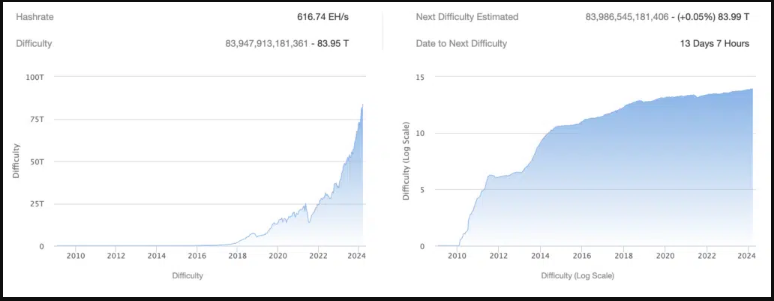
The Bitcoin network is currently traversing one of its most pivotal historical junctures. As the digital asset ecosystem gears up for the quadrennial "halving" event—a programmatic reduction in supply issuance—the underlying infrastructure is simultaneously grappling with an unprecedented surge in computational demand. On March 14, 2024, the Bitcoin network officially shattered records, with mining difficulty soaring to an all-time high of 84 trillion hashes. This milestone, while a testament to the network’s robust security, underscores the intensifying "arms race" among global mining operations.
The Mining Difficulty Dilemma: A Technical Overview
At its core, Bitcoin’s Proof-of-Work (PoW) consensus mechanism relies on a self-regulating difficulty adjustment algorithm. To maintain a consistent block production rate—targeting an average of one block every ten minutes—the network automatically recalibrates the complexity of the cryptographic puzzles miners must solve.
As more computing power (hashrate) enters the network, the difficulty rises to prevent blocks from being produced too quickly. According to data from BTC.com, the network has witnessed a 5.80% surge in difficulty since the last adjustment. This increase is a direct response to a massive influx of participation, with the global hashrate peaking at approximately 617 EH/s (exahashes per second).
This phenomenon is not occurring in a vacuum. The surge in hashrate is inextricably linked to Bitcoin’s recent price volatility. As the asset surged toward an all-time high of $73,800 on March 14, the profit margins for miners expanded, incentivizing large-scale operations to deploy newer, more efficient hardware—such as the latest generation of ASIC miners—to capitalize on the bull market.

The Halving Effect: Scarcity as a Catalyst
While the record-breaking difficulty captures the attention of engineers, the impending halving in April remains the primary focus of market analysts and institutional investors. The halving, which occurs every 210,000 blocks, serves as the engine of Bitcoin’s deflationary monetary policy. By cutting the block reward—the amount of new BTC minted per block—in half, the protocol reinforces its scarcity.
Historically, the halving has been a harbinger of significant price appreciation. The 2020 halving, for instance, preceded a historic bull run that saw Bitcoin reach new heights in 2021. The economic logic is straightforward: if the supply of new coins is halved while demand remains constant or increases, the fundamental supply-demand curve dictates a higher equilibrium price.
However, this transition places an immense burden on the mining industry. With the reward for finding a block set to drop from 6.25 BTC to 3.125 BTC, miners are essentially facing a "revenue shock." Operations that are not running at optimal efficiency or those burdened by high electricity costs risk becoming unprofitable overnight, leading to a potential capitulation of smaller, less efficient miners.
Supporting Data: Profitability and Operational Costs
The tension between rising difficulty and the impending revenue cut creates a complex balancing act. Despite the higher difficulty, miners have seen a temporary windfall, with daily mining rewards reaching nearly $79 million in mid-March. This influx of capital has provided a "buffer" for miners, allowing them to accumulate capital before the rewards are sliced in half.

Yet, this profit-seeking behavior has direct environmental and operational implications. The increased difficulty necessitates higher electricity consumption, as the network requires more power to generate the necessary hashrate. This has ignited renewed debates regarding the sustainability of the Proof-of-Work model. As energy prices fluctuate and regulatory scrutiny intensifies in regions such as the United States and the European Union, the geographical distribution of mining is shifting toward areas with abundant, low-cost renewable energy.
A Chronology of the 2024 Mining Surge
- Early Q1 2024: Bitcoin prices begin a steady climb, driven by the anticipation of Spot ETF approvals and institutional adoption.
- Late February 2024: The total network hashrate begins a sharp vertical trajectory as mining firms ramp up operations in preparation for the halving.
- March 14, 2024: Bitcoin hits an all-time high of approximately $73,800, coinciding with the network’s difficulty adjustment to a record 84 trillion hashes.
- Mid-March 2024: Mining revenue peaks at roughly $79 million per day, providing a temporary cushion against the upcoming 50% revenue reduction.
- April 2024 (Projected): The Bitcoin Halving event occurs, setting the stage for a new phase of supply scarcity and market testing.
Implications for the Future of Proof-of-Work
The convergence of record difficulty and the halving represents a critical test for the Bitcoin network. The primary implication is a potential "shakeout" of the industry. The most efficient, well-capitalized miners will likely survive and consolidate their market share, while inefficient operations may be forced to shut down or merge.
Furthermore, the rising difficulty highlights the growing divide between the network’s security and its energy footprint. While proponents argue that Bitcoin mining is increasingly driving investment into renewable energy and grid balancing, critics remain skeptical of the sheer magnitude of power required to maintain the ledger. This tension is driving innovation, with firms now focusing on "heat recycling," where excess heat from mining is repurposed for agricultural or residential heating, attempting to mitigate the environmental impact.
The Institutional Perspective
Institutional interest in Bitcoin mining has shifted the industry from a hobbyist pursuit to a highly professionalized sector. Publicly traded mining companies now report their hashrate and energy efficiency metrics to shareholders, mirroring traditional energy or infrastructure companies.
Industry analysts observe that these institutions are playing a "long game." By upgrading their fleets to the latest, most efficient mining hardware, they are positioning themselves to remain profitable even when the block reward drops. The record difficulty is, in many ways, the market’s way of saying that the industry has "grown up." It is no longer possible to mine profitably with outdated equipment or in regions with high electricity costs.
Conclusion: The Path Ahead
As we look toward the post-halving landscape, the Bitcoin network remains in a state of high-stakes transition. The record-breaking difficulty serves as a symbol of the network’s resilience and the immense value that global actors place on its security. While the path ahead presents challenges—specifically regarding energy costs and the squeeze on mining profitability—it is also a period of profound maturation.
The upcoming weeks will likely define the next chapter for Bitcoin. Whether the market sees a "sell the news" event or a continued rally fueled by increased scarcity remains the subject of intense debate. What is clear, however, is that the infrastructure beneath the digital gold is more robust than ever, engineered to withstand the pressures of the most rigorous economic and computational tests.
As the network continues to scale and the difficulty fluctuates in response to global market conditions, the focus will inevitably shift toward the sustainability of Proof-of-Work. For now, the miners—the silent architects of this financial revolution—continue their work, solving the puzzles that keep the network secure, one block at a time.
Disclaimer: The information provided in this article is for educational purposes only and does not constitute financial, investment, or legal advice. Cryptocurrency investments carry inherent risks, including the total loss of principal. Readers are advised to conduct their own independent research and consult with a qualified professional before making any financial decisions. NewsBTC and its contributors do not endorse any specific investment strategy.