The Psychology of the Bottom: CZ’s Contrarian Call Amidst Crypto’s "Extreme Fear"
In the high-stakes theater of cryptocurrency, few voices command the attention of Changpeng Zhao (CZ), the founder of Binance. As the market grapples with a period of profound volatility and pervasive investor anxiety, CZ offered a timeless, albeit often ignored, piece of investment philosophy. Posting to his social media channels on November 29, 2025, the former Binance CEO reminded his followers of the classic contrarian mantra: "Unpopular opinion, but it’s better to sell when there is maximum greed, and buy when there is maximum fear."
While the advice is a staple of financial literature, its delivery arrived at a precarious juncture for the digital asset space. The market is currently oscillating between the hope of a year-end rally and the creeping dread of a deeper macroeconomic contraction. As Bitcoin struggles to find a firm footing above the $90,000 threshold, the crypto community is locked in a fierce debate: are we staring at a generational buying opportunity, or is this merely a deceptive pause before a more significant structural decline?
The Anatomy of a Market in Panic
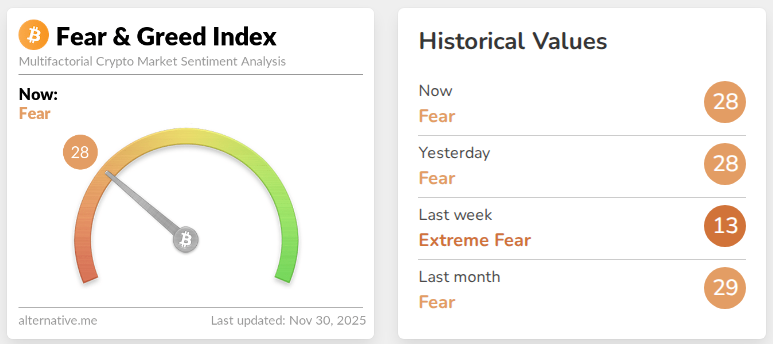
To understand the weight of CZ’s statement, one must look at the quantitative data driving current market sentiment. The Crypto Fear & Greed Index, a barometer of the collective psyche of the retail and institutional trading class, recently spent an arduous eighteen-day streak trapped in the "Extreme Fear" zone. On November 22, the index plummeted to a yearly nadir of 10, a reading that typically signals a state of capitulation among long-term holders and absolute terror among short-term speculators.
While the index has since crept upward to a reading of 20—technically exiting the most severe category—the psychological damage remains palpable. Market analyst Matthew Hyland noted that this particular stretch of fear was among the most profound in the current market cycle. Other veteran traders have argued that the index, while useful, may be underestimating the depth of the current pessimism, as the exhaustion of capital flows has left the market devoid of the typical "dip-buying" enthusiasm seen in previous bull runs.

Chronology: A Tense Month of Retreat
The current state of affairs is the result of a month-long drift from the lofty highs of October 2025.
- Mid-October: Bitcoin reached a spectacular all-time high of approximately $126,000, fueled by optimism regarding institutional adoption and favorable regulatory winds.
- Early November: A sharp correction set in, driven by profit-taking and a cooling of geopolitical enthusiasm. Bitcoin slipped toward the $95,000 level.
- November 22: The Crypto Fear & Greed Index hit its yearly low of 10, marking the apex of market despondency.
- Late November: As prices hovered near $91,000, trading volume thinned significantly. The lack of conviction led to a stagnant, sideways price action that frustrated bulls and bears alike.
- November 29: CZ’s intervention sparked a surge in online discourse, coinciding with the first positive flip in the Coinbase Premium in nearly a month.
This timeline reflects a market transitioning from the exuberance of a new all-time high to the cold, hard reality of a correction that has tested the resolve of even the most hardened "HODLers."
Data-Driven Insights: Beyond the Noise
While market psychology is often fluid, the underlying data provides a sobering look at where the smart money is positioning itself. According to Santiment, an on-chain analytics platform, online sentiment has shifted away from the "moon-boy" excitement that characterized the October rally. Instead, current discourse is dominated by discussions of volatility, the risk of institutional sell-offs, and the looming impact of global liquidity constraints.
Furthermore, the Altcoin Season Index has stalled at 22/100. This low score suggests that capital is aggressively retreating into the perceived safety of Bitcoin, or even into stablecoins and fiat, rather than risking exposure to the more speculative end of the crypto ecosystem. When altcoins are ignored, it is a clear indicator that the market’s appetite for risk is currently at a localized bottom.
Technical analysis offers a glimmer of hope. Analyst Nicola Duke has highlighted a recurring historical pattern: over the last five years, Bitcoin has consistently found a local bottom within weeks of reaching extreme levels on the Fear & Greed Index. However, analysts are quick to caution that correlation is not causation. Bitwise researcher André Dragosch has warned that the current pricing environment is heavily influenced by a global growth outlook that is arguably the most bearish it has been since the 2020 pandemic and the 2022 market deleveraging. This suggests that while history provides a map, the current macroeconomic terrain is significantly different from previous cycles.
The Coinbase Premium: A Sign of Life?
Perhaps the most compelling piece of data to emerge during this period of uncertainty is the shift in the Bitcoin Coinbase Premium. For 29 consecutive days, the premium—the difference in price between Bitcoin on the Coinbase exchange compared to global averages—remained in negative territory. This served as a persistent signal that selling pressure was concentrated within the United States, as American traders and institutions liquidated positions amidst uncertainty.
On November 30, however, that trend finally broke. The premium flipped to a positive 0.0255%. While this figure is modest, its symbolic importance cannot be overstated. A positive premium historically indicates that buying pressure in the U.S. market is once again outpacing global selling, often serving as a lead indicator for institutional capital inflow and a recovery in dollar liquidity. It suggests that while the "retail" crowd may still be fearful, the "smart" money is quietly absorbing the supply.
Implications: The Gap Between Logic and Emotion
The discourse following CZ’s post highlighted a fundamental truth about human nature in financial markets: the "knowledge-action gap." When asked about the post, many traders acknowledged that they agreed with the logic—that buying during periods of extreme fear is the only way to generate substantial long-term wealth. Yet, they admitted that the biological impulse to flee when prices drop is often too strong to overcome.
This disconnect is where professional traders separate themselves from amateurs. In a market dominated by algorithmic trading and high-frequency data, retail investors often feel like they are playing a rigged game. However, the current market structure suggests that patience may be the most significant competitive advantage. If the Coinbase premium continues to trend positively, it may provide the foundational support necessary for a sustained recovery, proving that those who acted on "maximum fear" were, as CZ suggested, on the right side of history.
Looking Ahead: The Macroeconomic Headwinds
As we look toward the final month of 2025, the crypto market remains in a delicate state. The interplay between institutional appetite and global recessionary fears will likely dictate the next move. Investors should be mindful that while the Fear & Greed Index provides a useful psychological snapshot, it does not account for external "black swan" events or abrupt changes in central bank policy.
The consensus among analysts remains cautious. While the technical setup for a bounce is present, the macro environment remains fraught with uncertainty. The recovery of the Coinbase premium is a positive signal, but it is one that requires follow-through. For those following CZ’s advice, the current period represents a test of conviction. Buying into extreme fear is rarely a comfortable endeavor; it is, by definition, a move against the grain of the majority. Whether this current bottoming process leads to a new parabolic run or a prolonged period of consolidation, one thing remains certain: in the world of crypto, the only constant is the cycle of human emotion, and those who can navigate it with a cool head are the ones who ultimately survive.
As the market continues to recalibrate, participants are advised to keep a close watch on volume metrics, the sustainability of the Coinbase premium, and the shifting narrative within the institutional sector. The road ahead may be volatile, but for those with a long-term horizon, the current fear may well be the bedrock of the next significant cycle.