Ethereum’s Silent Accumulation: Decoding the Divergence Between Retail Apathy and Whale Positioning
The current landscape for Ethereum (ETH) is defined by a palpable sense of market exhaustion. As the asset struggles to maintain momentum below the $1,700 threshold, the broader crypto ecosystem is gripped by a state of directionless apathy. For many retail investors, the lack of a clear trend is a source of frustration, leading to a palpable decline in network engagement. However, beneath the surface of this perceived stagnation, sophisticated on-chain data points to a highly orchestrated shift in capital distribution—one that challenges the narrative of a market in structural decline.
The Paradox of Network Activity: Fewer Transactions, Larger Values
While surface-level metrics might suggest that Ethereum is losing its relevance, a deeper dive into on-chain data reveals a different story. According to recent findings by CryptoOnchain, there is a striking divergence in transaction patterns that has emerged over the last week.
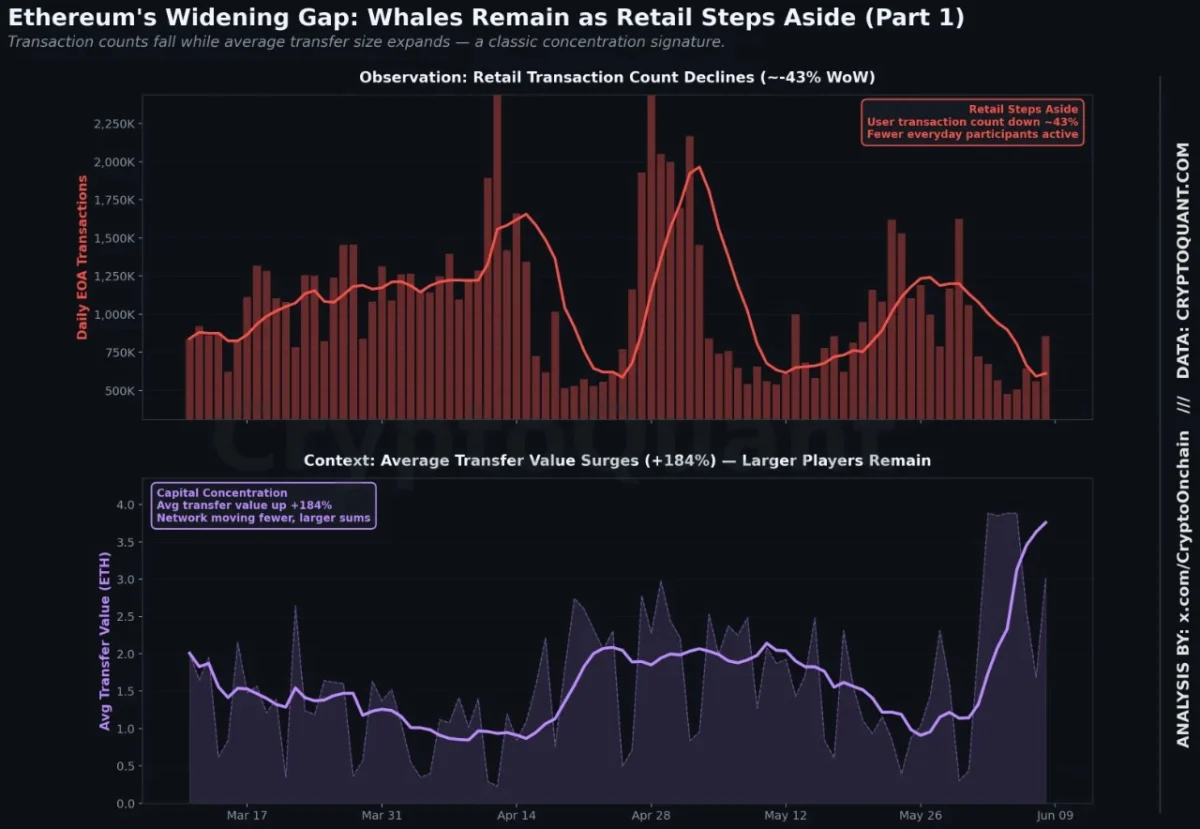
Daily transaction counts from standard user wallets have plummeted by approximately 43%. In a vacuum, this would be a clear indicator of a dying ecosystem. However, this contraction in volume is being offset by a massive surge in the average value per transaction—up by more than 184%. The median transfer size is also exhibiting significant growth.
This specific combination of data is a classic hallmark of market transition. When smaller, routine participants retreat due to uncertainty, they leave behind a vacuum that is increasingly being filled by larger entities. This is not a sign of a network in decline; rather, it is the signature of capital consolidation. Larger holders are not exiting the ecosystem; they are streamlining their activity, moving larger sums of capital in fewer, more deliberate transactions.

Chronology of the Recent Downturn
To understand where Ethereum stands today, one must look at the timeline of its recent technical breakdown:
- February to May 2026: Ethereum spent several months in a period of consolidation, establishing a support base between $1,800 and $1,900. This range served as the primary demand zone for the first half of the year.
- The Breakdown: Following the failure of the $1,800 support level, selling pressure intensified rapidly. The loss of this critical floor triggered a cascade of stop-losses, pushing the asset toward fresh 2026 lows near the $1,500 mark.
- The May Peak: Prior to the current decline, the April-May recovery effort topped out near $2,400. This peak proved to be a "lower high," confirming that the bears remained in control of the broader market structure.
- Current State: As of mid-June 2026, Ethereum is trading near $1,630, struggling to find a firm foundation while remaining well below its 50-, 100-, and 200-day moving averages.
Supporting Data: The Institutional Pivot
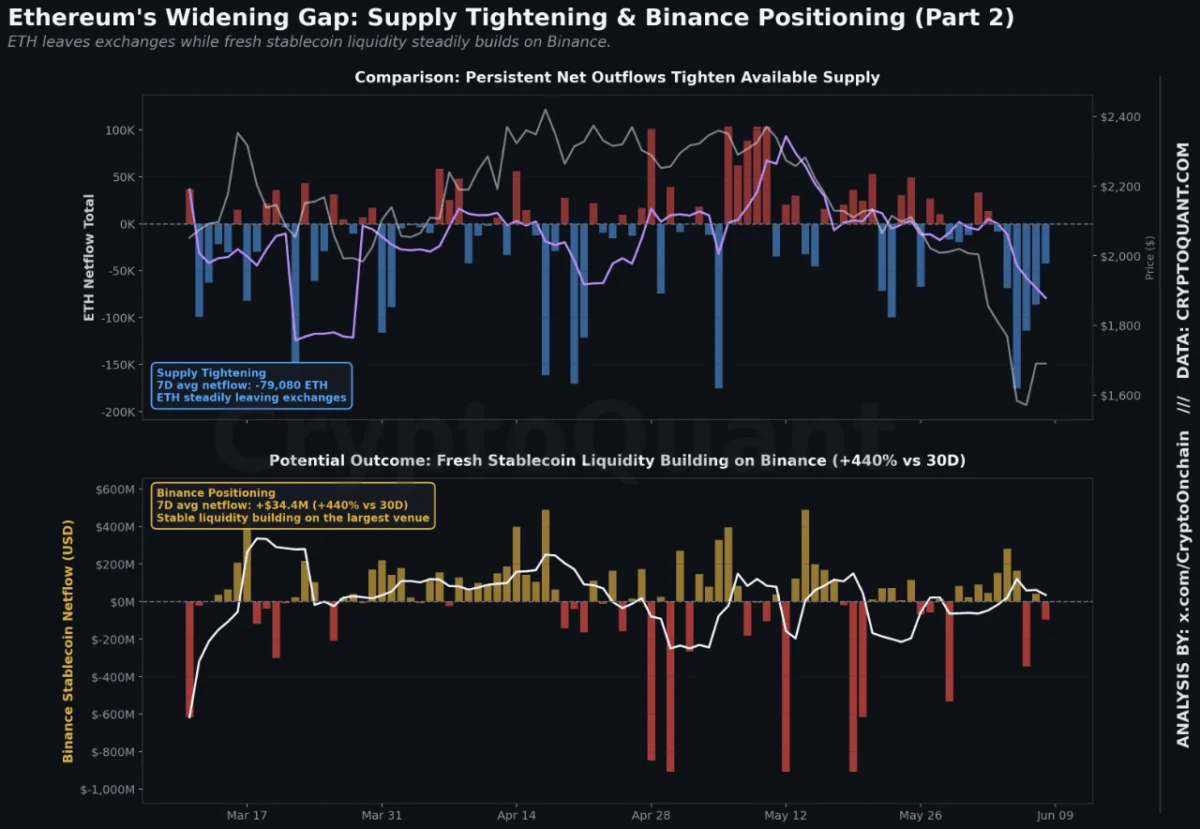
The divergence in transaction behavior is supported by a confluence of exchange flow data. The total ETH netflows remain deeply negative, hovering around -79,080 ETH. This indicates that large quantities of spot ETH are being withdrawn from exchanges, moving into cold storage or private wallets. This ongoing contraction of liquid supply on exchanges is a bullish long-term indicator, as it removes the sell pressure that typically plagues recovery efforts.
Simultaneously, liquidity is moving in the opposite direction. Stablecoin netflows into Binance have spiked to +$34.4 million, a staggering 440% increase compared to the 30-day average. This indicates that major participants are "parking" their buying power on exchanges, ready to deploy capital at a moment’s notice.
Furthermore, Open Interest on Binance has expanded by 9% over the current quarter. This suggests that while spot supply is tightening, derivatives exposure is rising. The combination of spot withdrawals and stablecoin accumulation is a textbook setup for a "supply-side squeeze," where the available float of ETH is being restricted even as large-scale capital prepares for a potential trend reversal.

Market Implications: The Calm Before the Catalyst
The current market structure presents a unique opportunity for observers to differentiate between noise and signal. While the price action remains bearish—characterized by a sequence of lower highs and lower lows—the underlying accumulation suggests that the "smart money" is not waiting for a breakout to position itself.
The implications of this setup are profound. Market reversals are rarely instantaneous; they are almost always preceded by a period of apathy where the weak hands are shaken out. Once these participants have cleared the field, the market becomes thinner, making it more susceptible to explosive moves when a legitimate catalyst emerges.
However, caution remains necessary. This structural setup does not guarantee an immediate price surge. Markets require external catalysts—such as macro-economic shifts, regulatory clarity, or significant network upgrades—to activate these stored demand dynamics. Until the price can reclaim the $1,800 support level, any short-term rallies will likely be treated by the market as corrective, rather than impulsive.
Technical Analysis: The Battle for $1,500
From a technical perspective, Ethereum is currently fighting to hold the $1,500–$1,550 zone. This region represents the most critical support level of the year. If this level holds, it could provide the base necessary for a durable recovery after a 35% decline from the May highs.

The volume profile during the recent selloff is particularly telling. The breakdown through the $1,800 level was accompanied by one of the largest volume spikes in months, confirming that the move was backed by significant selling interest. While a modest bounce occurred near $1,500, the inability of bulls to reclaim lost resistance suggests that the "bearish control" remains intact.
Expert Perspectives and Market Psychology
Seasoned market observers emphasize that the current apathy is, in many ways, a cleansing process. In the world of finance, "apathy" is the final stage of a bear market cycle. When participants no longer care to trade, when social media sentiment hits a nadir, and when the price stops reacting to negative news, the market is usually nearing its bottom.
The divergence between retail abandonment and institutional accumulation is a recurring theme in the history of financial assets. During periods of extreme fear or boredom, the average investor often sells at a loss, while institutional entities—who view the market on a multi-year horizon—begin to quietly aggregate assets.
As noted by industry analysts, the current positioning on Binance, combined with the net withdrawal of ETH from exchanges, mirrors the patterns seen in previous accumulation phases. While the short-term chart remains bleak, the long-term, on-chain data paints a picture of a market that is fundamentally strengthening its foundation, even as the price action suggests a structural decline.

Conclusion: Watching the Pivot
As Ethereum continues to test its resolve near $1,500, the market stands at a crossroads. The technical indicators clearly favor the bears, with moving averages and price structure confirming a downtrend. Yet, the on-chain data provides a compelling counter-argument: the scarcity of liquid supply, coupled with the influx of fresh stablecoin liquidity, suggests that the market is coiling like a spring.
For investors and traders alike, the coming weeks will be defined by the ability of the $1,500 support level to withstand further pressure. If the current accumulation pattern holds, and if the market finds a catalyst to trigger the stored demand, Ethereum may find itself in a position to reclaim its former highs. Until then, the narrative remains one of patience, as the market transitions from a phase of retail-led volatility to a phase of institutional-led consolidation.
Investors should remain vigilant, monitoring the $1,800 resistance level as the primary indicator for a potential shift in sentiment. In the volatile world of decentralized finance, the ability to read the difference between a dying network and a consolidating one is the difference between being a victim of market volatility and being a beneficiary of it.