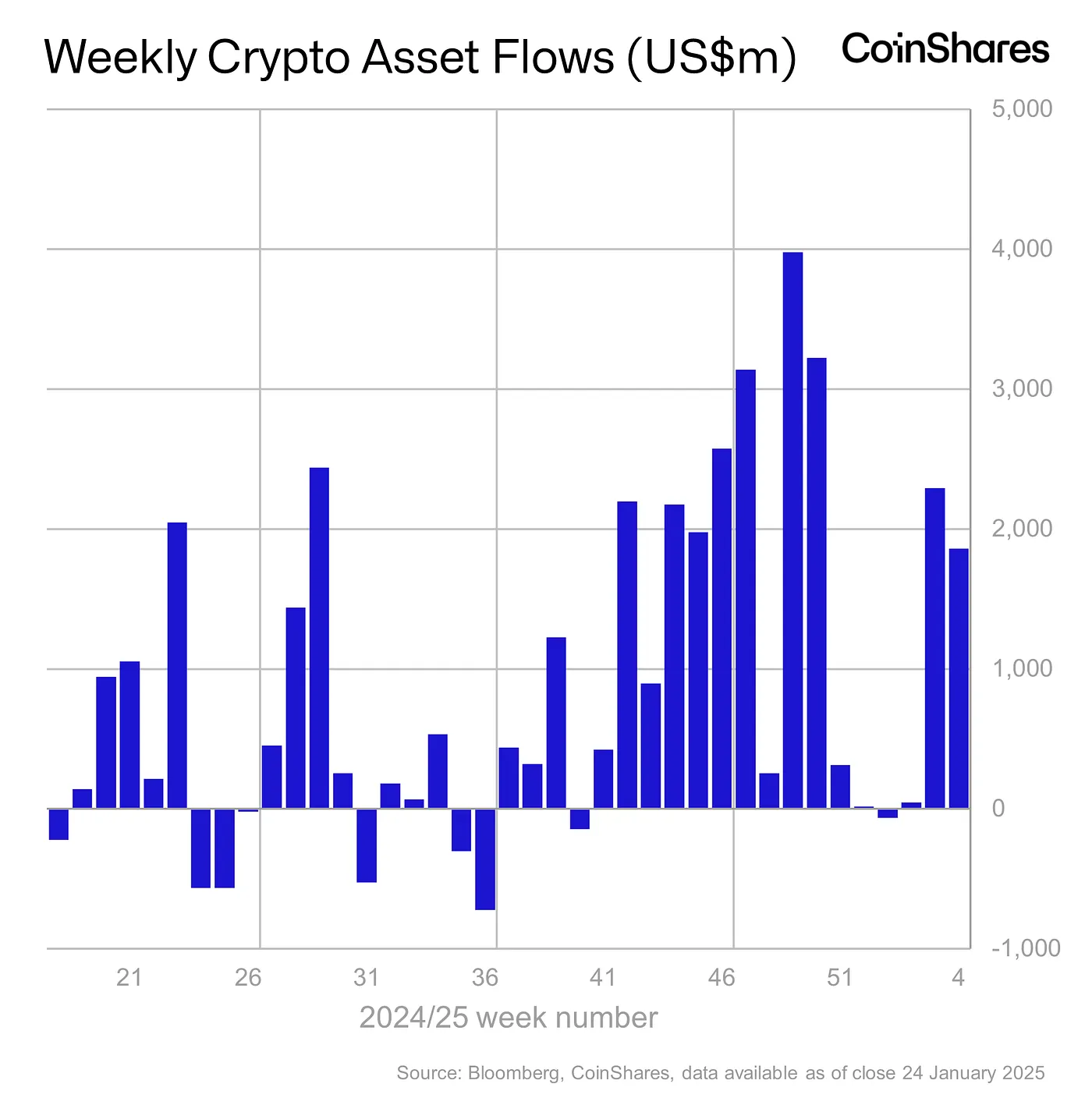
Institutional Capital Floods Crypto Markets Following Fed Rate Cut Pivot: A Deep Dive into the Latest Data
The global financial landscape witnessed a seismic shift last week as the U.S. Federal Reserve initiated its long-anticipated interest rate cut cycle. While traditional markets debated the nuances of the central bank’s "hawkish" approach to monetary easing, the institutional digital asset sector provided a definitive verdict. According to the latest Digital Asset Fund Flows Weekly Report from CoinShares, institutional investors aggressively pivoted back into cryptocurrency, fueling a massive $1.9 billion wave of inflows into digital asset exchange-traded products (ETPs).
This surge marks the second consecutive week of positive momentum, signaling a robust recovery in investor sentiment after months of macroeconomic uncertainty. The influx serves as a strong indicator that institutional players view the Federal Reserve’s pivot as a green light for risk-on assets, despite the initial volatility that characterized the immediate post-announcement window.
The Chronology of a Market Pivot
To understand the scale of the recent capital movement, one must examine the timeline of last week’s market behavior. For months, the digital asset market had been paralyzed by speculation regarding the Federal Reserve’s monetary policy. When the Fed finally announced its decision to lower interest rates, the initial market response was one of confusion, often described by analysts as a "hawkish cut."
The Initial Hesitation
In the immediate aftermath of the announcement, institutional investors adopted a defensive posture. The nuance of the Fed’s messaging—which suggested that while rates were coming down, the path forward remained data-dependent and cautious—led to a brief period of uncertainty. During the early days of the week, capital flows were lukewarm as hedge funds and institutional desks processed the implications of a "higher-for-longer" narrative potentially lingering in the background.
The Mid-Week Rebound
However, as the dust settled on Thursday and Friday, the sentiment underwent a rapid transformation. Once the market digested the reality of the easing cycle, capital flooded into the sector. CoinShares data reveals that a staggering $746 million in net inflows occurred within those final 48 hours alone. This late-week surge confirmed that the "hawkish" concern was secondary to the long-term bullish implications of cheaper liquidity. The rapid shift highlights the high-frequency nature of modern institutional crypto trading, where desks are prepared to reallocate massive capital reserves at a moment’s notice based on central bank signaling.
Supporting Data: A Global Perspective on Capital Flows
The $1.9 billion figure represents one of the most significant weekly inflows of the year, underscoring the renewed appetite for crypto exposure. This capital was not distributed evenly, revealing distinct regional preferences and asset-specific trends.
Regional Dominance
The United States remains the undisputed engine of the institutional crypto market. Of the $1.9 billion total, a massive $1.8 billion originated from U.S.-based investment products. This concentration confirms that the U.S. spot Bitcoin and Ethereum ETFs remain the primary vehicle for institutional participation globally.
Following the United States, secondary markets showed localized strength:
- Germany: Added $51.6 million in inflows.
- Switzerland: Contributed $47.3 million.
- Brazil: Recorded $9.3 million.
Conversely, Hong Kong experienced a slight divergence from the global trend, reporting minor outflows totaling $3.1 million. This suggests that while Western institutional appetites are currently voracious, Asian markets are maintaining a more cautious, wait-and-see approach to the current liquidity cycle.
Asset-Specific Performance
Bitcoin (BTC) predictably secured the largest share of the inflows, attracting $977 million. This continues a multi-month trend of "King Crypto" serving as the primary hedge for institutional portfolios. Conversely, short-bitcoin products—designed to profit from price declines—saw further capitulation, with $3.5 million in outflows. The total Assets under Management (AuM) for short-bitcoin products have now dwindled to a multi-year low of $83 million, suggesting that the institutional "short" thesis is effectively losing its structural support.
Ethereum (ETH) emerged as a massive beneficiary, pulling in $772 million. This is a particularly noteworthy figure, as Ethereum has faced significant scrutiny and net outflows for much of the year. The sudden reversal in sentiment for ETH suggests that investors are increasingly comfortable with Ethereum’s role as the backbone of decentralized finance (DeFi) in a lower-interest-rate environment. Other altcoins also saw notable interest, with Solana (SOL) attracting $127.3 million and XRP securing $69.4 million, reflecting a broadening of interest beyond the two primary assets.

Official Analysis and Expert Sentiment
CoinShares’ researchers noted that the resilience of the market during the initial volatility was the true "tell" of the week. By interpreting the Fed’s move as a structural change in the cost of capital, institutions moved to front-run the long-term inflationary pressures that often follow interest rate cuts.
Market analysts, including those at Rekt Capital, have pointed to historical charts indicating that the current inflow pattern aligns with previous cycles where liquidity expansion consistently preceded significant price action. While the report focuses on inflows, the underlying implication is that institutional risk committees have cleared the way for higher allocations to digital assets, viewing them as a "beta" play on global liquidity.
It is important to note that the market’s enthusiasm is not without its detractors. Traditional financial analysts continue to warn that if the Fed’s rate cuts are a response to a looming recession rather than a "soft landing," the initial surge in crypto prices could face headwinds. However, the data from last week suggests that for now, the institutional narrative is firmly focused on the benefits of liquidity expansion rather than the fears of economic contraction.
Implications for the Future of Digital Assets
The $1.9 billion inflow carries several profound implications for the digital asset ecosystem as we move into the final quarter of the year.
1. The Normalization of Crypto as an Asset Class
The sheer volume of capital flowing through regulated ETPs demonstrates that cryptocurrency is no longer a peripheral asset for speculative retail traders. It is now a core component of institutional asset allocation, treated with the same scrutiny as commodities or tech stocks. When the Fed signals a policy shift, institutional crypto desks now react with the same speed and volume as bond traders.
2. The Power of ETPs
The success of these flows confirms that the launch of spot ETFs in the U.S. and abroad has fundamentally changed the market structure. Previously, capital inflows to crypto were restricted by the complexities of self-custody and regulatory hurdles. Today, the ability for institutional portfolios to gain exposure through traditional brokerage accounts has effectively bridged the gap between Wall Street and the blockchain.
3. Shift in Risk Appetite
The decline of short-bitcoin products to multi-year lows is a strong signal of changing sentiment. Institutional investors are betting on a bull trend. When the cost of borrowing drops, the opportunity cost of holding non-yielding assets like Bitcoin decreases, and the potential for price appreciation in a "risk-on" environment becomes the primary driver for capital deployment.
4. Regulatory and Macroeconomic Convergence
The correlation between the Fed’s decision and the inflow data suggests that the crypto market is becoming increasingly sensitive to macroeconomic indicators. This convergence is a double-edged sword: it brings legitimacy and massive capital, but it also means that crypto assets are now inextricably linked to the broader macroeconomic health of the United States.
Conclusion
The latest CoinShares data paints a picture of a market that has found its footing. Despite the initial trepidation following the Federal Reserve’s "hawkish" interest rate cut, the overwhelming institutional response was one of confidence. With $1.9 billion entering the market in a single week, the message from the institutional world is clear: the era of cheap capital is viewed as a catalyst for digital asset growth.
As we look ahead, the interplay between Federal Reserve policy, institutional allocation, and the performance of major assets like Bitcoin and Ethereum will define the next phase of the market. For now, the "Smart Money" has made its move, and the data suggests that the foundations for the next cycle are being laid with unprecedented force.
Disclaimer: This report is for informational purposes only and does not constitute financial, investment, or legal advice. Cryptocurrency investments involve a high degree of risk and are subject to extreme volatility. Always perform your own due diligence and consult with a certified financial advisor before making any investment decisions. The Daily Hodl does not endorse or recommend the purchase of any specific digital assets.