Institutional Appetite for Crypto Surges: A Deep Dive into the 2026 Inflow Renaissance
The cryptocurrency market has kicked off the new year with a resounding statement of institutional confidence. According to the latest data from CoinShares, the leading digital asset management research firm, institutional investors are aggressively expanding their exposure to major crypto-assets, signaling a robust start to 2026. This surge in capital follows a monumental 2025, during which the sector saw near-record-breaking inflows, cementing digital assets as a cornerstone of modern institutional portfolios.
The State of the Market: A $582 Million Weekly Kickoff
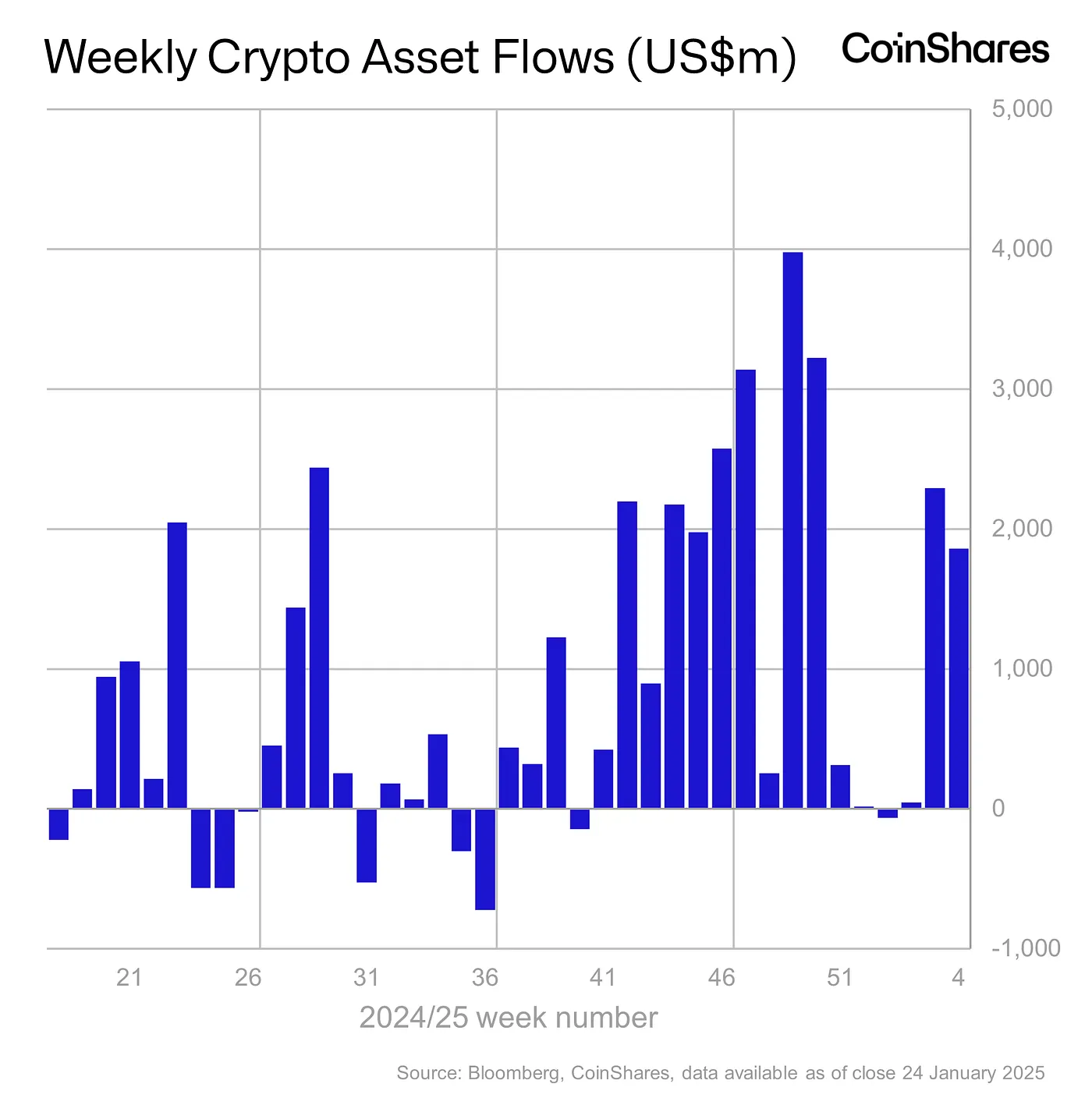
The opening week of 2026 has provided a definitive answer to skeptics questioning the sustainability of the crypto bull run. Despite early-week volatility that triggered temporary outflows, the market demonstrated remarkable resilience. By the week’s end, net inflows into digital asset investment products reached a staggering $582 million.
This momentum was punctuated by a massive single-day surge on Friday, which saw $671 million in fresh capital enter the space. This late-week pivot effectively erased the losses incurred during the preceding days, setting a bullish tone for the remainder of the quarter.
Breakdown of Weekly Inflows
The capital allocation for the first week of 2026 highlights a clear hierarchy of institutional preference:
- Bitcoin (BTC): Remains the undisputed king of institutional portfolios, drawing $512 million in new capital.
- Ethereum (ETH): Solidifying its position as the premier smart-contract platform, Ethereum attracted $119 million in net inflows.
- XRP: Continuing its momentum from the latter half of 2025, XRP saw an impressive $10.7 million injection.
- Solana (SOL): Interestingly, Solana bucked the broader trend, recording $30 million in outflows, suggesting a period of portfolio rebalancing or profit-taking by institutional holders.
A Retrospective: The 2025 Landscape
To understand the significance of this year’s start, one must look at the gargantuan numbers posted in 2025. Total global inflows reached $47.2 billion, coming tantalizingly close to the all-time record of $48.7 billion set in 2024. This consistent performance indicates that institutional interest is no longer a fleeting trend, but a structural shift in global asset management.
Geographic Distribution of Capital
The United States continues to dominate the digital asset landscape, accounting for $44.5 billion of the total 2025 inflows. While this figure represents a 12% decline from the previous year’s record, the U.S. remains the primary engine for liquidity in the crypto market.
However, the international landscape is shifting:
- Germany: The European powerhouse staged a remarkable recovery, recording $2.5 billion in inflows after a difficult 2024.
- Canada: Retained its position as a major hub, adding $1.1 billion to its institutional holdings.
- Switzerland: Remained a steady pillar of support, contributing $775 million throughout the year.
Asset-Specific Performance: Analyzing the Growth Trajectory
The divergence in asset performance over the last 12 months reveals a maturing market where investors are increasingly discerning about their allocations.
Bitcoin: The Institutional Bedrock
Bitcoin remains the primary gateway for institutions. In 2025, BTC products attracted $26.9 billion in inflows. Notably, "short-bitcoin" products—financial instruments that bet against the price of BTC—attracted $105 million. While this figure is non-trivial, it remains a fraction of the total market, suggesting that the vast majority of institutional sentiment remains firmly bullish.
The Rise of the Altcoin Giants
While Bitcoin provides stability, Ethereum, XRP, and Solana have provided the growth.
- Ethereum: With $12.7 billion in annual inflows, Ethereum saw a 138% year-over-year increase. This surge is likely tied to the continued development of Layer-2 scaling solutions and the platform’s dominance in DeFi and NFT infrastructure.
- XRP: The most explosive growth was seen in XRP, which recorded $3.7 billion in inflows—a massive 500% increase over the previous year. This performance highlights renewed institutional faith in Ripple’s cross-border payment utility and regulatory clarity.
- Solana: Solana outperformed all others in percentage growth, attracting $3.6 billion, a staggering 1,000% increase year-over-year. Despite the recent weekly outflow, its long-term trajectory remains one of the most significant narratives in crypto-asset management.
Chronology of Institutional Adoption
The trajectory of institutional involvement has moved from "cautious exploration" to "strategic necessity" over the past 24 months.
- Early 2024: The approval of spot ETFs in the United States served as the catalyst for the massive $48.7 billion inflow record.
- Mid-2024 to Early 2025: Market consolidation occurred as institutional investors began diversifying beyond BTC into "Blue Chip" altcoins like ETH and SOL.
- Late 2025: A period of "regulatory normalization" took hold, as global jurisdictions began providing clearer frameworks, further de-risking the asset class for pension funds and insurance companies.
- January 2026: The current period marks the transition into a mature investment cycle, characterized by rapid "buy the dip" behavior as seen in the recent weekly rebound.
Implications for the Broader Economy
The data provided by CoinShares carries profound implications for the global financial system.
1. The Institutionalization of Volatility
The sheer volume of capital pouring into these products suggests that crypto is increasingly being used as a macro-hedge. When institutions hold significant portions of their portfolios in digital assets, the asset class becomes tethered to broader economic indicators like interest rate policies, inflation data, and geopolitical stability.
2. The Decline of Niche Altcoins
A concerning trend for smaller projects is the weakening sentiment toward "various other altcoins," which saw inflows drop by 30% year-over-year. This indicates a "flight to quality." As institutional capital becomes the dominant force, smaller, less-liquid projects are struggling to attract attention, potentially leading to a market-wide consolidation where capital is concentrated in the top five to ten assets by market cap.
3. The Regulatory "Moat"
The fact that Germany and other European nations are seeing renewed inflows suggests that jurisdictional competition is heating up. Countries that provide clear, predictable regulatory environments are winning the battle for institutional capital. This puts pressure on the U.S. and other major economies to maintain favorable policies to prevent capital flight.
Expert Analysis: What Lies Ahead?
Financial analysts note that the trend of institutional accumulation is likely to accelerate as we move further into 2026. Several factors are expected to drive this:
- Integration with Traditional Banking: As more banks integrate digital asset custody services, the barrier to entry for retail and mid-sized institutional clients is vanishing.
- Yield Generation: With institutional-grade staking and lending products becoming safer and more transparent, Ethereum and other Proof-of-Stake assets are increasingly viewed as "digital bonds" that offer yield in an inflationary environment.
- Macroeconomic Hedging: As sovereign debt levels remain elevated globally, Bitcoin is increasingly being scrutinized as a "digital gold" equivalent—a neutral reserve asset that exists outside the direct control of central banks.
Conclusion: A New Era of Maturity
The data from the first week of 2026 is a microcosm of a larger, more permanent shift. The days of cryptocurrency being a fringe, retail-dominated asset class are effectively over. We are now in the era of institutional maturity, where inflows are driven by risk-adjusted return models, portfolio diversification strategies, and a growing recognition of blockchain technology’s long-term utility.
While volatility remains a hallmark of the space, the "whale" activity—both in terms of corporate inflows and institutional fund allocation—suggests that the floor for these assets is rising. For investors, the takeaway is clear: the digital asset market is being integrated into the global financial architecture at an unprecedented pace. As always, while these trends are promising, they underscore the necessity for rigorous due diligence. The market is no longer just about the technology; it is about the macro-economic reality that crypto has become a permanent, influential fixture of the global portfolio.
Disclaimer: The information provided in this report is for educational and informational purposes only and does not constitute financial, investment, or legal advice. Digital assets carry a high level of risk, and investors should conduct their own research or consult with a certified financial advisor before making any investment decisions. The Daily Hodl is not responsible for any financial losses incurred based on the data presented here.